
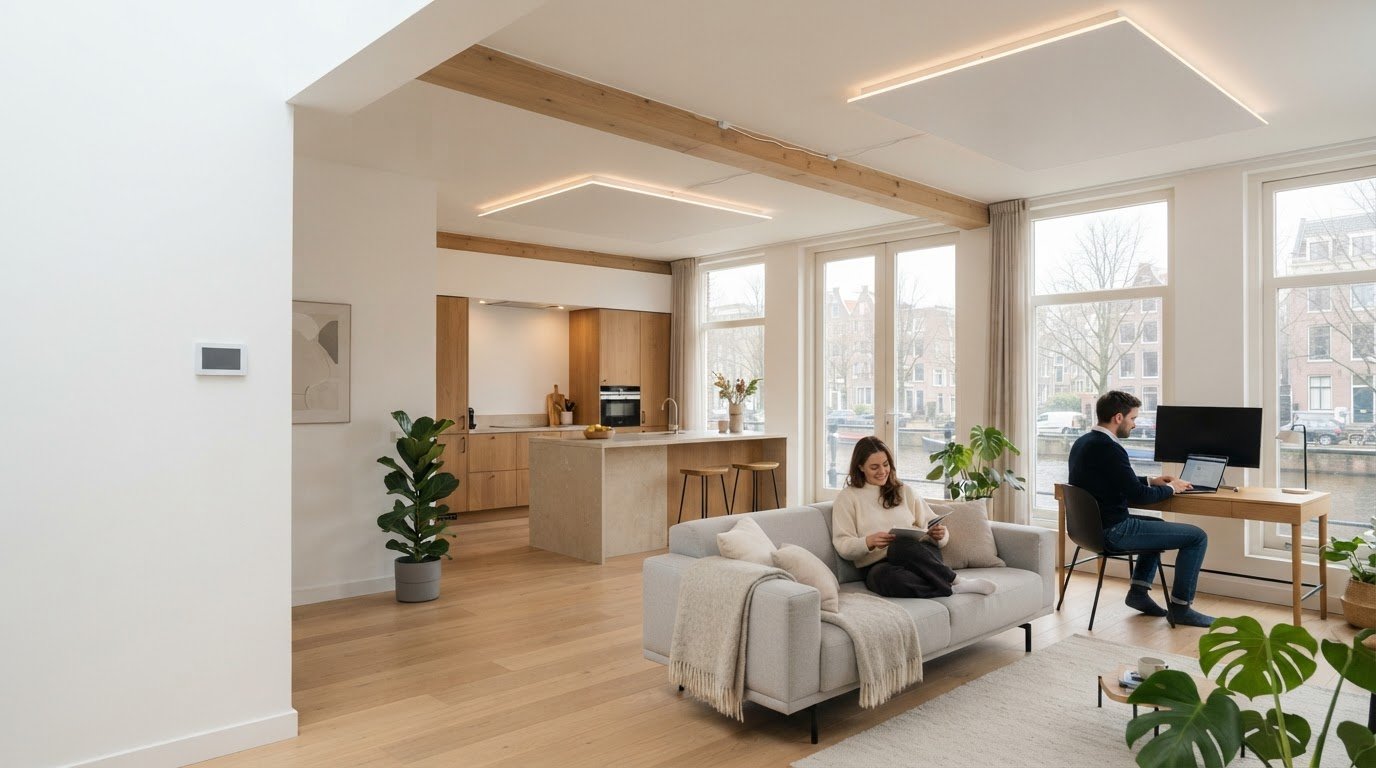
A ceiling heating panel can keep walls free but requires careful positioning and installation. First establish where heat is needed, how the room is used and the ceiling construction. Then check whether the selected model is approved for this mounting. Ceiling mounting is a positioning choice, not a separate guarantee of comfort or low consumption.
This guide helps you assess the room, panel specifications, controls and installation together for a home, office or customer project. We advise private and business end users and support installers and wholesalers with product selection.
Key points
Check mounting approval, ceiling structure and clearances. Match output and distribution to heat loss and use. Consider thermostat sensor location and assess lighting or smart controls separately. A ceiling heating panel is not underfloor heating and does not automatically make every corner equally warm.
What is a ceiling heating panel?
An infrared panel uses electricity to warm a surface. That warm surface releases energy through thermal radiation and also convection. People and surfaces absorbing the radiation become warmer. Perceived warmth ultimately depends on the panel, distance, direction, layout and room conditions. The technology does not remove the need for insulation, ventilation or suitable controls.
How does a ceiling panel heat the room?
Warm air rises through buoyant flow; thermal radiation works differently and can reach surfaces below a ceiling panel. This does not make positioning unrestricted. Distance, obstructions and model properties affect which places receive radiation. Heated surfaces then also transfer heat to their surroundings.
Assess seating, desks, circulation routes, ceiling height and obstructions. Thermal radiation can reach and warm surfaces, but tables or cupboards can affect distribution. There is no universal angle, mounting height or coverage for all models. Assess comfort at head height and follow permitted clearances.
When might a ceiling panel suit your room?
Compare ceiling and wall mounting with the room layout. A ceiling panel frees wall space; a wall position may better suit the occupied zone or an unsuitable ceiling. In homes assess seating, in offices workstations, and in industrial halls occupancy and mounting height.
Main heating must meet the demand of the room as a whole. For local supplementary heating, assess the occupied seating or work area alongside existing heating. One compact panel is therefore not suitable as complete room heating without assessment. Low wattage is also not proof that the desired comfort will be achieved.
A seating area, workstation, bathroom and industrial hall do not require the same version. Assess coverage and obstructions for local warmth. In bathrooms, model approval, position and electrical protection must work together; an IP code alone is insufficient. In industrial settings, dust, vapours, accessibility and special requirements also matter.
Checks for selection and installation
Gather room dimensions, ceiling height, window area, insulation and usage times. Record possible mounting positions and electrical points. Have required capacity assessed, then compare output, weight, dimensions, mounting approval and desired controls. Do not copy generic clearances from another model.
Check structural load capacity and use the specified fixing system. A wooden or suspended ceiling is not automatically suitable. Recessed mounting requires an approved version, clearance and any additional support or securing specified by the manufacturer. Do not simply replace a ceiling tile without this assessment.
Check substrate, load capacity, fixings and clearances according to the manual. Ceiling installation is not always best. Have a competent installer assess supply, protection and combined electrical load. A plug or wireless thermostat does not make every connection or location suitable.
Choose compatible controls, receiver and sensor location. Wi-Fi, window detection or energy monitoring vary by combination. Follow manual cleaning and inspection requirements and keep connections accessible where needed. Low-maintenance does not exclude faults, wear or replacement parts.
For a panel with LED lighting, check lighting and heating separately: colour temperature, dimming, controls and connection vary by model. An app or smart-home connection is not included as standard. Ask for the complete set, including any receiver and gateway required.
Choosing a ceiling panel with us
We supply private and business end users, installers and wholesalers. Share dimensions, photos or a plan, insulation and usage times. Include existing heating and mounting and operation preferences. We discuss suitable combinations for your building or customer project and identify technical information still needed.
Choose ceiling heating around your room
Bring technology, installation and use together in one proposal. Also compare purchase, installation, controls and running costs at the desired comfort. If uncertain, first request the correct manual or an assessment of structure and connection. An available ceiling position is not automatically a suitable installation point.
Ceiling panel questions
Can every infrared panel be ceiling-mounted?
No. Check approved mounting, structural capacity, fixings and clearances for the selected model. Ask us for the correct documentation and have structural or connection uncertainties assessed by a qualified installer.
How much electricity does a panel use?
A 600-watt panel operating continuously at full power for one hour uses about 0.6 kWh. Multiply actual consumption by your total electricity tariff. This is a calculation example, not a prediction of daily operating time.
Can the surface become hot?
Yes. Surface temperatures vary by version and can pose a contact risk. Choose an approved location considering children, pets and other vulnerable users. A temperature limiter does not automatically make touching safe. Do not cover the device unless expressly permitted.