
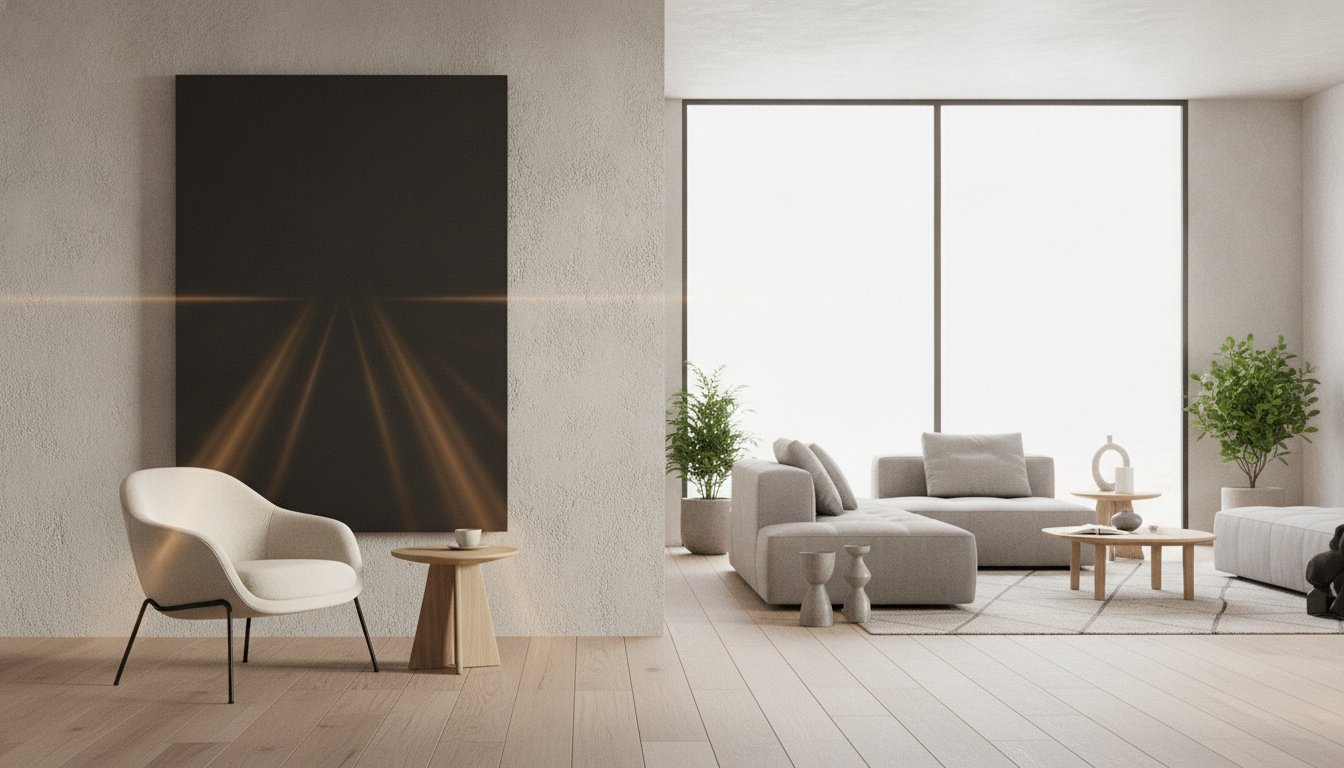
Illustration: the light lines beside the panel have been added; infrared radiation itself is not visible.
How does an infrared panel work? It uses electricity to warm a surface. That surface releases energy as thermal radiation and also through convection. People and surfaces absorbing the radiation become warmer. The eventual sensation depends on panel, distance, direction, furnishings and room conditions. The technology does not make insulation, ventilation or suitable controls unnecessary.
Key points
Thermal radiation, electricity consumption and annual consumption are different subjects. A panel does not heat only objects or leave the air entirely unaffected. Placement determines which surfaces are reached; heat loss helps determine how much energy remains necessary. Assess primary and targeted supplementary heating separately.
What is an infrared panel?
An electric heating element warms the panel construction and emitting surface. Materials, construction, output and controls differ by version. Not every panel has the same rear insulation, temperature profile or mounting options. Consult the specific model’s data instead of treating one general panel construction as standard.
An infrared panel transfers heat through radiation and also convection. Radiation can reach people and surfaces; heated surfaces then release heat to their surroundings. A convector mainly warms air, which spreads through the room. The distinction is therefore not an absolute separation between air heating and radiant heat.
The comparison with solar warmth helps explain radiant heat, but does not make a panel identical to sunlight. Different sources have different spectra, temperatures and intensities. Base a heater assessment on manufacturer data and permitted use, not the description “natural warmth”.
From electricity to heat in the room
- The element draws electrical power.
- The panel surface warms up.
- The warm surface emits radiation and also heats air through convection.
- Surfaces reached absorb or reflect part of the radiation.
- Heated surfaces then exchange heat with their surroundings.
These processes happen simultaneously and depend on the appliance and room.
Emissivity, radiant fraction and conversion of electricity to heat are different quantities. High emissivity does not mean that the same percentage of all input energy arrives as useful radiation in your occupied zone. Use measurements for the exact version and avoid general rankings based only on material or finish.
A building’s thermal mass does not arise from hanging a panel: the walls, floors and furniture already existed. Heating changes their temperature. How much heat they absorb and release depends on material, mass and temperature differences. This does not prevent ventilation or envelope losses or guarantee a minimal recovery time after opening a window.
Assessing comfort and consumption separately
Heat sensation depends on position, distance, surface temperature, room and person. Not every panel releases heat equally quickly or intensely. Warmer surfaces can affect comfort but do not fix thermal bridges or insulation defects. A fixed reduction in air temperature with unchanged comfort cannot therefore be promised for every situation.
Electric resistance heating converts almost all input electricity to heat. This applies not only to infrared panels but also other electric resistance appliances. Radiant fraction is different from total heat conversion. A high radiant fraction therefore does not prove a fixed reduction in annual consumption.
A heat pump works differently: it uses electricity to transfer ambient heat. Do not compare only two resistance appliances when heating a whole home. Assess each system’s heat demand, performance in relevant conditions, investment, installation and running costs. No heat-emission method eliminates ventilation or poor-insulation losses.
Compare purchase, mounting, controls, maintenance and energy use. At constant full power: watts × hours ÷ 1,000 = kWh. A 1,000-watt appliance running continuously at full power for two hours uses about 2 kWh. Costs are kWh × your electricity tariff. A thermostat changes actual on-time; two hours of occupancy do not automatically mean two hours at full power.
Heating is intended for thermal comfort and does not treat allergies, asthma or other conditions. Ventilation, cleaning and addressing moisture sources remain necessary. Different heat emission therefore does not guarantee a healthier indoor climate or dust-free room.
Placement and controls in practice
Measure length, width and height. Record windows, doors, insulation, possible draughts, desired temperature and operating times. Draw where you sit or work and available mounting positions on a floor plan. Photos help assess furnishings and obstacles. A general watts-per-square-metre rule does not replace heat-loss assessment.
Primary heating must cover the room’s heat demand as a whole. For local supplementary heating, assess the zone where someone sits or works alongside existing heating. One compact panel is therefore not suitable for complete room heating without calculation. Low wattage likewise does not prove desired comfort is reached.
Match position to the occupied zone. Furniture, high shelves and other obstacles can limit direct radiation. Wall or ceiling mounting is only possible if the chosen model permits it. Check distances, load-bearing capacity, environment and electrical connection in the manual. Warm-up time and perceived heat vary by version and situation; do not expect generally guaranteed immediate room heating.
Check load-bearing capacity, fixings, mounting height, clearances and electrical connection. Establish whether a thermostat is built in or needed separately, whether supplied and what load the controller can switch. Match schedule and temperature to actual use. Seek expert assessment before mounting or connecting if in doubt.
Check that controls and appliance are suitable together and which functions actually exist. Schedules, presence sensors, adaptive warm-up and open-window detection may help but differ by model. Detection thresholds and switching loads are product-specific. An app or energy-management link does not guarantee savings; incorrect settings may increase consumption.
Versions and product advice for your application
Metal, glass, mirror glass, ceramics and printed surfaces differ in appearance and construction. Compare weight, dimensions, surface temperature, mounting and controls by model. Do not assume every glass panel has the same safety glass or one metal always performs better. Rear construction or insulation must be assessed within the whole appliance, not as separate proof of savings.
For an office, counter, workshop or industrial hall, assess occupied zones, mounting height, operating hours and environment. A residential panel and industrial radiant heater are not necessarily interchangeable. Desk heating must also suit the actual position and distance. For installers and wholesalers, discuss model codes, quantities, suitable controls and project terms.
We supply private and business end users, installation companies and wholesalers. Describe the room, existing heating, desired heating zone and operating times. State dimensions, insulation data and preference for wall, ceiling or another version. We help compare suitable products, mounting conditions and controls.
From explanation to a suitable heating plan
Do not compare only purchase prices and wattages. Include controls, installation, maintenance, energy prices and the overall heating design. Electric supplementary heating is not automatically cheaper than gas or a heat pump. The result depends on the systems and the heat demand actually replaced or added.
Low-maintenance does not mean maintenance-free. Follow the manual for cleaning and checking appliance, fixings, connection and controls. Do not cover a heater and maintain prescribed clearances. Recurring damp, mould or draughts require assessment of the cause; heating is not a general solution to such building or ventilation problems.
Frequently asked questions about panel operation
Does a panel heat no air at all?
No, that assumption is incorrect. The panel also releases convective heat and heated surfaces transfer heat to their surroundings. Radiation can reach surfaces directly but does not eliminate air movement.
What happens when the panel switches off?
The appliance cools and already heated surfaces may continue releasing heat. Room cooling speed depends on building, temperature, ventilation and use. There is no general guarantee that infrared warmth is retained longer after switching off than heat from every other system.
Do I need to consider hot surfaces?
An operating panel can become hot. Even brief contact may cause burns. Check the model’s surface temperature and instructions, prevent unwanted contact and consider children and other vulnerable users. A mounting position must follow every requirement for that appliance; ceiling mounting is not automatically permitted for every model.
Is a panel suitable for every home?
Not automatically. Assess building, heat demand, electrical installation and intended application. Poor insulation does not disappear with different heat emission. For a whole home, also compare other suitable systems and seek advice if capacity or mounting is unclear.