
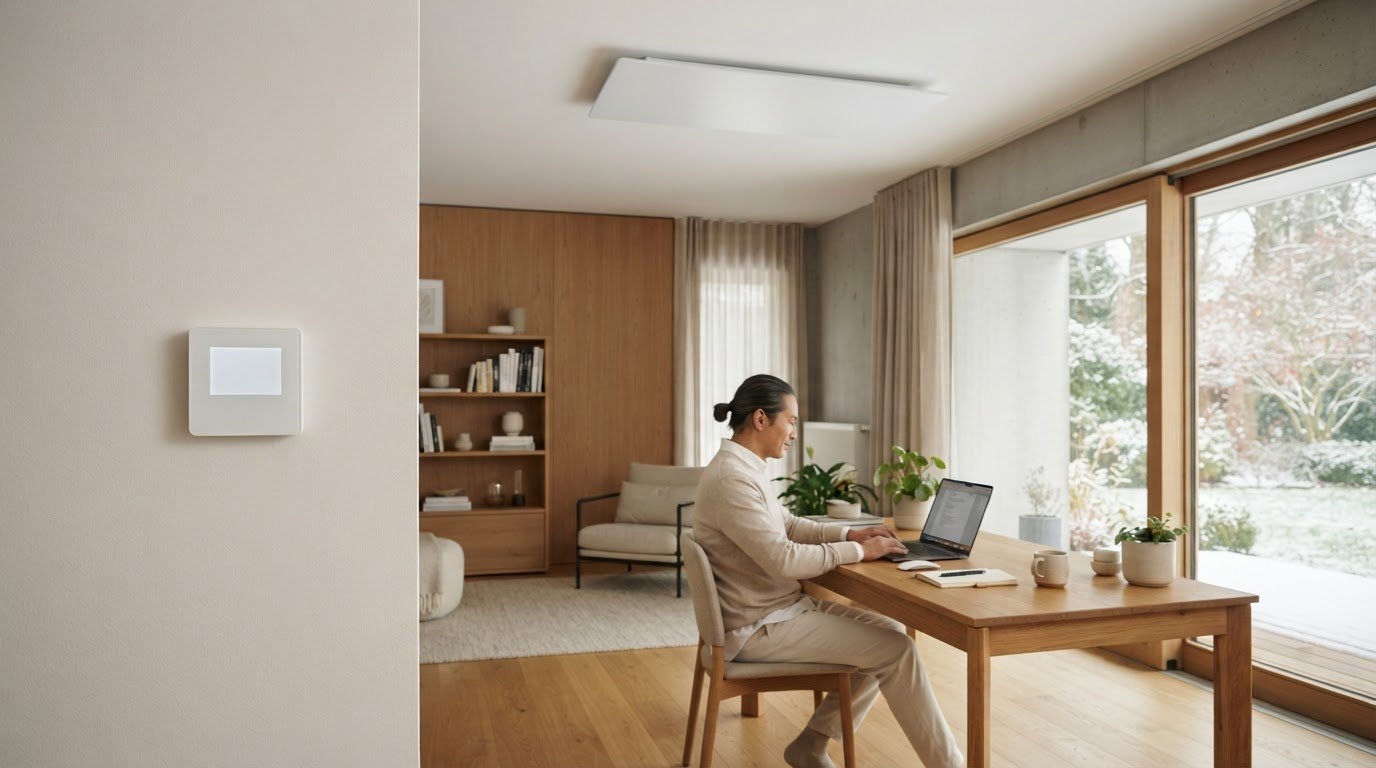
An infrared panel with a thermostat combines a heat source with temperature control. Suitable controls depend on the panel, connection, room and preferred operation. Check the documentation for both components before combining them.
We help private and business end users, installers and wholesalers choose a suitable combination. Tell us the panel model, how the room is used and your control preferences. Our advice follows the application: not every thermostat works with every panel.
Key points
The thermostat controls heating using the temperature at its measuring point. Perceived warmth also depends on radiation, distance, positioning and use. Check electrical load and control method, choose a representative measuring location and follow the installation instructions. Smart controls do not guarantee a fixed saving.
Why an infrared panel needs suitable controls
Suitable controls match heat demand to the desired temperature and operating times. This can limit unnecessary heating. Consumption still depends on factors including heat loss, temperature settings and operating time. A thermostat cannot automatically make an unsuitable panel or poorly insulated room economical.
How thermostat control works
A thermostat compares a measured temperature with a setpoint and controls heat demand accordingly. Switching behaviour, hysteresis, sensor type and any schedules vary by model. Do not assume a fixed cycle, accuracy or app function unless confirmed in the product data.
The panel transfers heat through radiation and convection. The thermostat does not directly measure how warm the radiation feels to a person. Radiators also provide both radiant and convective heat; the proportions differ between systems. Panel controls also operate central heating only if the installation has specifically been designed for this.
Built-in or separate thermostat?
Built-in controls place the interface and sometimes the sensor on or near the panel. A separate thermostat can measure elsewhere. Some wireless room thermostats use a separate receiver. Check what is actually included: a remote control is not automatically a temperature sensor, and Wi-Fi says nothing about electrical compatibility.
Compare operation and measuring location
Built-in operation is practical if the panel is accessible and the manufacturer considers its measurement suitable for the application. A separate thermostat offers more freedom of location but needs a compatible connection and sometimes extra components. Choose according to the installation rather than appearance alone.
Choosing and positioning a thermostat
Check panel model, supply voltage, output, permitted switching load and required control method. Compare total connected output with the limits of the thermostat, receiver and installation. A volt-free contact, switched mains voltage and a manufacturer-specific connection are not interchangeable by default. If uncertain, ask us and the installer to assess the combination.
Place a separate room sensor at a representative, unobstructed location following the manual. Sunlight, draughts, a cold external wall or a heat source can affect the reading. Consider panel position too. Do not assume a universal mounting height or distance: follow the instructions for your model.
Installation and bathroom use
A plug-in thermostat is suitable only if panel, plug connection, load and location allow it. Use a qualified installer for fixed wiring or unclear connections. In bathrooms, panel, controls and connection position must meet the applicable installation requirements and manufacturer instructions. An IP rating alone is not a complete positioning assessment.
Find a suitable panel and thermostat with us
Tell us which room you want to heat, when you use it and whether a panel or controls are already installed. Include model details and your preference for local operation, schedules or remote control. Business partners can also discuss product selection across several rooms and the components required. We confirm which functions and combinations are available for the selected model.
Choose controls for your room
Assess panel, controls and positioning as one combination. Start with technical compatibility, choose a suitable measuring point and match temperatures and schedules to actual use. For whole-home heating, also assess heat loss and other suitable systems. We help you evaluate product options for your situation.
Frequently asked questions
Does a thermostat always save energy?
Suitable controls can limit unnecessary heating, but no fixed saving is guaranteed. Settings, use, building and the chosen comparison determine the outcome.
Can one thermostat control several panels?
Sometimes, if the system supports it and the total load stays within every limit. Check receivers, zoning and measuring location too. Have the required combination assessed before connecting panels together.