
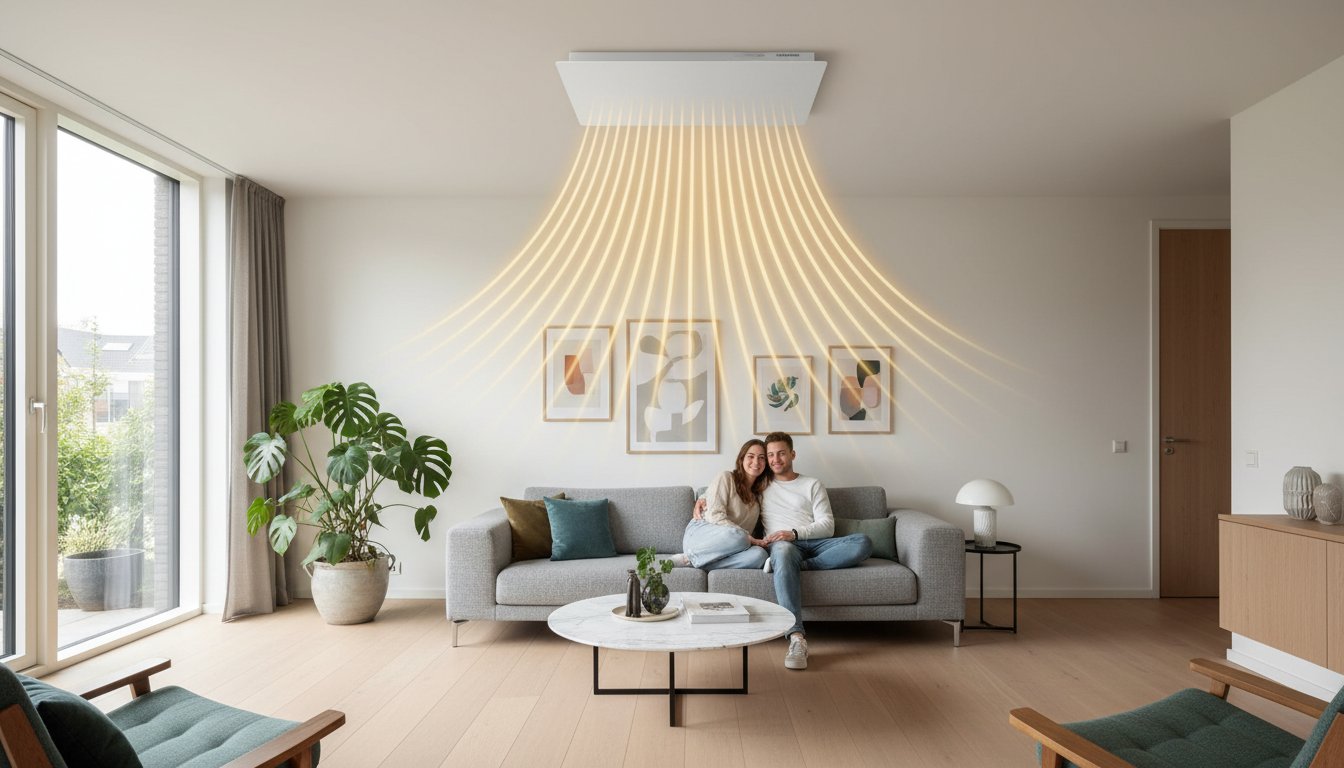
Which infrared heating do you need? Start with purpose: warming a seating area temporarily differs from heating an entire home. Then assess demand, mounting positions, electrical supply and controls.
This guide helps gather the required information. It does not replace model instructions or building assessment. A simple wattage factor or attractive material name cannot establish comfort in every condition.
Key considerations
Define primary or supplementary heat, schedules and temperature. Assess heat loss and electrical capacity. Then choose quantity, output, materials and controls. Check permitted environment and mounting for each version.
Define the heating task first
Primary heating must cover demand under the design conditions. For local comfort assess occupied position, distance and duration. The rest of the room may still need heat; a local panel does not automatically serve the whole room.
Panels emit radiation and convection. People and surfaces receive radiant heat while air also warms. Air movement remains. The technology guarantees no general health, sleep, concentration or dust benefit.
Match capacity and quantity to heat loss
Assessment includes insulation, glazing, exposed surfaces, ventilation, adjoining spaces and temperature. Building age or energy rating alone is insufficient. Generic watts per square or cubic metre are not an exact heat-loss calculation.
Too little capacity can compromise comfort. More capacity affects response but guarantees neither fewer kWh nor longer life. Panel quantity also depends on layout, mounting and distribution, not merely summed watts.
Use indicative calculators as a starting point and check inputs and assumptions. Ask which conditions were used and what information is missing. A room of a given size does not automatically need two or three panels.
Assessing each application
Living rooms and kitchens require attention to occupied areas, furniture and mounting space. Photo or coloured panels may suit interiors but must be technically appropriate. Panels behind large obstacles do not provide the same exposure as unobstructed layouts.
For bedrooms or work corners, consider temperature, schedules and placement. Use only approved under-desk appliances. Check legroom, cables and moving furniture; a room panel is not automatically a desk heater.
Bathrooms require suitable model, exposure, mounting and complete connections. IP alone grants no general permission. Heated mirrors are not always condensation-free and ceiling panels do not guarantee a warm floor. Ventilation remains necessary.
Tall halls, workshops and outdoor areas differ from homes. Assess height, zones, exposure and special hazards. Choose equipment intended for the environment rather than a domestic panel based only on watts.
Comparing materials and controls
Metal, glass and ceramic differ in appearance, weight and construction. Overall design determines response. There is no universal insulation thickness, emissivity or warm-up time for quality panels. Use actual model measurements for radiant fraction.
Compatible thermostats, sensors and receivers need suitable total-load ratings and placement. Schedule according to use. Wi-Fi, adaptive start, occupancy and metering depend on the model; apps may measure or only estimate.
Compare identical demand using your tariffs and hours. Heat pumps differ from resistance panels and may use less electricity. Solar generation does not automatically make heating free or winter-autonomous.
Checking mounting and electrical capacity
Follow exact-model instructions for mounting, height, orientation and clearances. Assess structure, fixings and hidden services. Ceiling grids or plasterboard must not support weight without checking. Recessing requires approved equipment and accessories.
Have a competent installer assess total load, simultaneity, protection and supply. There is no universal safe single-phase limit or automatic need for one particular three-phase connection. A plug does not automatically make an existing point suitable.
Prevent hot-surface contact, especially around children, pets and vulnerable users. Protection devices do not replace correct installation and use. Follow cleaning and checks; life and warranty are separate and product-specific.
A heating plan for your situation
We advise private and business end users and support installers and wholesalers. Share plans, insulation, existing heating, schedules and mounting preferences. Specify models, controls, accessories and work. Going gas-free also requires hot-water planning.
Frequently asked questions
Is ceiling mounting always best? No. Position depends on model, structure, coverage and layout. No fixed angle or height applies to all panels. An unobstructed position helps only where permitted and safe.
Can panels heat my whole home? Assess all rooms, losses, electrical capacity and controls. Include alternatives and check the complete plan before removing existing heating.
How do I check performance claims? Use manuals and traceable model data. CE is not an independent quality test and certification applies only within its stated scope. Ask for evidence for the exact appliance.