
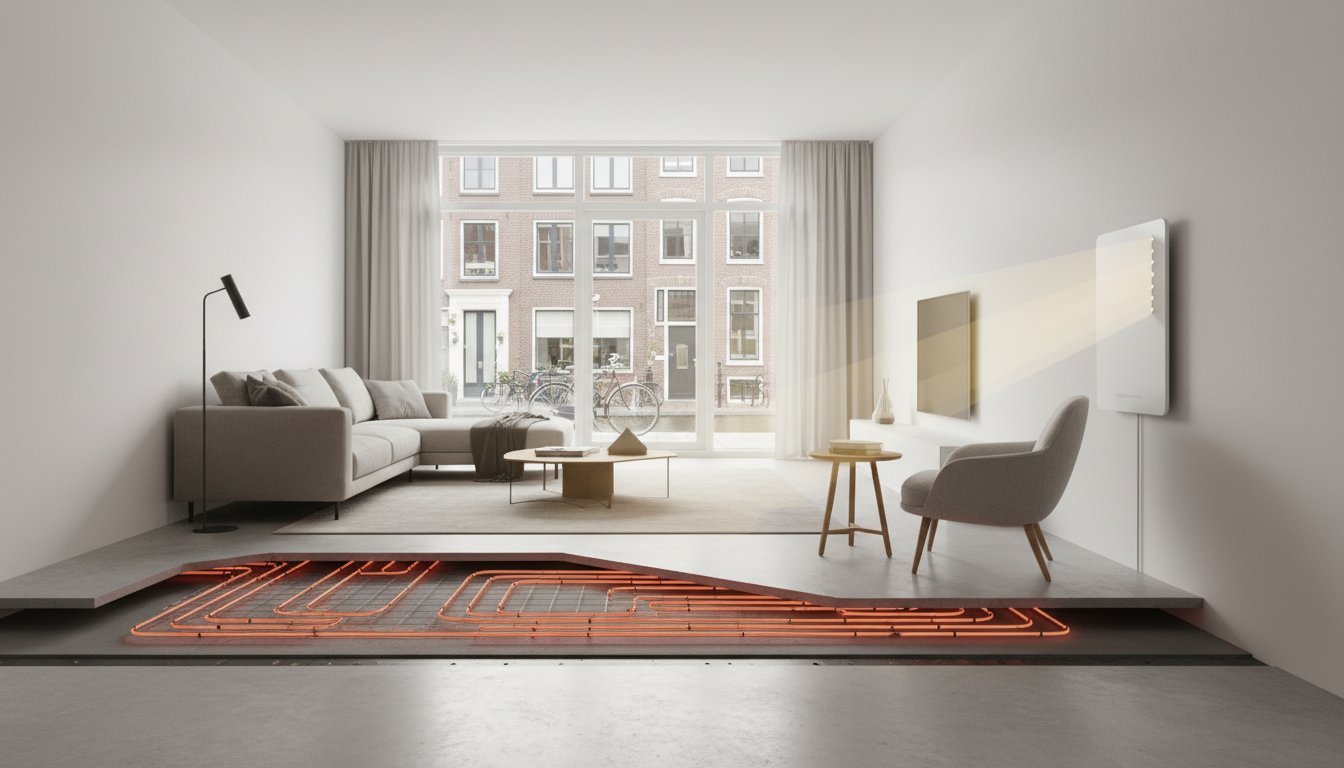
Comparing underfloor heating and infrared panels starts with another question: electric or hydronic underfloor heating? The floor is a heat emitter; for hydronic systems, the source, such as a heat pump, also determines energy use.
Then consider construction, comfort locations and schedules. Fast response can help with short use; another room may need stable background heat. Neither property alone proves the lowest total cost.
Key considerations
Compare complete systems for identical demand. Check floor construction and finish for underfloor systems, and mounting and coverage for panels. Match controls to use and include installation, energy and maintenance.
How do both systems emit heat?
Warm floors and infrared panels both emit radiation and convection. Floors heat from a large surface, panels from their wall or ceiling location. Obstructions, distance and layout affect comfort. Panels do not automatically eliminate every cold spot, and ceiling heating is not equivalent to a heated floor.
Response depends on construction, mass, insulation, source and starting conditions. Thin systems can differ from thick screeds. Panel-surface warm-up is not directly comparable with heating an entire cold room. Avoid fixed minutes or hours as a universal ranking.
For underfloor heating, check thermal resistance and permitted temperatures of flooring and underlay. Tiles, vinyl, laminate, wood and carpet need product-specific assessment. One temperature limit does not cover all combinations. Approved flooring must also emit enough heat for demand.
Which energy performance are you comparing?
Electric underfloor heating and many infrared panels use resistance: almost all electricity ultimately becomes heat. Insulation, controls, placement and use affect results. Conversion alone makes neither universally more economical.
Hydronic floors require including the source. Heat pumps may deliver several units of heat per unit of electricity; use seasonal performance. Distribution or pumping losses matter but do not prove lower annual panel consumption without calculation.
Compare identical temperatures, hours and zones. Use your tariffs and include warming and cooling behaviour. A fixed temperature reduction or insulation threshold does not automatically establish a cheaper system.
Comparing installation work and maintenance
For floors assess structure, build-up height, insulation, finish and routes for pipes or elements. Milling is not always possible or necessary. Include drying, access and source connection in planning.
Panels may leave flooring intact but require suitable support, fixings, clearances and electrical capacity. A plug does not authorise every location. Follow model instructions and use competent fixed-wiring installation.
Get comparable complete-system quotes including controls, flooring and electrical upgrades. Maintenance and lifespan vary by part and model. No water or pump does not guarantee decades without repairs; cleaning and inspection remain necessary.
Assessing comfort and indoor conditions separately
Both can provide comfort with suitable design and controls. Neither prevents air movement or removes allergens. No general medical benefit for circulation, pain or relaxation can be promised. Ventilation, cleaning and moisture-source control remain separate tasks.
Consider hot surfaces and vulnerable users with panels. Ceiling mounting requires approved models, structure and clearances. Floor heating needs correct limits and sensor settings. Safety requires assessing the complete system.
Justifying a choice or combination
First establish the source, feasible floor work and room use. Then assess losses, output, placement and controls. A combination can serve different functions but is not automatically cheapest. Avoid controls causing unnecessary simultaneous heating.
A gas-free home also needs hot water planning. Assess the complete installation before removing the existing source. We help private and business end users and support installers and wholesalers with panels, controls and project information.
Request a comparison for your situation
Send plans, known floor construction, insulation, source and schedules. We can discuss panel options and required information. Compare proposals for the same comfort and cost categories.
Frequently asked questions
Is infrared always more economical than floor heating? No. Distinguish electric and hydronic systems and include the source. Compare equal demand and hours using realistic controls and insulation.
Do I always need PID? No; use manufacturer-approved controls matching sensors, load and use. An algorithm name alone guarantees neither savings nor comfort.
Does heat vanish immediately after switch-off? A warm panel continues emitting while cooling. Floors and building fabric can store heat too. Duration depends on construction and conditions; no universal residual-heating period applies.