
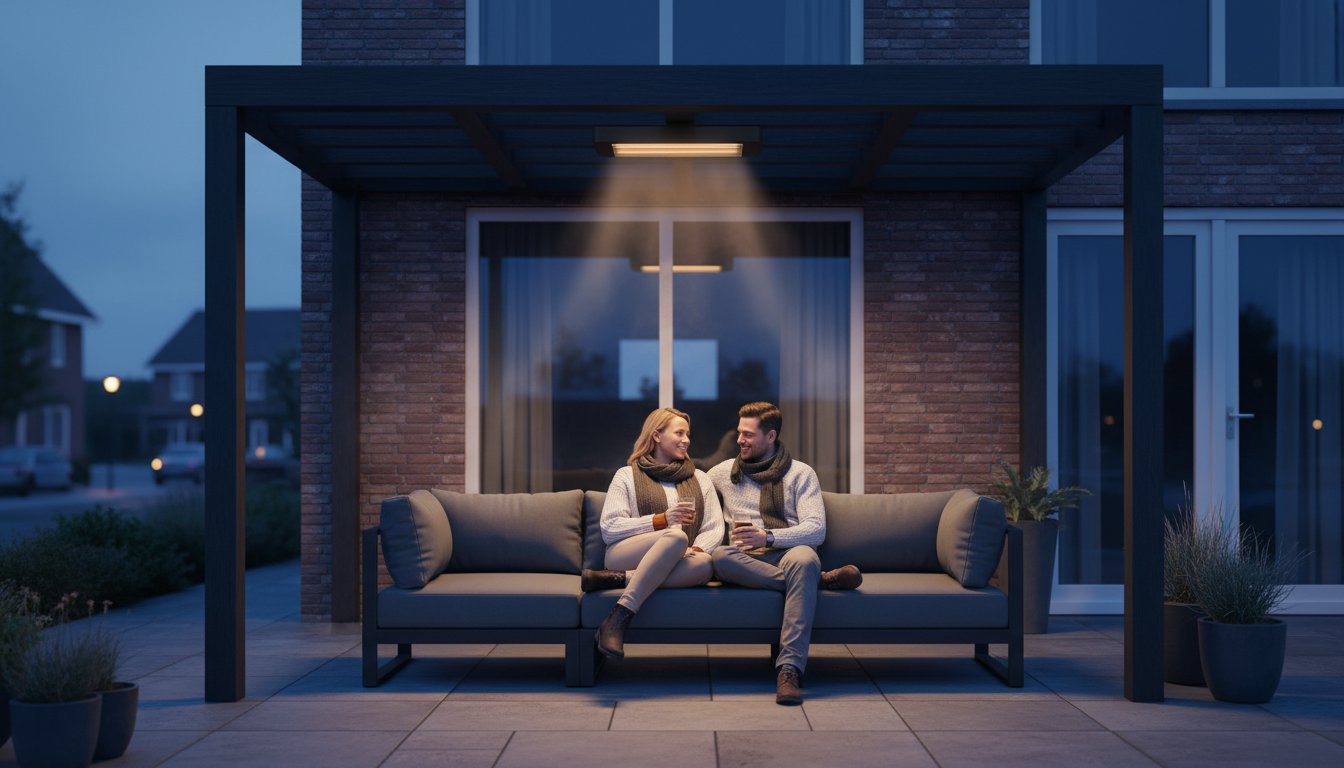
Choose a patio heater for where people sit or stand, not merely the total garden area. Shelter, wind, seating and permitted mounting affect comfort. This guide helps you ask the right questions before ordering.
Heaters differ in output, radiation and controls. Price or wavelength does not automatically establish suitability for your patio. Compare the actual model under its intended conditions.
Key considerations
Define the comfort zone and schedules. Check visible light, mounting, weather exposure, electrical load and permitted controls. Use model-specific clearances and coverage; generic wattages or IP ratings do not provide a complete safety assessment.
How does radiant heat work outdoors?
Infrared heaters transfer heat to people and surfaces within range. Air movement and convection remain. Wind can increase people’s heat loss and alter comfort. No heater guarantees identical warmth at every outdoor temperature and wind condition.
Electric heaters have no combustion at the point of use and need no gas cylinder. They still have hot surfaces and electrical risks requiring correct mounting and operation. Overall emissions depend on production, electricity generation and use; electric does not automatically mean carbon-neutral.
Wavelength, visible light and perceived warmth
IR-A, IR-B and IR-C describe parts of the infrared spectrum. They are not quality grades or complete measures of comfort or safety. Intensity, reflector, distance and exposure duration also matter. Greater skin penetration is not a general benefit to seek.
Some elements emit visible light; others have a discreet dark appearance. Warm-up and heat distribution vary by model. Choose through application and verified data, not promises that one wavelength is always windproof, instantly warm or the only suitable technology.
Choosing output, protection and supply
Use manufacturer coverage data for the stated height and shelter. A generic area-based wattage cannot replace those conditions. Reflectors and multiple heaters affect distribution, as do obstacles and orientation towards people.
An IP rating describes certain enclosure protection against solids and water. It does not automatically permit permanent rain exposure, coastal conditions or every orientation. Assess appliance, cables, plugs, controls and connections together for the exposure.
Have a competent installer check total load, simultaneity, starting behaviour, wiring and protection. A type-C breaker is not a universal heater solution and requires installation assessment. A plug or a power rating below a threshold does not automatically establish suitability.
Matching placement to use and surroundings
Follow the exact model’s height, angle and clearance instructions. Check timber, plastics, fabrics, furniture and movable awnings in every position. Heat shields or extended brackets are solutions only when approved for that combination; do not improvise around combustible structures.
Recessing requires an approved version and kit with adequate space and cooling. A patio heater is not automatically suitable for a dusty workshop or tall hall. Assess combustible materials, process hazards and potentially explosive environments separately.
Dimmers, timers, sensors or apps can help manage use but must be approved for the model. Check features and failure behaviour before relying on remote operation. Switch off when heat is unnecessary and never cover a hot appliance.
Finding suitable equipment with us
We supply private and business end users and support installers and wholesalers. Send photos, dimensions, height, shelter, seating and schedules. Hospitality projects may benefit from separately controlled zones; we cannot promise extra trading days or revenue.
Heatstrip series and versions, for example, differ in application and controls. Confirm the locally available model code and use its documentation. Do not transfer origin, warranty or specifications from another series or overseas version.
Request a proposal with clear assumptions
Specify model, accessories, mounting, electrical work and controls clearly. Compare purchase and operating costs for the same situation and ask about maintenance and replacement parts. This reveals the complete project, not merely rated watts.
Frequently asked questions
What does an hour cost? Multiply actual input power in kW by operating hours and your tariff. For power settings, check consumption at each level. A display setting does not automatically prove an identical percentage reduction in electricity.
May it remain outdoors? Only under the exact model’s and complete connection’s conditions. Follow maintenance and storage instructions. Use a cover only if permitted and fully cooled; prevent accidental operation under a cover.
Is electric patio heating always cheaper than gas? No. Compare the same comfort zone, duration and conditions using your current tariffs. Warranty, lifespan and maintenance are product-specific; generic hourly costs or payback periods are unreliable.