
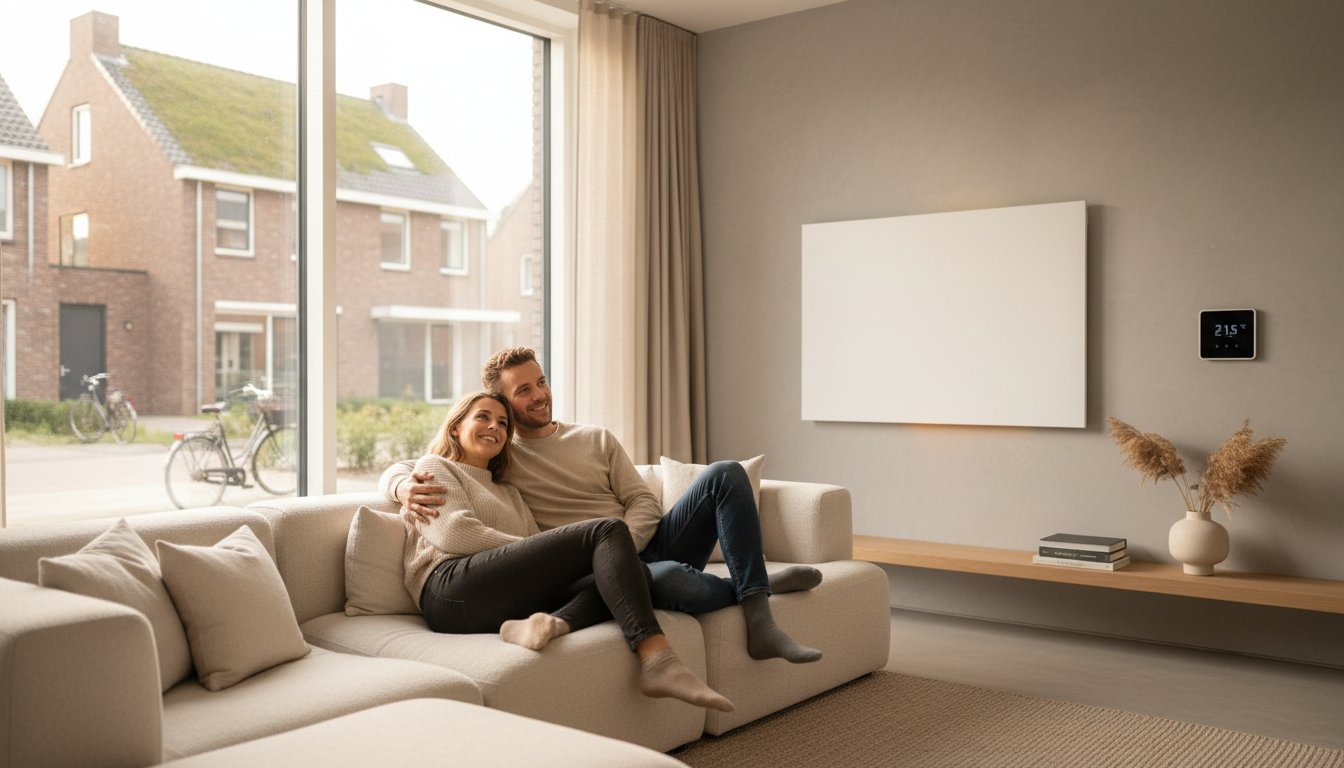
Want to know what your infrared panel actually uses? Distinguish its rated power, the time it is actually energised and a measured quantity of kWh. These three figures help you check an estimate and assess an app reading.
This guide explains a practical calculation, what measurements can and cannot establish, and which settings affect the result. A single day’s measurement is not automatically a whole home’s annual consumption.
Separate power, time and measurement
Watts measure power; kWh measures energy. Use actual energised time, not merely the time a programme is enabled. Check whether an app measures or estimates, and include receiver or thermostat consumption when comparing the complete system.
What does the rating plate tell you?
Rated power indicates electrical load under the stated conditions. An energised resistance panel draws approximately its version’s specified power; a thermostat does not continuously make it use less while energised. The controls can change the total operating time.
A programme enabled for four hours does not necessarily supply full power for four hours. Conversely, short operating time is not guaranteed. Heat demand, power and settings determine how often the controls energise it. Do not assume a fixed number of minutes per hour.
Record the measurement conditions
Record indoor and outdoor temperatures, occupancy times, ventilation and other operating heating. Log setting changes too. Otherwise lower consumption may simply reflect milder weather, less occupancy or another heat source.
A home loses heat through its fabric and air exchange. Insulation can reduce demand; storage in walls mainly changes timing and creates no additional heat. Dimensions or an energy label alone cannot establish exact consumption.
Check placement and obstructions, but do not call a sofa in front of a panel a thermal bridge: that is a different building-physics phenomenon. Clear radiant space can improve local comfort. Permitted distances and mounting follow the specific model, not one generic ceiling height.
Calculate kWh and apply your own tariff
For a period at constant power: watts ÷ 1,000 × actual operating hours = kWh. A 600-watt panel operating continuously for fifteen minutes at that power uses 0.6 × 0.25 = 0.15 kWh. This is only an example, not a forecast per shower.
For variable costs, multiply kWh by the applicable contract tariff. If prices change, split the measurement period accordingly. Keep fixed costs separate when comparing systems. A purported current national tariff does not automatically match your contract.
Want to measure? Use only an energy meter suitable for the unit, load and environment, following both products’ instructions. Do not insert an arbitrary plug-in meter into fixed wiring or a wet-room installation. Have an installer prepare suitable measurement where necessary.
An app may estimate from switching time and entered power. That differs from separately measured kWh. Check documentation and measurement boundaries: does the figure cover the panel alone, an entire circuit or other appliances too?
Compare the same delivered service
Do not directly compare one locally heated workstation with an entire home at a higher temperature. The service differs. A convector also converts almost all electricity into heat; for the same room demand, the word infrared alone does not prove fewer kWh.
A heat pump may need less electricity for the same heat by using ambient heat. Lower purchase cost or maintenance needs do not change that. Assess total costs separately using actual quotes and a justified usage estimate.
Adjust and measure again
Start with unnecessary operating hours, unsuitable sensor positioning and unused zones. Prefer changing one setting at a time and account for weather. Suitable controls can adjust operating times; PID does not automatically mean the panel draws less power when energised.
Do not save by disabling necessary ventilation. Assess moisture and comfort at lower temperatures. Heating does not treat allergies or prevent all air and dust movement. Low-maintenance panels still need cleaning and checks according to their manuals.
Support your choice with data
We help private and business end users and supply installers and wholesalers. Share room details, intended use and any measurements. We can then discuss products and controls without promising a fixed saving or unsupported annual cost.
Frequently asked questions about measuring and calculating
Can a panel stay on all day? This depends on model, permitted use, placement and controls. Follow the manual. A generic surface temperature or warm-up time does not prove that unattended or continuous use is permitted for every version.
How many solar panels cover consumption? You need measured or calculated heat demand and actual generation. Annual kWh may match arithmetically while you still import winter electricity. A particular panel count does not guarantee grid independence.
Is floor heating always slower and more expensive? No. Electric and water-based versions are not one system. Construction, controls, heat source and use determine response and consumption. A panel may respond differently locally, but this does not establish a universal cost ranking.