
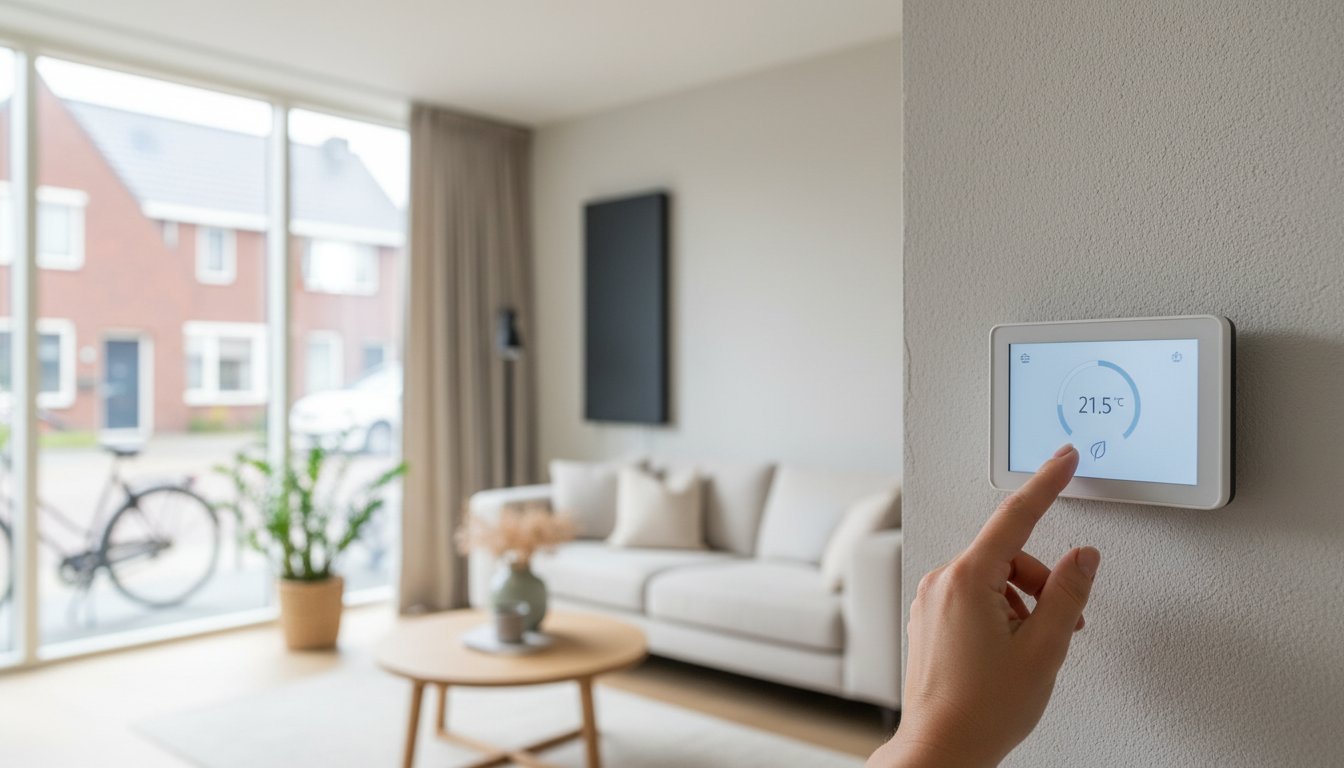
A smart thermostat for infrared panels must first suit the panel and electrical installation. Wi-Fi, an app or an attractive display does not prove compatibility. Check the complete chain from sensor and thermostat to receiver and heating load.
This guide distinguishes electrical suitability, control behaviour and extra features. Smart controls can limit unnecessary use but do not guarantee savings or health benefits.
Check the combination before the features
Check supply, output type, permitted load and compatible receivers. Define zones and a representative temperature-measurement position. Then consider schedules, app, internet dependence, support and privacy terms.
What controls do and do not change
A thermostat compares measured temperature with a setpoint and operates a suitable output. It does not change insulation or the panel’s energy-conversion principle. It can prevent a zone being heated longer or warmer than intended.
Hysteresis, measurement accuracy and display resolution are different properties. A display showing tenths does not prove that measurement accuracy. A narrow hysteresis or PID function is not automatically the best setting for every installation.
Plug-in, fixed and wireless-receiver systems
A plug-in thermostat may suit a compatible plug-connected unit in an approved location. Check load, earthing, accessibility and environment. An intermediate plug is not suitable for every bathroom, panel or connection.
A wireless thermostat communicates with a compatible receiver. Wi-Fi may add remote access, but architectures vary by range. RF, Wi-Fi, Zigbee, Matter or Thread do not guarantee interoperability; check models, protocol and any required hub.
Not every thermostat must or may switch the full heating load itself. An output may be a control contact for a receiver or another device. Have output, voltage, current, load type, wiring and protection checked together. Do not assume a universal 16-amp or 3,600-watt limit.
Choose schedules and automation deliberately
A weekly schedule sets usage times. Presence detection, geofencing and adaptive start may be available on supporting models. Check behaviour with a flat phone, missing sensor or manual override too. A feature name does not explain the full control behaviour.
Open-window detection may identify a temperature drop rather than use a physical window sensor. Thresholds, pauses and recovery vary. Check behaviour in your room and do not use it to replace necessary ventilation.
PID or time-proportional control may adjust switching time; it does not automatically mean electrical dimming of the panel. Check permitted settings and switching-component suitability. Shorter or more frequent cycles do not universally guarantee better performance.
Solar or dynamic-tariff integration needs compatible equipment and settings. Heating at low prices or during surplus only helps when heat is useful and the overall economics work. Controls do not change winter heat demand or solar availability.
Zoning and sensor location
Define usage times and temperature for each room or zone. One thermostat may control multiple receivers if supported, but quantity, range and load need checking. Separate rooms may need individual sensing and control.
Place the sensor as instructed at a representative location away from disturbances. Sunlight, draughts and appliance heat can affect readings. One fixed height or seated height does not guarantee that the reading matches perceived comfort.
In bathrooms, assess positioning, model suitability, protection and the complete connection together. A floor sensor has a different purpose from a room sensor and belongs only in systems supporting it. Floor-heating sensors and limits follow heating and flooring requirements.
Do not skip commissioning and management
Have fixed wiring and checks performed by a competent installer. Follow model-specific pairing and record zones and settings. Test communication and shutdown before handover. Generic wiring instructions or a fixed installation time are insufficient.
Compare sensor values with a reliable reference using a suitable procedure. An offset does not fix poor sensor placement. Check updates and support as advised and use strong unique passwords. Keep manual-operation and fault instructions available.
Advice on a suitable combination
We help private and business end users and supply installers and wholesalers. Send panel models, quantities, existing controls and desired functions. We can discuss components without promising universal compatibility or fixed savings.
Frequently asked questions about smart controls
Will it work without internet? This varies. Check local functions, whether schedules are stored locally or in the cloud and behaviour after power failure. Test as instructed; not every system guarantees the last programme continues.
Is wireless always quieter and more reliable? No. Relay noise, batteries, radio range and communication-loss behaviour vary. Ask about these for bedrooms, long distances or inaccessible receivers.