
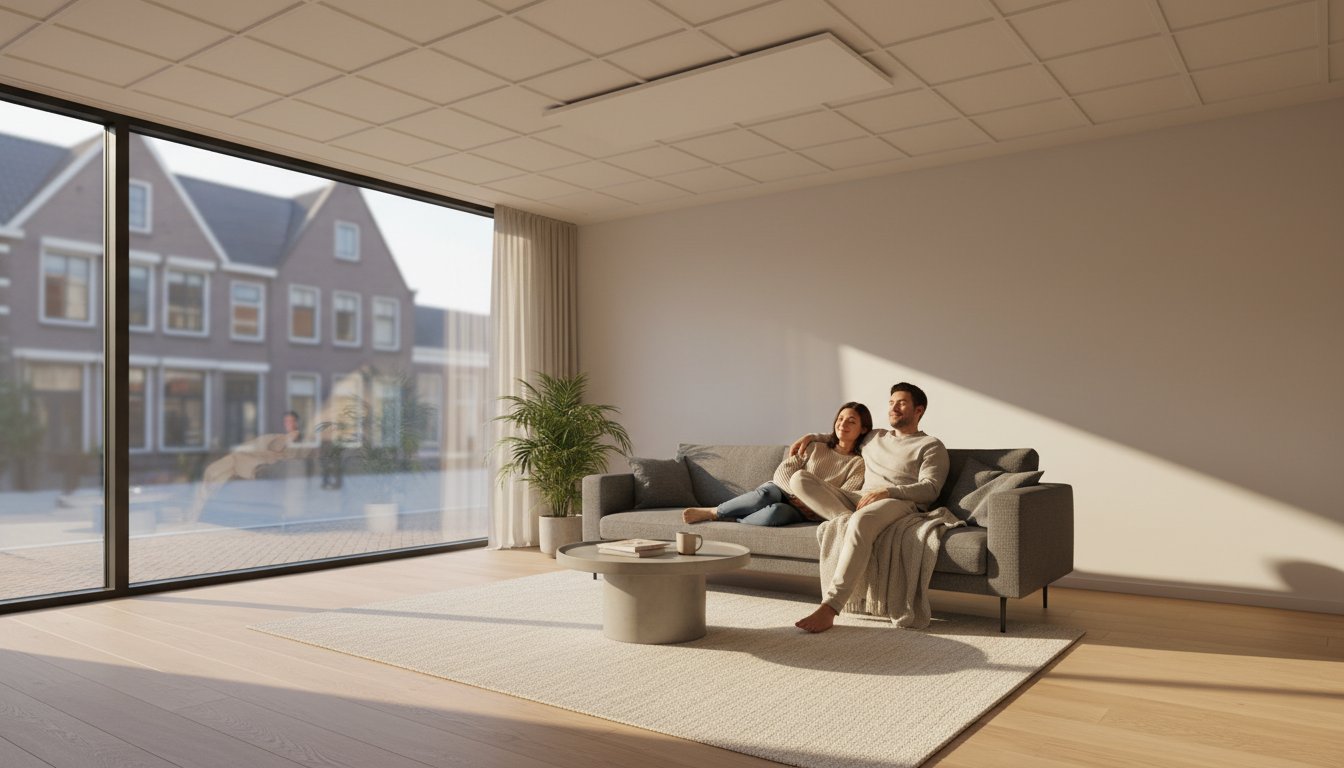
Metal infrared panels come in various constructions for homes and business premises. A matt finish, slim profile or low weight can be useful, but these vary by model. Choose by function and product data rather than general promises about metal.
This guide covers finish, heat delivery, mounting and controls. Distinguishing an office panel from an industrial radiant heater also matters: the outer material alone does not determine its application.
What should you compare?
Check output, dimensions, weight, fixings, permitted environment and controls. For special requirements, request exact model data. Impact resistance, corrosion protection, ceiling approval and certification are not automatic features of every metal panel.
Different metals and heating constructions
An electric element heats the panel construction, which emits radiant and convective heat. Steel and aluminium appear in various designs. Check the element, insulation, surface treatment and controls separately in model information.
A metal finish can suit a functional interior. It does not automatically make the unit light enough for a thin partition or suspended ceiling. Even a relatively light panel needs suitable fixings and sufficient structural support.
Assess coating and measurement data
Coating and surface temperature affect radiant output. A generic emissivity figure or the word powder coating is insufficient for comparing performance. Request measurements and test conditions if radiant share matters to your choice.
Resistance heating ultimately converts almost all electricity into heat. That does not establish the radiant proportion or a room’s annual kWh demand. Assess heat loss, use and controls rather than attributing fixed efficiency or low consumption to the material.
Protection and permitted temperatures vary by construction. Do not assume two sensors or one fixed cut-out temperature. Do not cover a panel to test protection. Follow the manual and have abnormal behaviour assessed.
Compare metal, glass and ceramic
Compare exact models with comparable functions and output. Weight and response depend on the complete construction, not only the front. A metal model is not always faster, and a heavier panel does not automatically provide cheaper heat.
A matt finish may reduce reflections; a glass front may suit an interior preference. Impact and scratch resistance need model data. Handle metal carefully too and take coating, cable or casing damage seriously. A robust appearance does not authorise industrial use.
Lifespan and repair options vary by product. Ask about support for electronics, element and fixings and end-of-life disposal. Metal parts do not automatically make an entire electrical product easy or fully recyclable.
The environment matters beyond the surface
Primary home heating needs heat-loss assessment. A fixed wattage based on construction year or energy label is insufficient. For supplementary bedroom or workstation heating, assess the zone, existing heat and occupancy times.
A suspended ceiling needs approved panel dimensions and mounting, sufficient structural support and a suitable connection. Fitting the grid does not prove the grid may carry the weight. Have any additional restraint assessed too.
Halls and workshops require assessment of height, work position, dust, moisture and other environmental risks. A domestic panel is not automatically suitable, and infrared is not the only potentially economical option. Assess equipment and zones for the actual environment.
For a bathroom, assess exact position, protection, connection and model approval together. Metal or an IP rating alone does not permit every location. Clearances and the prohibition on unauthorised covering still matter.
Product advice for your project
We help private and business end users and supply installers and wholesalers. Share the application, floor plan, insulation details and mounting restrictions. We can discuss suitable versions and any further information needed.
Check certificates and warranties for the selected model and relevant property. European origin or a German brand does not mean every product has identical certifications or terms. Expected lifespan is not a whole-system warranty.
Make the choice concrete
Define the comfort required, how controls work and who mounts and connects the system. Compare complete proposals rather than panel prices alone. We help find suitable products without blanket leadership, health or fixed-saving promises.
Frequently asked questions about metal panels
May I repaint the panel? Only if the manufacturer expressly permits it for that version and specifies the method. Ask about factory colours beforehand. A fixed RAL colour count or retained warranty cannot be promised for every range.
How hot and how quickly? Consult the exact model’s data. Power, surface, controls and environment affect temperature and warm-up. Hot surfaces can burn; faster cooling or a metal casing does not protect against contact.
What does it use per hour? Power in kW multiplied by actual operating hours gives kWh. A 600-watt panel operating at that power for an hour uses about 0.6 kWh. Operating time depends on heat demand and controls; no fixed duty cycle applies to every home.