
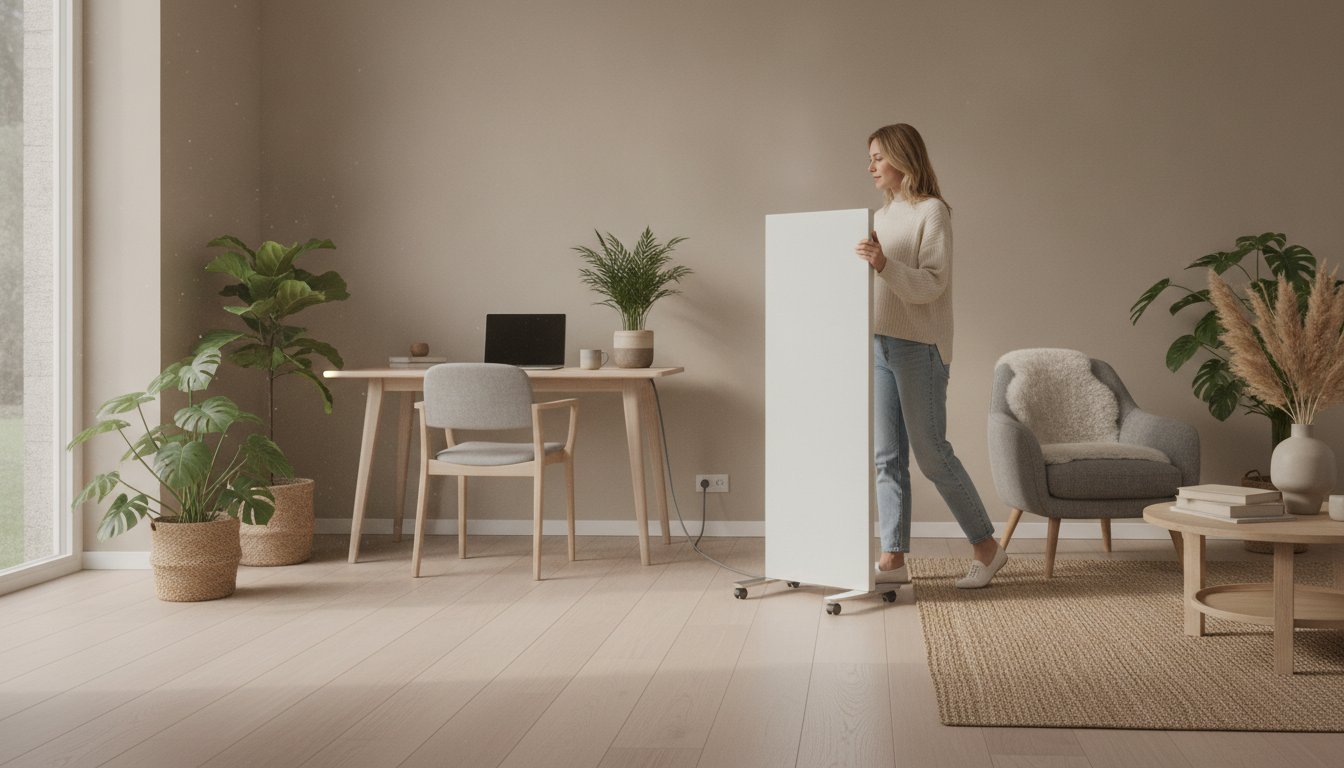
Choose a standing infrared panel when you want flexibility in positioning. Feet or a stand allow an approved panel to stand independently. This may suit a desk or armchair, but needs floor space, cable management and safe clearances. Leaning a wall panel against furniture is not an alternative to an approved freestanding arrangement.
This guide helps you select a practical position, assess capacity and costs and use the heater carefully. It does not assume a fixed gas price, automatic savings or universal coverage. Suitability depends on the model and the room where you intend to use it.
Key points
First identify the occupied spot and provide stable positioning away from walkways. Check approved accessories, protective features and connections. Distinguish personal supplementary warmth from full room heating. Calculate using actual power and running time, and assess existing heating use too.
What makes a panel suitable for standing use?
The manufacturer must approve the panel-and-stand combination. Check foot installation, orientation and floor requirements. Use wheels as instructed and lock them where required. A broad base does not eliminate every tipping risk; impacts, cable pulling and uneven floors still need attention.
The electric element heats the surface, which emits heat through radiation and convection. Warm-up time and surface temperature vary by version. Surfaces may be hot enough to cause burns even on brief contact. A limiter or tip-over device does not make touching or covering safe.
When is portability useful?
For a changing workspace or temporary seating area, positioning can change without wall mounting. Recheck safety after every move. A standing panel occupies floor space and may be less suitable around children, pets or busy passages than an approved fixed alternative. Move it only as instructed, generally after switching off, safe disconnection and cooling.
You can add local comfort without immediately increasing the main heating. That does not mean the main system can always be reduced or costs automatically fall. Consider other users and necessary background heating. If existing systems run unchanged, the panel’s consumption is additional.
Assessing output, controls and protection
Full room heating depends on room heat loss under the desired conditions. Insulation, glazing, ventilation, exposed walls and temperature requirements matter more than floor area alone. Personal supplementary heating also involves distance, panel area and line of sight. Neither 40 to 100 watts per square metre nor a 2.5-to-4-metre range applies to every model and room.
Check which tip-over and overheat protection is actually fitted and how it operates. Origin or marketing names do not prove universal certification. Check the specific product and follow cable, connection and use instructions. If uncertain, have the socket and electrical capacity assessed.
In a bathroom, a minimum IP rating alone does not establish suitability. The manufacturer must permit the application, and the precise location, connection and protection must be appropriate. Have this assessed beforehand. Safe use elsewhere does not automatically permit portable operation in a damp room.
Practical positioning near a desk or seat
Choose a position where heat reaches the user without obstructing movement. A desktop, sofa or cabinet may block some radiation. Do not put a general-purpose panel under a desk without approval: specific clearances and use conditions apply. Keep room to move away from the heater.
A compatible thermostat or timer can help limit unintended continued heating. Check compatibility and unattended-use instructions. Ventilation and cleaning remain necessary: radiant warmth does not eliminate convection, dust or damp problems, and preventing dry eyes or sore throats is not a general product feature.
Choosing a standing panel with our advice
We help private and business end users, installers and wholesalers. Tell us how many people use the area, expected heating periods and existing heating. Photographs of furniture and cable routes help practical assessment. We compare suitable panels, stands and controls without assuming every model fits everywhere.
Check the arrangement with each use
Check stability and that the appliance has not accidentally been covered. Protect cables from damage and trapping. Switch off after use and store only when cooled. After storage, inspect feet, cable and plug. Follow cleaning and maintenance instructions; low maintenance does not remove the need for checks.
Frequently asked questions
How do I calculate electricity costs?
Multiply power input in kilowatts by actual running hours. A 500-watt panel operating continuously at that power for four hours uses about 2 kWh. Multiply by your tariff. With thermostat control, count actual heating periods, not just scheduled availability. Also compare changes in main-heating use.
How many watts for twenty square metres?
Floor area alone cannot determine this. Primary heating needs an appropriate heat-loss assessment; a single seating position also depends on coverage at the user. Share dimensions, insulation and intended use so we can discuss an informed choice.