
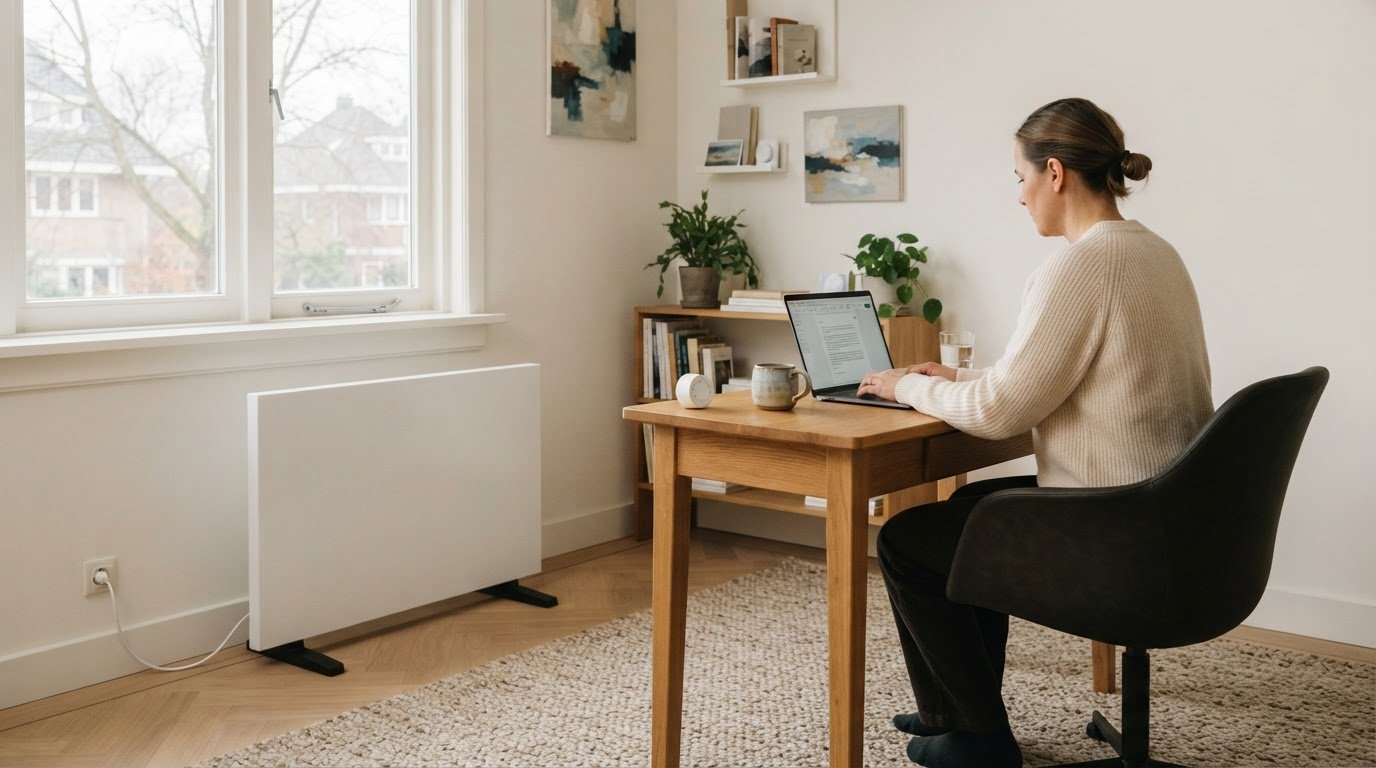
Freestanding infrared heating can be practical when you want to move a heat source or avoid wall mounting. Examples include a workspace, temporary hobby area or changing seating arrangement. Choose an appliance explicitly approved for freestanding use with its designated feet or stand.
Portability does not mean every socket, room or floor is suitable. This guide examines applications, radiant coverage, output and safe use. Lower energy bills do not follow automatically from the heater type; compare total heating use in your situation.
Key points
Check approved feet, stability, clearances and permitted surroundings. Decide whether you need local supplementary warmth or full room heating, then check output and controls. Let the appliance cool and disconnect it safely before moving, as the manual requires.
When is a freestanding model suitable?
A freestanding panel may suit a rented home or workspace where fixed mounting is undesirable. Still check the permitted use and any landlord or employer requirements. Allow sufficient clear floor space without people bumping into the heater or cable. Fixed mounting may be more practical in a busy passage.
Supplementary heating adds warmth where needed. Assess locally whether the main heating can be reduced, considering other occupants and protection against moisture or frost. An additional electric appliance may increase total consumption if the existing heating continues unchanged.
How does a portable panel transfer heat?
The panel converts electricity into heat and transfers it through radiation and convection. People and surfaces absorb some radiation; furniture can block direct warmth. Clear positioning helps coverage, but there is no universal comfortable distance of one-and-a-half to three metres. Follow the model’s safe clearances first, then assess comfort.
Material, mass, surface and construction affect weight and warming behaviour. Glass does not inherently release heat more advantageously than metal; stored heat comes from electricity used earlier. Rear insulation and origin alone do not prove lower overall consumption or safety either. Compare actual specifications, instructions and warranty conditions.
Choosing output for supplementary or primary heating
Full room heating requires capacity matched to heat loss, target temperature and conditions. Floor area alone is insufficient: windows, insulation, ventilation, exposed walls and warm-up needs also matter. Local supplementary heating additionally depends on coverage at the seat. A small panel that warms your legs comfortably may not maintain the whole room’s temperature.
We therefore do not provide a universal table assigning a fixed floor area to 300, 500 or 600 watts. If uncertain, request an assessment of the room and proposed arrangement. Several smaller panels may sometimes suit the layout better, but do not automatically eliminate cold spots or insufficient capacity.
Safe positioning and everyday use
Use a level, stable surface permitted by the manufacturer. Fit feet as instructed and prevent cable trip hazards. Maintain clearance from curtains, furniture and combustible materials. Do not move the heater by pulling its cable or dry clothes on it. Any tip-over or overheat protection does not replace these precautions.
Check which protective features are actually fitted. Surfaces can become hot; keep children and pets away from hot parts and cables. Keep routes away from the heater clear. Do not automatically use a portable appliance in bathrooms or outdoors: its intended use, exact location, connection and protection must explicitly permit this.
Check the socket, combined load and specified connection. Do not use an extension lead or power strip unless permitted by the manufacturer and suitable for the combination. Use only compatible temperature or timer controls; apps or external switches must not bypass safety functions. Follow the model’s instructions for unattended operation.
Advice on a suitable portable solution
We support private and business end users, installation companies and wholesalers. Tell us where the heater will stand, who uses the room and whether you need supplementary or primary heating. Photographs and a floor plan help assess placement and coverage. We then compare suitable models with their permitted accessories and controls.
Flexible use requires a considered routine
After every move, recheck stability, clearances and cable routing. Switch off after use and allow cooling before storage. Clean only as instructed and inspect cable, plug and feet for damage. A panel provides warmth, not allergy treatment or a guarantee of dust-free or healthy air; ventilation and cleaning remain necessary.
Frequently asked questions
Is freestanding infrared always more economical?
No. Electric resistance heating ultimately converts almost all electricity consumed into heat. Differences in comfort and use may affect energy requirements, but must be compared in the same situation. Lower power running longer is not automatically cheaper.
Can the panel be wall-mounted later?
Only if the manufacturer approves that mounting for the model and you use the correct fixings. Removing feet does not automatically make a panel suitable for a wall or ceiling. Check the separate instructions for each permitted arrangement.