
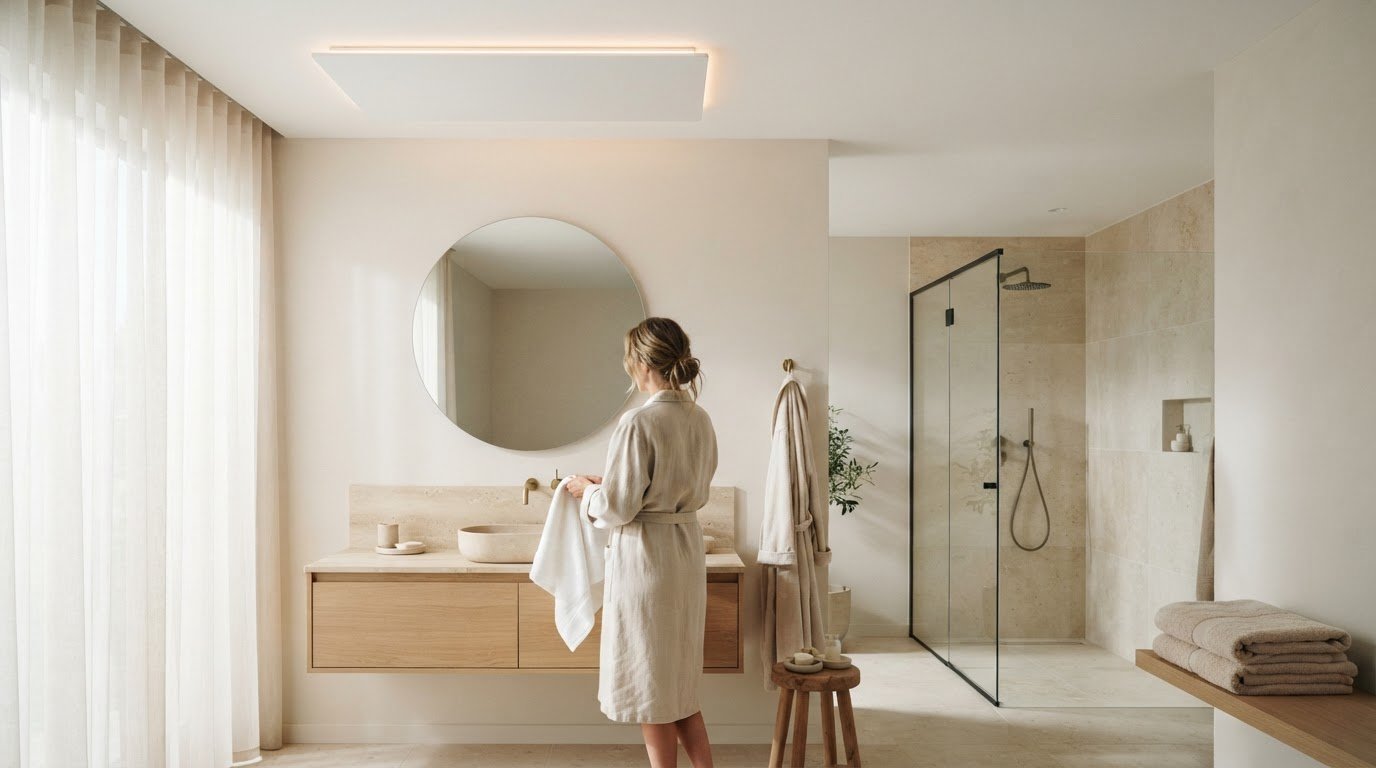
Choose an infrared bathroom heater by asking what heating role you need and where the appliance may be installed. Brief comfort at the basin differs from heating the whole room. A bathroom-heating label does not prove every model suitable for every position.
Compare wall panels, approved ceiling panels and infrared mirrors by application, installation and controls. This guide explains the information needed and when an installer should assess the situation. We advise private and business end users and support installers and wholesalers with product choice.
Key points
Check the exact model’s suitability for the actual bathroom position. Assess mounting, IP protection, product class and connection together. Match capacity to heat loss and use, and choose compatible controls. A mirror finish or high wattage cannot replace installation assessment.
When can infrared bathroom heating suit?
Define where warmth is missing, when and what heating exists. Supplementary heating can improve comfort at an occupied spot. Primary heating must cover the whole bathroom’s demand. Consider insulation, windows, ventilation and target temperature. A locally comfortable mirror does not automatically heat the entire room sufficiently.
How does infrared work and which version suits?
An infrared panel uses electricity to warm a surface. That warm surface releases energy through thermal radiation and also convection. People and surfaces absorbing the radiation become warmer. Perceived warmth ultimately depends on the panel, distance, direction, layout and room conditions. The technology does not remove the need for insulation, ventilation or suitable controls.
Positioning determines which people and surfaces receive radiation. The panel itself also gives convective heat, and warm surfaces heat their surroundings. Radiators likewise combine radiation and convection. Assess comfort at the intended location rather than assume equal warmth in every corner.
Wall panel, ceiling panel or mirror?
A wall panel needs a suitable free wall; an approved ceiling panel can free wall space. A mirror combines reflection with heating, but anti-fog and space heating are different functions. Compare other electric appliances by their actual bathroom approval and installation conditions too.
Check bathroom suitability
Have the exact position, approved product application and electrical installation assessed together. An IP rating alone does not permit use in every bathroom zone. The installation must meet relevant requirements and the manual. Do not assume generic zone distances, earthing requirements or connection methods without assessing product class and installation.
Check wall construction, weight, mounting system, clearances and connection access. Use the specified fixing method; supplied plugs are not automatically suitable for every wall. Have fixed wiring and uncertain mounting assessed by a qualified installer. Viewing height should be practical but cannot replace mounting requirements.
If approval for your model and location is unclear, ask us for the correct documentation first. Have uncertain positioning, fixed connections or existing installation suitability assessed by a qualified installer. A product photo or the word splashproof is insufficient.
Choose output, positioning and controls
Record length, width, height, insulation, cold external surfaces and usage times. Mark basin, shower, bath, doors and free mounting areas on a plan. Assess capacity and permitted positions together; floor area or wattage alone is incomplete. Cabinets and other obstructions can limit direct heat.
Check compatibility between controller and appliance and which functions are actually available. Schedules, occupancy sensors, adaptive start and open-window detection may be useful, but do not work identically on every model. Detection thresholds and switching loads are product-specific. An app or energy-management link does not guarantee savings; incorrect settings can increase consumption.
Suitable controls match heat demand to the desired temperature and operating times. This can limit unnecessary heating. Consumption still depends on factors including heat loss, temperature settings and operating time. A thermostat cannot automatically make an unsuitable panel or poorly insulated room economical.
Prepare a suitable solution with us
Tell us which room you want to heat, when you use it and whether a panel or controls are already installed. Include model details and your preference for local operation, schedules or remote control. Business partners can also discuss product selection across several rooms and the components required. We confirm which functions and combinations are available for the selected model.
Choose around your bathroom
Compare comfort, installation, controls, maintenance and costs for the same situation. Heating does not remove moisture: ventilation and damp problems remain separate issues. Low maintenance is not maintenance-free. Follow cleaning, cooling and inspection instructions and confirm missing information first.
Bathroom heating questions
Is a mirror enough for the whole bathroom?
Not automatically. Check whether the product is designed for space heating and whether the whole system suits heat loss, target temperature and use. An anti-fog function does not prove sufficient room heating.
Does a thermostat always save energy?
Suitable controls can limit unnecessary heating, but no fixed saving is guaranteed. Settings, use, building and the chosen comparison determine the outcome.