
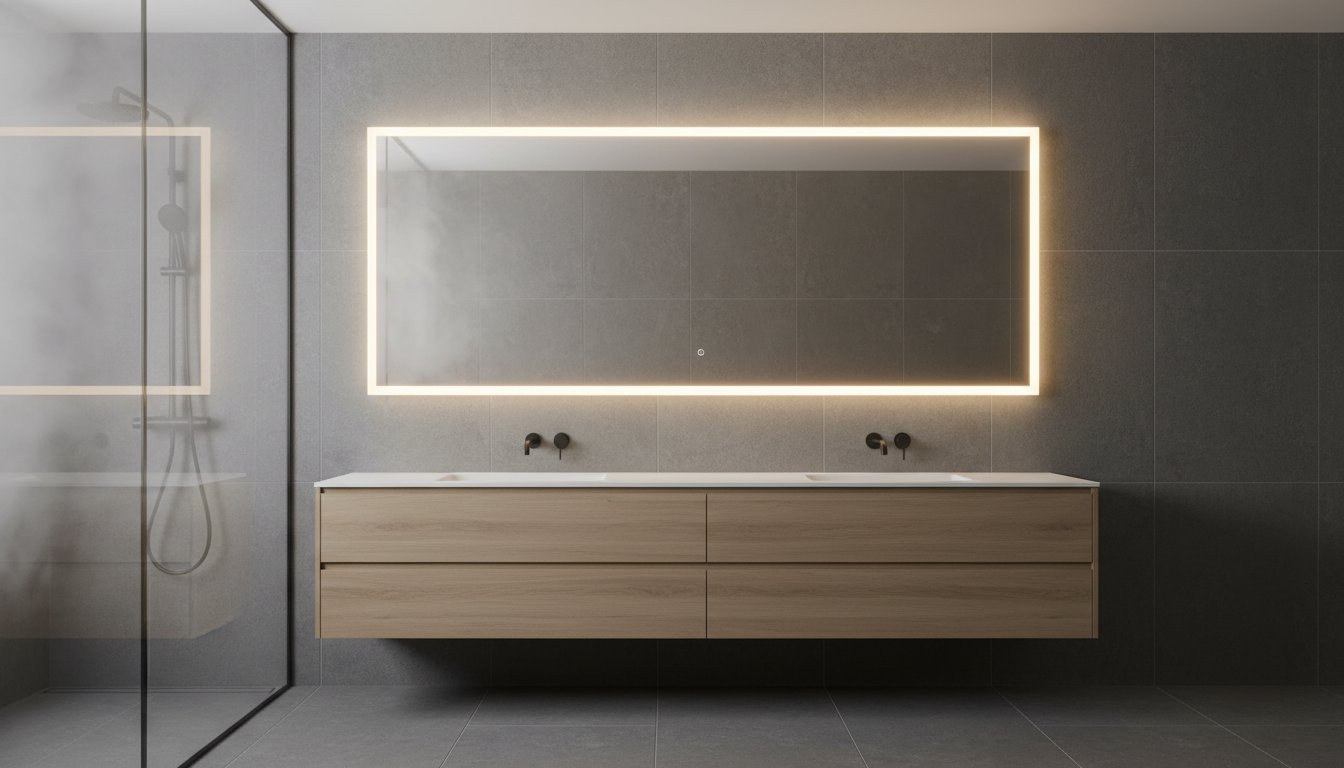
A bathroom mirror can combine reflection, lighting and heating. Check which functions the chosen model actually provides. An anti-fog pad heats the mirror surface; it is not automatically a heating system for the whole bathroom. Even an illuminated infrared mirror does not replace existing heating without assessment.
This guide helps you assess heating, lighting, controls and installation separately. We support private and business end users, installers and wholesalers in choosing suitable products. Share the bathroom layout, existing heating and preferred controls so we can compare relevant options.
Key points
Distinguish anti-fog heating from space heating. Compare heating output, lighting and controls for each model. Have the bathroom location and electrical connection assessed together. Do not assume a fixed clearing time, saving, lifespan or complete radiator replacement without product and room data.
Why combine mirror, lighting and heating?
Combining functions can save wall space and support daily grooming. Assess mirror dimensions and viewing height as well as light colour, distribution, dimming and controls. Lighting is a separate selection criterion: heating output does not indicate suitability for shaving or make-up. Not every illuminated mirror includes heating.
Condensation can form when humid air meets a sufficiently cold mirror surface. Warming that surface can reduce fogging. Results depend on the surface, heated area, moisture production and conditions. A warm mirror does not remove water vapour from the bathroom or replace ventilation.
How infrared mirror heating works
An infrared panel uses electricity to warm a surface. That warm surface releases energy through thermal radiation and also convection. People and surfaces absorbing the radiation become warmer. Perceived warmth ultimately depends on the panel, distance, direction, layout and room conditions. The technology does not remove the need for insulation, ventilation or suitable controls.
Perceived warmth depends on position, distance and surfaces receiving radiation. The panel also emits convective heat, and warmed surfaces transfer heat to their surroundings. Radiators likewise combine radiation and convection. A mirror panel does not automatically make a bathroom dust-free or guarantee health benefits.
Electric resistance heating converts almost all input electricity into heat. This applies to infrared panels and other electric resistance appliances. The radiant share is a different quantity from total conversion into heat. A high radiant share therefore does not prove a fixed reduction in annual consumption.
Anti-fog function or space heating?
An anti-fog function is primarily intended for the glass surface. An infrared mirror designed for space heating can contribute to bathroom comfort. Its name, price or glass thickness does not prove this distinction: check intended use and specifications. Primary heating requires assessment of total heat loss, target temperature, positioning and controls.
There is no universal mirror wattage per square metre of bathroom. Existing underfloor heating or a radiator may remain part of the design. Choose supplementary mirror heating only when its function, connections and controls are appropriate. Do not assume fixed surface temperatures, guaranteed clearing or a lower bill without data for the chosen model.
Installation and bathroom specifications
Have the exact position, approved product application and electrical installation assessed together. An IP rating alone does not permit use in every bathroom zone. The installation must meet relevant requirements and the manual. Do not assume generic zone distances, earthing requirements or connection methods without assessing product class and installation.
Check wall construction, weight, mounting system, clearances and connection access. Use the specified fixing method; supplied plugs are not automatically suitable for every wall. Have fixed wiring and uncertain mounting assessed by a qualified installer. Viewing height should be practical but cannot replace mounting requirements.
Lighting and temperature controls
Check whether heating and lighting can be operated separately and which components are required. Touch controls, dimming, Wi-Fi, an app or a wireless thermostat are not standard on every mirror. Room controls must be compatible with heating; an anti-fog function may have different controls. Follow the combination specified by the manufacturer.
Mirror options and advice for your bathroom
Share dimensions, insulation, ventilation, existing heating and a photo or plan. Specify mirror size, lighting and controls. We help compare products and controls and identify missing information. For customer projects, we also coordinate selection with the installer or business partner. Visits to our premises are not possible.
Choose functions suited to your bathroom
Compare purchase, installation, controls, lighting, consumption and product terms. Expected lifespan is not a warranty, and LED lifetime does not automatically apply to the whole mirror. Low maintenance does not mean maintenance-free. Follow the model’s instructions for switching off, cooling, cleaning and inspection.
Heated bathroom mirror questions
How much electricity does it use?
Use input power and actual operating time. A 600-watt heating function running continuously at full output for half an hour uses about 0.3 kWh. Add lighting and other components separately where needed. This is an example, not a daily consumption forecast or fixed cost promise.
How quickly does it clear?
This varies by model and conditions. Heated area, initial temperature and moisture production affect the result. Check product information rather than assuming a universal warm-up time or completely fog-free glass.