
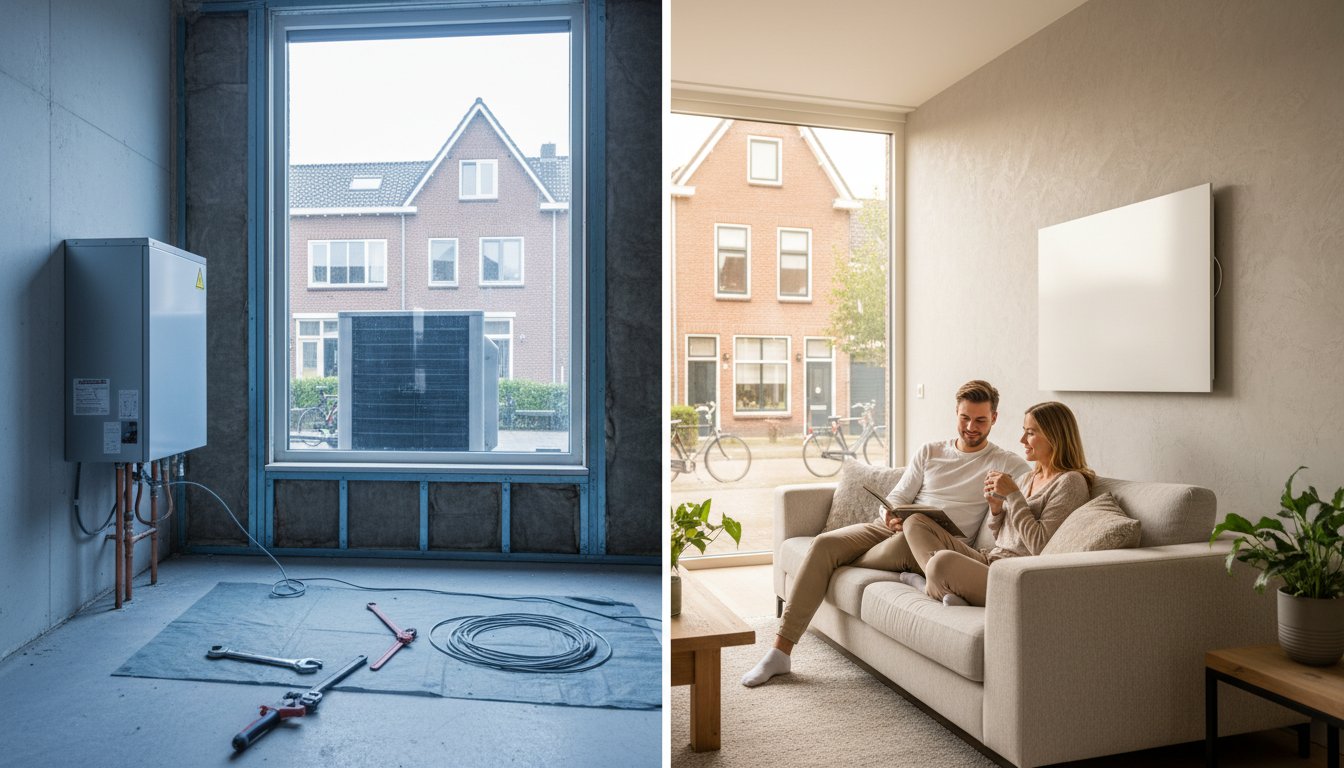
Infrared panels and a heat pump can both provide space heating without gas, but their energy performance differs. Heating a whole home is a different decision from temporarily warming one workstation. Compare the task first, then the systems.
This comparison separates heat demand, comfort, investment and running costs. Neither is automatically best for every building; a fair comparison uses the same rooms, temperatures and occupancy times.
The core comparison
A heat pump moves ambient heat and can require less electricity for the same heat delivered. Infrared panels are electrical resistance heaters and can be practical for targeted use. Easy installation or local comfort does not cancel that energy-performance difference.
Start with the heating plan’s purpose
Define whether you need full space heating, local supplementary heat or a combination. Also consider domestic hot water: infrared panels do not replace that provision. Assess insulation and ventilation for both options, not only for a heat pump.
A heat pump is not necessarily an air-heating system. It may heat water for radiators or floor heating, or heat air through indoor units. The emitters influence response and comfort. Conversely, an infrared panel provides convection as well as radiant heat.
Construction year alone does not determine suitability. An existing home may be suitable for a heat pump after assessment of heat loss, required flow temperature and emitters. Heating a poorly insulated home entirely with electric panels can require substantial electricity.
COP, seasonal performance and radiant share
COP describes heat output relative to electricity input under specified conditions. A relevant seasonal performance is more useful for annual consumption than one favourable test point. Source and delivery temperatures, controls and auxiliary electric heating affect the result.
A panel ultimately converts almost all electricity into heat. Its radiant share describes how heat is emitted and does not replace COP. Heat stored in walls does not create additional heat, and having no water pipes does not prove that higher electricity demand is automatically offset.
Comfort also depends on surface and air temperatures, draughts, position and individual preference. A fixed two-degree reduction with identical comfort cannot be guaranteed. Do not compare one locally heated zone with an entire warmer house as though appliance technology were the only difference.
Compare total costs over the same period
Include purchase, installation, electrical alterations, emitters and any building work. Add calculated energy costs, maintenance, repair risks and relevant component replacement for both options. A generic purchase price or fixed lifespan is not a project quote.
Panels without a fan or fluid circuit may need limited maintenance, but still require cleaning and checks according to the manual. Heat-pump maintenance varies by type and installation. Use actual conditions, not zero maintenance cost versus an unsupported fixed annual charge.
Check grants or tax benefits against current rules and the exact product and project. Do not deduct a potential benefit as though it were certain. Use your own energy tariffs and scenarios where future prices are uncertain.
Four situations for a focused comparison
A well-insulated home usually needs less heat, which can shift the balance between investment and consumption compared with a high-demand building. Low demand does not make a heat pump irrelevant, and an energy label does not automatically prove panels are the cheapest primary heating.
For renovation, assess existing radiators, possible flow temperatures, insulation and space. A heat pump does not always require new floor heating. Infrared may reduce pipework, but electrical capacity and positioning may still need alterations.
For a briefly used workstation or bathroom, a suitable panel can provide local support. Assess response time and whether background heating can actually be reduced. A heat pump does not need to heat the entire home more for every short comfort demand; its controls may have zones too.
In a tall industrial hall, targeted workstation heating may be worth investigating. Select equipment suited to height, environment and use. An industrial radiant system is not interchangeable with a domestic panel. Installers and wholesalers can ask us for project-specific product information.
A combination is possible but not automatically most efficient. Coordinate heat pump, panels, sensors and zones. No universal background temperature guarantees comfort and economy, and auxiliary electric heating must remain in the total consumption calculation.
Solar and storage do not change heat demand
Both systems can use solar electricity. Winter heat demand does not automatically coincide with generation. Annual output from a given number of panels therefore does not prove self-sufficient heating. Include grid imports, self-consumption and the economic value of solar electricity.
A home battery shifts available electricity over time but creates no new energy and does not automatically bridge a low-sun winter. Capacity, power, losses, controls and cost must fit the whole installation. A battery does not automatically make either heating option profitable or carbon-neutral.
Request a proposal that compares fairly
We help private and business end users with product advice and supply installers and wholesalers. Share your purpose, building details and existing installation. Request a comparison under the same conditions, with explicit investment, energy and maintenance assumptions.
Frequently asked questions about choosing a system
Does the electrical supply need altering? Have total simultaneous load, circuits, wiring, protection and supply capacity assessed. Checking only the main connection or a generic current rating is insufficient. One fixed connection recommendation does not suit every project.
Can I install panels myself? Follow the exact model’s manual and have support, fixings and electrical connection assessed. Some units have plugs; others need fixed wiring. Fixed electrical work and necessary checks should be performed by a competent installer.
Which system gives a healthier indoor environment? Heating is not a treatment for allergies, asthma or mental-health conditions. Comfort, ventilation, moisture and cleaning need separate assessment. Air and dust still move with radiant heating; no dust-free or mould-free outcome is guaranteed.