
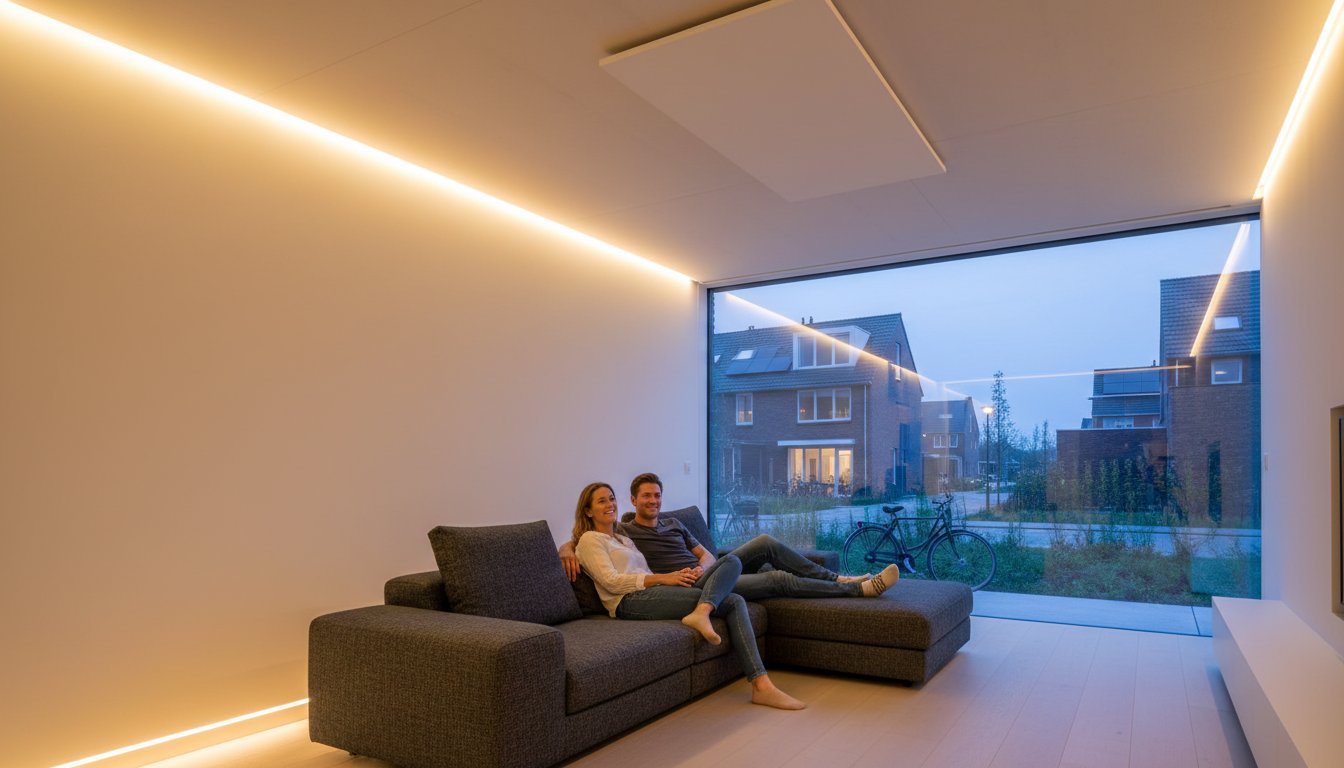
Want to use less gas or heat a room electrically? First compare the heating function, demand and alternatives. Infrared heating can provide local comfort but does not automatically guarantee lower bills or suitability for an entire home. A phased plan helps avoid removing existing heating before the new solution is assessed.
Key considerations
Separate local supplementary heating from full heating. Calculate capacity and total running costs for the project. Check which technology, controls and mounting the model permits. Solar generation, a battery or a quality label does not change building heat demand.
Which infrared heating suits the purpose?
The term covers different appliances: flat panels, compact workstation heaters and radiant heaters for patios or halls. Wavelength, temperature, visible light and permitted application vary. Choose by the model instructions, not a general statement that all long-wave appliances are safe or all short-wave heaters are outdoor-only. An indoor panel and an industrial heater are not automatically interchangeable.
Understand radiation, convection and heat storage
A warm panel releases radiant and convective heat. Their ratio varies by product; conventional radiators also radiate heat. Warm walls and furniture can release heat later, but storage adds no energy and does not stop ventilation or fabric losses. Comfort depends on surface temperatures, distance, clothing, air movement and use. A fixed equivalence of 18 or 19 degrees to 21 degrees is not valid for everyone.
A heating panel does not treat allergies, asthma or other conditions. It does not eliminate air movement or replace ventilation. Warmer surfaces may affect condensation, but leaks, moisture production and mould require assessment of their cause. Skin and eyes can also be affected by excessive heat exposure. Follow usage conditions and prevent unintended contact with hot surfaces.
Assess heat demand, electricity and costs together
For direct electric heating, input power multiplied by actual on-time determines consumption. A 750 W panel, for example, uses about 0.75 kWh in one hour of continuous operation. Use your own tariff; a national average price or fixed heating hours is not a project calculation. Compare purchase, fitting, controls, electrical alterations, maintenance and replacement over a suitable period. A fixed payback time or lower total cost than a boiler or heat pump cannot be established generally.
A heat pump can use environmental heat and require less electricity for the same heat output than a resistance panel. Local supplementary heating may still be practical if other heating is appropriately reduced; include every system. Solar panels and a battery require separate assessment of generation, availability, storage capacity, losses and cost. They do not automatically make winter heating self-sufficient or carbon-neutral. Insulation and limiting heat loss remain important.
Determine output, positioning and controls by room
Assess each room using dimensions, insulation, ventilation, windows, temperature and use. Panel quantity also depends on reach, obstructions and available positions; two smaller panels are not always better than one larger panel. Check structural support, specified clearances and electrical load. Bathrooms, suspended ceilings, desks and high halls have different requirements. Heated mirrors can limit condensation but do not guarantee clear glass; combining floor heating and panels requires coordinated controls and total-cost assessment.
Compare product data and terms
Request exact-model documents for output, temperature, mounting, controls and warranty. CE is not an independent quality mark; any separate test certificate must match the model and tested property. A low price does not prove a product unsafe, and a long warranty does not prove unlimited life. Check actual smart-home integration too: app, protocol, gateway, load and external automation. Google Home, Alexa or WiFi are not universal standards for every panel.
A proposal based on your building
We advise private and business end users, installers and wholesalers. Send dimensions, insulation, schedules, mounting photos and details of existing heating. State whether the aim is temporary comfort, supplementing a boiler or heat pump, or full heating. We help discuss possible products and controls before an order or replacement is committed.
Frequently asked questions about an electric heating plan
Can infrared heat a poorly insulated home? Local comfort may be possible, but high heat demand does not disappear. Is maintenance unnecessary? No: follow cleaning, visual checks and mounting and connection checks in the manual. Is a fixed saving achievable? Calculate it for the actual project and compare all heating used. Must you switch immediately because of a general 2026 claim? Base decisions on current information for the building, not an unchecked blanket obligation in sales copy.