
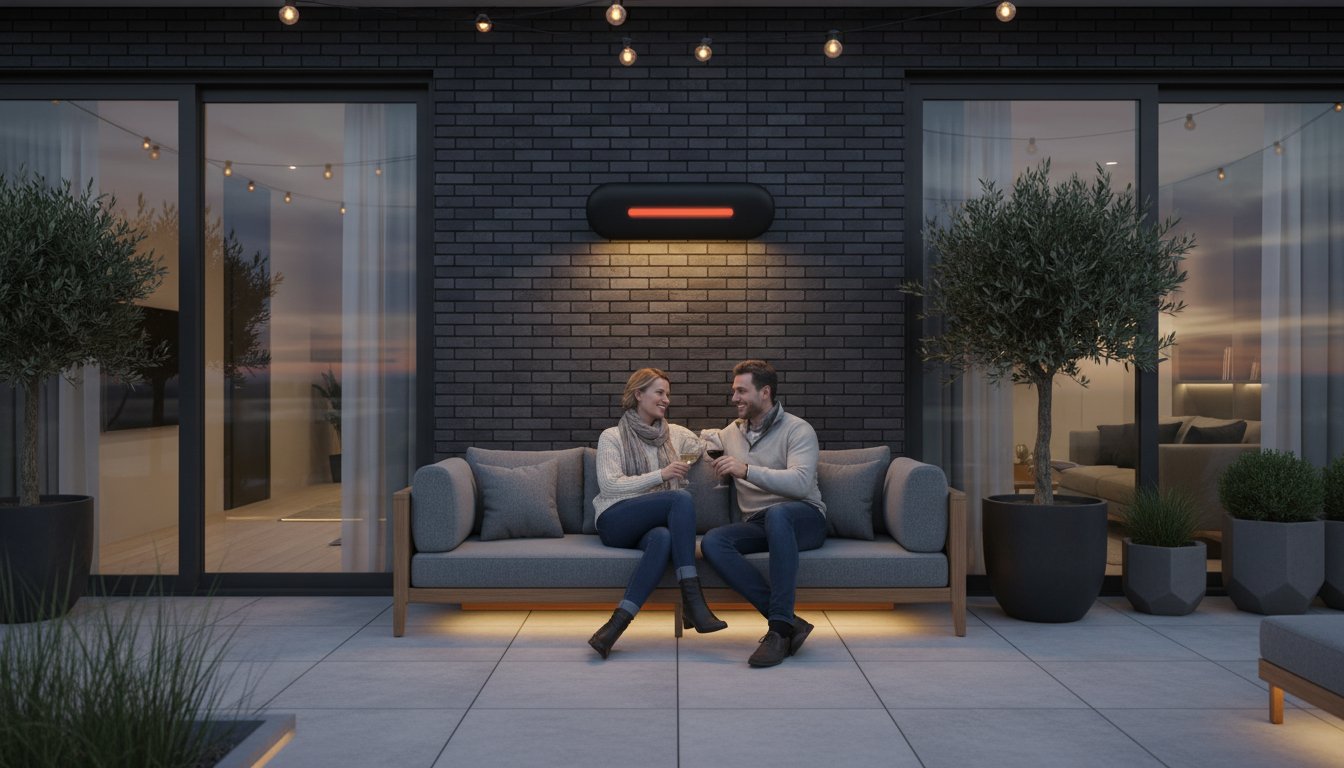
Infrared patio heating can add warmth to outdoor seating. Results depend strongly on wind, shelter, distance and equipment. A heated terrace does not guarantee comfort in every season or weather condition.
This guide compares technology, heated zones, installation and controls for private and business end users, installers and wholesalers preparing patio projects.
Map the outdoor area first
Record seating, canopy, wind, open sides and mounting points. Check each model’s outdoor approval and clearances. Assess supply capacity, protection, cables and controls together. IP or wattage alone is not complete installation advice.
Add outdoor comfort selectively
Outdoor heating differs from a closed room. Radiation can reach people and surfaces without first heating all air. Bodies and surfaces still lose heat to the environment, so wind can reduce comfort even with radiant heaters.
Heat occupied zones and switch off when unnecessary. Outdoor heating adds energy use; electric does not automatically mean efficient or carbon-neutral. Compare gas under equal conditions and actual tariffs rather than assuming a cost ranking.
Distinguish wavelength, light and use
Heaters differ in spectrum, temperature, reflector and output. Short-, medium- and long-wave categories describe technology but do not alone establish coverage or suitability. Check exact-version data.
Lamp heaters may emit visible light. Low-glare labels do not mean every model is completely dark. Low-light or non-glowing equipment may suit sheltered settings, but response and installation conditions vary.
Do not choose solely for promised one-second warmth or absolute wind immunity. Assess seating, distance and shelter. In exposed locations, better shelter or limited use may be preferable to continually increasing output.
Define zones rather than one standard watt factor
Fixed watts per square metre do not suit every terrace. Map seating, season, wind and height. Use manufacturer coverage and installation data within the plan and specify expected conditions.
Separate controllable zones can avoid heating empty areas. Match layout to users and mounting positions. Higher installation needs exact-model assessment, not automatically just a higher-powered unit.
Consumption is kilowatts × actual hours = kWh. A 2,000-watt unit running fully for an hour uses about 2 kWh. Apply your tariff. This is an example, not a universal price or saving.
Assess outdoor placement and electrical safety together
Follow manual clearances to ceilings, walls, awnings, wood, plastics and other materials. Generic twenty-, thirty- or fifty-centimetre gaps do not approve every model. Do not aim outside permitted positions at materials or people.
IP describes enclosure protection tests. It alone does not prove indefinite outdoor exposure, all rain directions or coastal suitability. Assess unit, orientation, cables, connections and exposure together. A canopy alone does not establish universal IP44 or IP65 requirements.
Have total power, simultaneous load, wiring, connection and protection assessed by a competent installer. A 3,000-watt limit is not universal DIY permission. Do not replace a breaker with a C-curve because a heater exceeds 2,000 watts; protection must suit the whole installation.
Dimmers, timers and remotes must suit heater and load. Not every heater dims and dimmer steps and ratings vary. Test controls and shutdown as instructed and keep connections accessible.
Follow cleaning, checks and storage instructions. Cover only a switched-off, sufficiently cool unit if permitted. Check cable, fixings, corrosion and damage. Low maintenance does not promise decades without service.
Advice for gardens, hospitality and project partners
We supply private and business end users, installers and wholesalers. Send photos, dimensions, shelter, use and mounting and connection options. We discuss products and further assessment.
Choose realistic outdoor comfort
A clear proposal specifies model, zone, mounting and controls. Assess whether shelter and use make the desired result achievable. Choose an application without unlimited weather, safety or saving guarantees.
Frequently asked questions about patio heating
Are all black heaters the same? No. Names and technology vary. Check light output, spectrum, recommended environment and response for the exact product. Casing colour does not determine operation.
Is outdoor infrared unlimitedly safe? No. Excessive exposure can thermally stress skin and eyes. Follow distances and permitted positions, especially for children or reduced heat perception. Hot surfaces and combustibles also matter.
How long does an element last? Use manufacturer data and terms. Rated hours do not promise a complete outdoor heater will last fifty years. Environment, switching, electronics and other parts may limit life.