
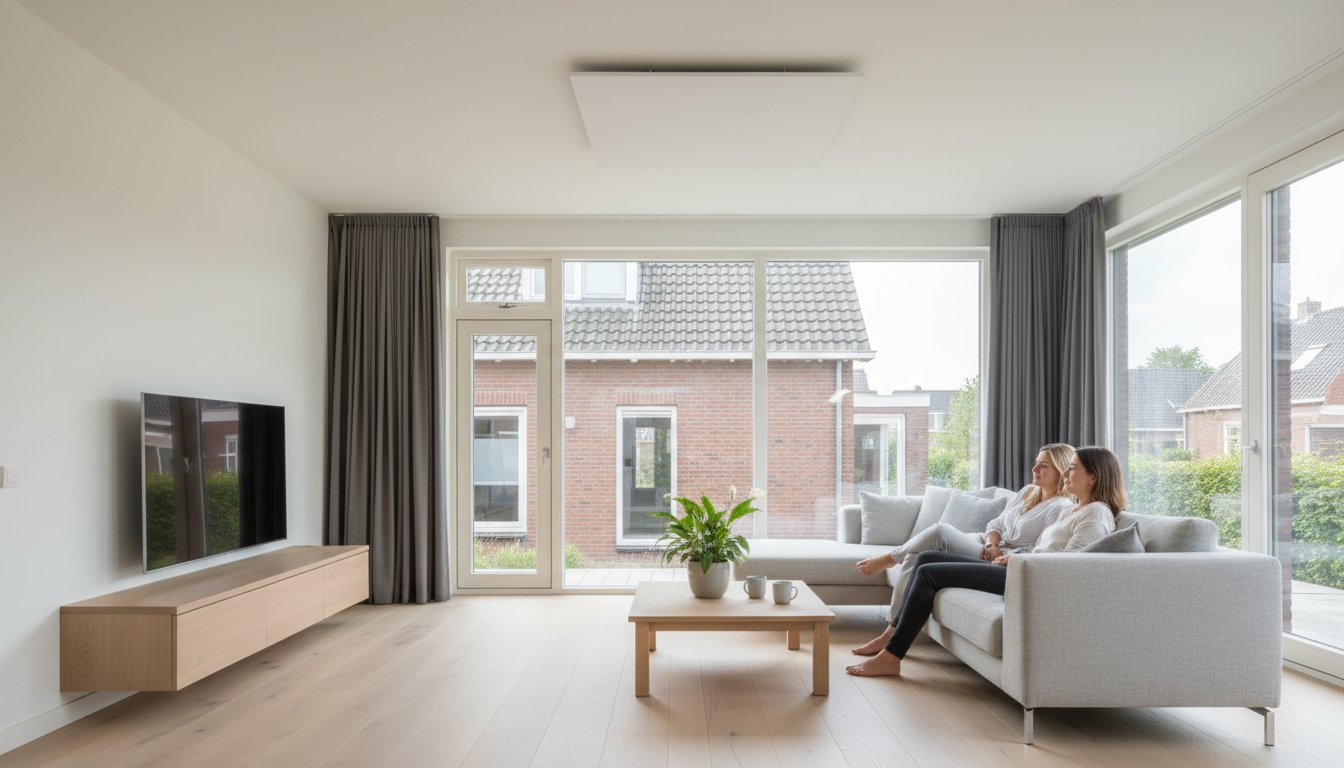
Infrared panels can play a role in an electric heating plan, for example as local supplementary heating or in a room with low heat demand. Their suitability as whole-home heating requires assessment of the building and its use. This guide helps compare technology, comfort, costs and installation without assuming a fixed saving.
Key considerations
Start with heating demand and the places where comfort is needed. Distinguish the radiant heat share from electrical conversion efficiency. Compare the total consumption of all heating and check mounting, controls and electrical connection for the exact model.
What are infrared panels and when might they suit you?
An electric element heats the panel surface, which releases heat through radiation and convection. Radiation warms people and surfaces within reach; warm surfaces and air together affect indoor conditions. Conventional radiators also emit radiant heat. Comparing the sensation with sunshine does not establish an identical spectrum or a health benefit.
Local supplementary heating can be practical for short use of a desk or seating area. Whole-room heating must be able to meet calculated heat losses. Direct electric heating can require substantial electricity, particularly with prolonged use and poor insulation. A heat pump can use environmental heat and therefore require less electricity for the same heat delivery. Include both options in a comparison for your building.
Assess technology, materials and controls by model
Panels are available in metal, glass, mirror, ceramic and printed versions. Construction, element, rear insulation and surface temperature vary by model. Request model-specific output, radiant share, dimensions, weight and permitted mounting information. Material or country of manufacture alone does not establish higher efficiency, a fixed warm-up time or service life. Stored heat is released later but is not additional generated energy.
A thermostat, schedule or zoning system helps match heating to use. Not every thermostat modulates wattage: many controls periodically switch the full load on and off. PID or PWM is not mandatory for every panel. Check load, sensor position, output type, any receiver or gateway and compatibility. WiFi, Zigbee and RF are different connections; wireless control does not remove the need for electrical power wiring.
Compare consumption and total costs on the same basis
Consumption depends on electrical input and actual on-time. As a calculation example, 1000 W operating continuously for one hour uses about 1 kWh. This is not average annual consumption. Use your own tariff and a reasoned estimate of operating hours, heat demand and thermostat behaviour. Compare all heating at equivalent comfort; otherwise a second heater may simply add consumption.
Include purchase, fitting, electrical alterations, controls, replacement and maintenance in total costs. A panel without a fan or liquid circuit may need limited maintenance, but cleaning and checks remain necessary. Free maintenance or fixed annual savings are not general product characteristics. Solar electricity can cover some consumption when available; winter heat demand and generation do not automatically coincide. Solar panels do not automatically make the system carbon-neutral.
Plan output, quantity and mounting together
A fixed W/m² or W/m³ value does not replace a heat-loss calculation. Include dimensions, insulation, windows, ventilation, exposed surfaces, desired temperature and usage times. Then determine feasible mounting positions and directions. A ceiling location can free wall space but is not best or permitted for every model and room. Furniture and other obstructions can limit reach. Lower air temperature does not give everyone the same comfort; a fixed comparison such as 18 versus 21 degrees is not universally valid.
Follow the model instructions for substrate, brackets, load-bearing capacity and clearances. Weight alone does not establish whether plasterboard fixings are adequate; have the whole mounting assessed. Also check total circuit load, wiring, protection, thermostat and any fixed connection. A plug does not automatically make a complete heating project plug-and-play. In a bathroom, appliance, position, moisture exposure and connection must all be suitable; an IP rating alone is not general permission.
Advice for end users, installers and wholesalers
We help with product selection and project preparation for homes, offices and other business premises. A small desk panel, ceiling panel and industrial heater are different products with different conditions of use. Send photos, a floor plan, insulation information and usage times. Installers and wholesalers can also discuss model codes, controls, wiring plans and scope of supply with us.
Prepare a suitable heating proposal
Choosing electric heating starts with the complete plan. Compare alternatives, check product documentation and match capacity, installation and controls. Ask us for a proposal for your home, business or customer project so the application can be discussed before parts are ordered.
Frequently asked questions about infrared panels
How soon will you feel warmth? It depends on model, starting temperature, distance and positioning; do not assume one time for all panels. Is a panel safe for skin and eyes? Follow permitted distances and duration: hot surfaces and intense exposure can cause harm. Panels do not treat allergies or asthma and do not replace ventilation. How long will they last? Check model documents and warranty terms; expected life is not a guarantee and does not establish the life of every controller or connection component.