
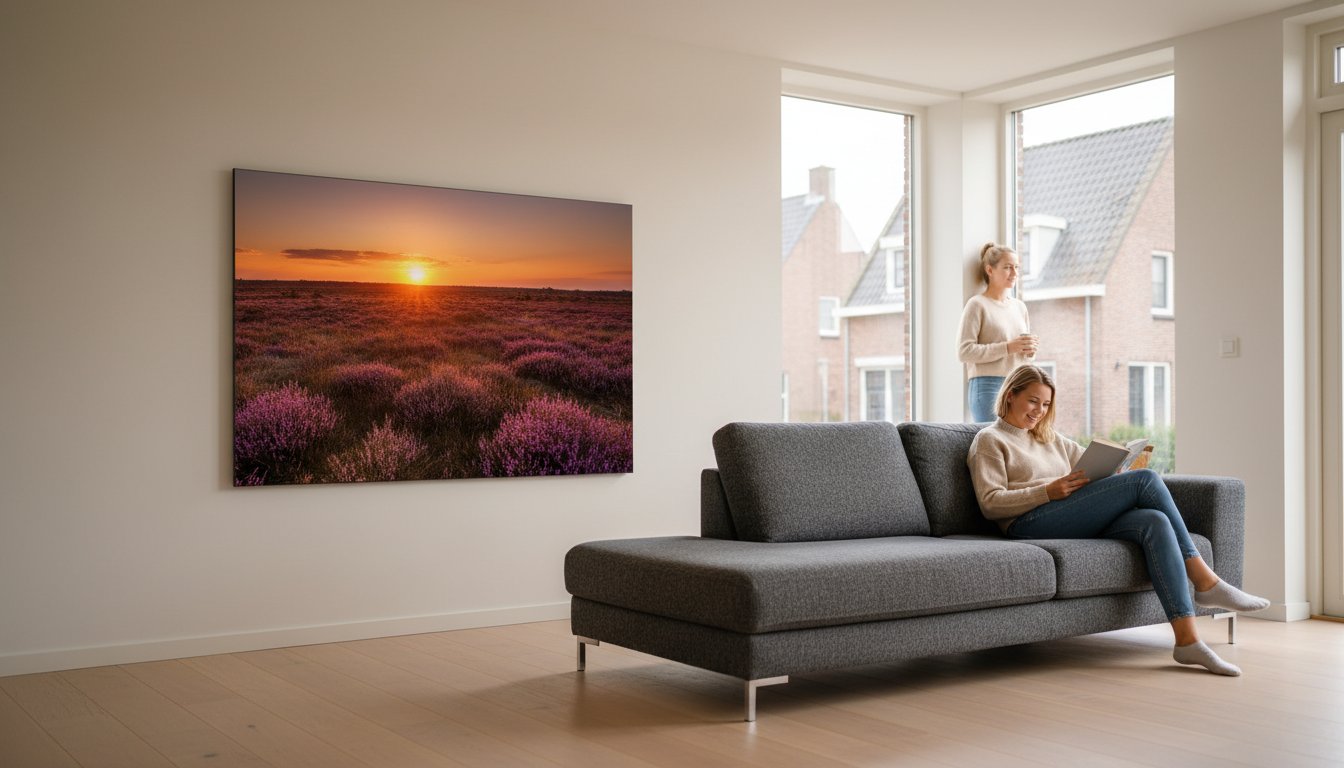
An infrared photo panel combines electric heating with an image. Start with heat demand and permitted mounting, then select the panel size and artwork. An attractive print does not establish lower consumption, fixed colour durability or suitability for every room. This guide helps prepare the heating plan and printing together.
Key considerations
Choose a printed version approved by the manufacturer. Match output, size and mounting to the project. Have resolution, cropping, colours and image rights checked before production. Confirm printing terms, delivery time and warranty in writing.
What is an infrared photo panel?
An electric element heats the panel surface, which releases radiant and convective heat. The image forms part of the designed finish. The panel remains a heating appliance even if it looks like a picture. Do not cover it with a loose photograph, fabric or film, or paint or sticker an ordinary panel without manufacturer approval. The surface can become hot; consider children, pets and nearby materials.
Assess printing and heat output for each version
Ink, coating and substrate must suit the exact appliance and operating temperature. Use model-specific documents for emissivity, heat output, warm-up time and any emissions testing. There is no general guarantee that every print lets radiation pass unhindered, produces no odour or has the same radiant share as a white panel. Radiant share also differs from electrical conversion efficiency. An image does not reduce room heat demand.
For colour durability, compare the terms of the specific printing process rather than relying on labels such as UV-resistant. Sunlight, cleaning, use and material can affect the result. A fixed fifteen- or twenty-year life for all prints is not established. Ask which warranty covers image, coating, panel and controls and which conditions are excluded.
Choose output, material and image format together
Determine output from heat loss, insulation, windows, ventilation, desired temperature and use. A standard W/m³ table or fixed extra margin is not a complete calculation. More watts do not automatically mean fewer kWh. Compare metal and glass using model data: weight, dimensions, finish, mounting and controls. Glass is not automatically permitted in every bathroom and metal does not always heat faster. Match landscape or portrait artwork to a permitted mounting orientation.
Prepare positioning and connection carefully
Check model brackets, load-bearing capacity, substrate and clearances. There is no universal mounting height, radiation angle or installation time for all photo panels. Keep furniture and curtains clear and have electrical load, cable routing and controls assessed. Fixed wiring must be appropriately installed. For damp rooms choose an approved model and assess the complete position and connection. A standard distance from shower or bath does not replace that assessment; heating does not fix leaks or ventilation problems.
Prepare your artwork and custom order
Send the original file with the desired panel dimensions and orientation. Suitable pixel dimensions and resolution depend on print size, cropping, viewing distance and producer requirements; one pixel or DPI minimum does not suit every panel. Request crop approval and a proof before production. Screen colours may differ from the printed result. Use only images for which you hold the required rights and permissions, including logos and photographs of people.
We advise private and business end users, installation companies and wholesalers on combining heating and artwork. Provide heating needs, room details, mounting points, desired size and the image file. Confirm which changes remain possible after approval and the terms for custom work, delivery and warranty. Do not assume all consumer rights are excluded or that returns are unlimited; have the terms for your order clarified beforehand.
Request a proposal for your printed panel
Send us your technical details and artwork requirements before ordering. We can discuss available versions and the components, controls and printing terms included in the proposal. This keeps the application as important as the image.
Frequently asked questions about photo panels
Can the print be cleaned? Switch off, let the appliance cool and follow the model instructions for cloths and cleaning agents; do not automatically use water or solvents. How long will the image look good? Request evidence and terms for the exact version rather than one lifespan for all images. Can a photo panel provide primary heating? It requires the same complete heating plan as an unprinted panel. The image does not make output, consumption and safety secondary to design.