
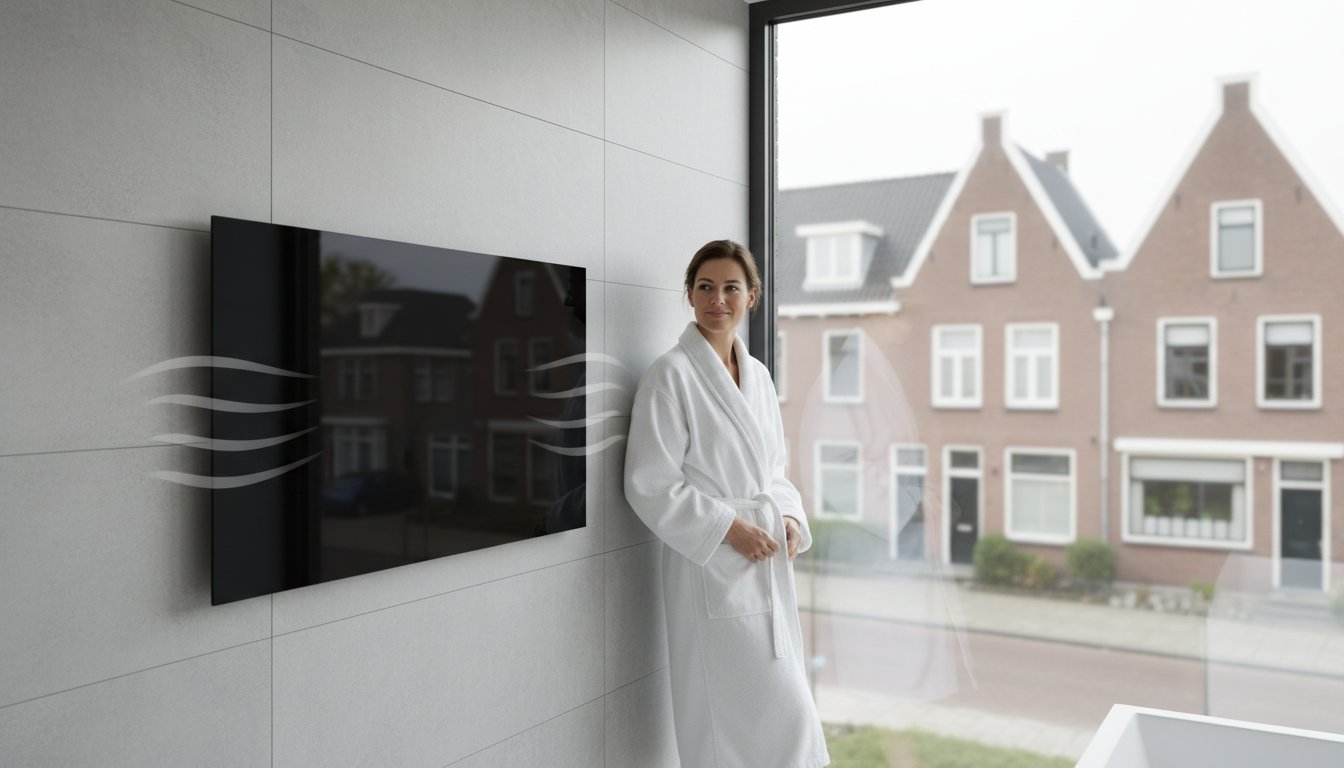
An infrared panel can provide bathroom comfort if the equipment, placement and electrical installation suit the conditions. Limited space, moisture and access to hot surfaces make the choice different from an ordinary living room.
Start with bathroom use and the exact appliance location. A mirror or ceiling model is not automatically suitable for every bathroom. Have the complete arrangement assessed before ordering or removing an existing radiator.
Key considerations
Check suitability, electrical protection and mounting together. Size heating from heat loss and use schedules. Maintain ventilation and use towel rails only when approved for the model.
What warmth can you expect?
The panel transfers radiant heat to people and surfaces and also warms the air by convection. Placement, distance, capacity and existing temperature affect comfort. A warm panel does not mean the entire bathroom or floor has reached temperature.
A panel does not replace ventilation or guarantee a mould-free room. Warmer surfaces can affect condensation, but recurring damp requires investigation of ventilation, leaks and building defects. Heating does not treat allergies or make the air dust-free.
Assessing suitability and electrical safety
Determine required protection from the model, mounting position, water exposure and complete connection. An IP rating describes particular enclosure protection but does not authorise every location. Do not infer a bathroom zone from one distance to a shower or basin alone.
Have a competent installer assess applicable installation rules, supply, protection and connections. Include any receiver, thermostat, LED components and joints. A suitable panel does not make an unsuitable plug connection or controller suitable for a bathroom.
Consider hot surfaces, children and people unable to react or move away quickly. Observe required clearances and do not cover the appliance. Ceiling models also require assessment of structure, fixings and maintenance access.
Mirror, glass, metal and accessories
A heated mirror can combine reflection and heat output. The heated area and room-heating capacity vary by model. Condensation-free visibility is not guaranteed in all conditions; consider ventilation and use.
Glass, metal, colours and printing offer design choices, but not every version is approved for bathrooms. Check dimensions including fixings, weight, connection and permitted orientation. A ceiling panel does not replace underfloor heating or guarantee coverage of the entire floor.
Use a towel rail only if approved for the exact panel and follow textile and clearance instructions. Do not drape towels directly over an ordinary panel. An accessory may affect heat available to the room; include this in the design.
Sizing without a generic rule
Determine heat loss at the desired temperature and outdoor conditions. Include insulation, glazing, ventilation, adjoining spaces and warm-up requirements. Volume multiplied by a generic factor is insufficient. A fixed-factor example is not a recommendation for every bathroom.
Extra capacity can affect warm-up but does not guarantee lower total consumption. Insufficient capacity may fail to reach the desired temperature. Several panels also require consideration of electrical load, coverage and permitted positions.
Coordinate mounting and controls
Prepare installation according to the model’s instructions. A plug does not make every bathroom location suitable. Conceal wiring only where material, temperature and access permit. Use approved brackets and have the substrate and concealed services checked.
Choose compatible controls with a suitable sensor location and switching equipment for the total load. Match schedules to use and actual warm-up. Wi-Fi, occupancy sensors and consumption measurement depend on the model and guarantee neither a precise comfort deadline nor lower bills.
Advice for your bathroom or project
We help private and business end users and support installers and wholesalers. Send a plan or photo, insulation details, schedules and existing heating information. We can discuss suitable equipment and further assessments needed for a proposal.
Frequently asked questions
How quickly does it warm up? This depends on model, placement and starting conditions. Panel warm-up is not the same as heating all air and building surfaces. A fixed number of minutes is no guarantee for your bathroom.
Is a panel cheaper than a towel radiator? Compare the same demand and hours using appropriate tariffs and system data. Towel radiators may be electric or hydronic. Heat-emission type alone does not prove lower costs.
What maintenance is needed? Follow instructions for cleaning and inspecting the appliance, connections and controls. Let it cool where required and avoid unsuitable cleaners. Lifespan and warranty are assessed per product.