
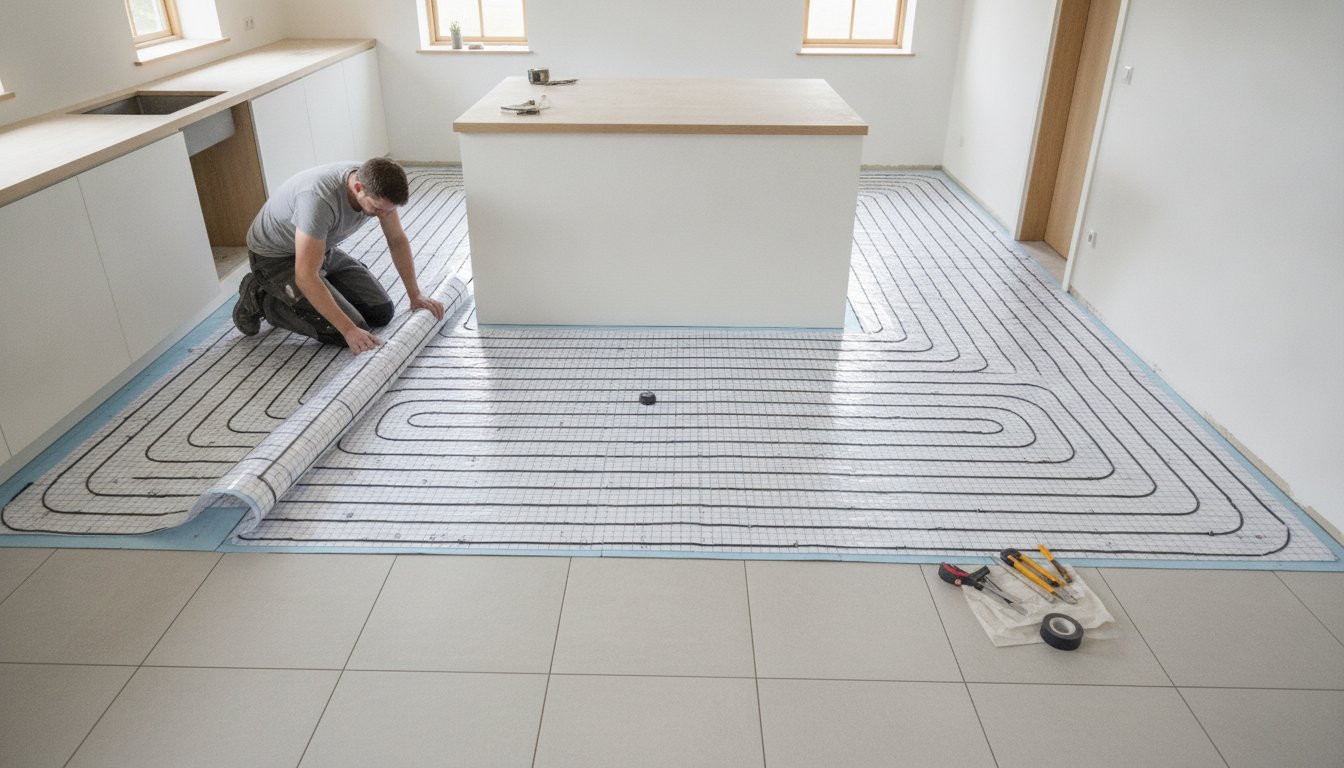
Electric underfloor heating mats can suit a new tiled floor or renovation where floor comfort matters. The choice involves more than unrolling a mat: available height, substrate, insulation, floor finish and controls must work together. This guide helps organise preparation and comparison with other floor systems.
Key points
Measure the net heated area and check the complete floor build-up. Select output and controls according to use and instructions. Heating cables must not be shortened or crossed. Record required test results and the layout before finishing the floor.
When are heating mats an option?
A mat supports a heating cable in a fixed pattern. The cable heats the surrounding floor construction, which then releases heat into the room. A warm floor can provide supplementary heating. For main heating, available floor output must meet calculated demand within the floor’s temperature limits.
In renovation, total height includes insulation if used, adhesive, levelling and new finish. Mat thickness alone does not establish whether doors and thresholds can remain. Drying and curing times also prevent a universal one-day installation promise.
Assess output and floor construction together
Watts per m² describe installed electrical power per heated area. This does not guarantee room temperature or low consumption. Selection depends on heat loss, net coverage, insulation and permitted floor temperature. No fixed wattage is automatically main heating.
Suitable insulation can limit heat flow into the substrate but does not eliminate every loss. Check compressive strength and compatibility with the whole floor. Tiles, stone, wood, laminate and vinyl have different requirements; approval from both heating-system and flooring suppliers is needed.
Mats, loose cables, film or hydronic heating?
Mats provide predefined cable spacing. Loose cable may suit irregular areas if specified spacing is observed. Film systems have their own requirements for dry or other approved build-ups. Beneath a finish, both mats and film transfer heat through the floor; film does not radiate unobstructed through every material.
A hydronic floor with a suitable heat source can have different operating costs and installation requirements. Compare purchase, preparation, controls, maintenance and expected energy at the same demand. Electric mats are not automatically the cheapest to run or fastest option for every project.
Layout, testing and commissioning
Prepare a layout before ordering, excluding prohibited zones under fixed furniture. Check substrate and compatible materials. Only the mesh may be cut as instructed for turning; never the heating cable. Cables must not cross, overlap or be spaced closer than permitted.
Have specified electrical checks performed and recorded at the required installation stages. Resistance alone does not establish complete electrical safety; required insulation and protective checks also matter. Keep photographs, cable readings and sensor location before the floor is covered.
Choose compatible controls and the required floor-temperature limit. Wi-Fi is not essential for good control. Respect drying times and start-up protocols for adhesive, levelling and finish; do not use heating for unauthorised accelerated drying. Have connection and protection assessed by a competent installer.
Our advice for your floor project
We help private and business end users, installers and wholesalers. Share the plan, net heated area, floor construction and intended use. We advise on materials and controls. Combining wall or ceiling panels may be useful but the whole system must be assessed for comfort, capacity and consumption.
Complete preparation avoids surprises
Before buying, establish the permitted floor construction and responsibility for planning, testing, connection and finishing. Ask about warranty and keep completion records. Compare the complete configuration and work in a quotation.
Heating mat questions
How do I calculate consumption?
Multiply installed kW by actual on-hours. Installed output is not average daily consumption. Insulation, weather, setting and floor construction affect how long controls demand heat. Use your own electricity tariff for cost.
How quickly does the floor warm?
This depends on complete construction, starting temperature, insulation, finish and output. A general 10–20 minute promise is therefore insufficient. Follow the approved start-up protocol and adjust schedules to the measured response if necessary.