
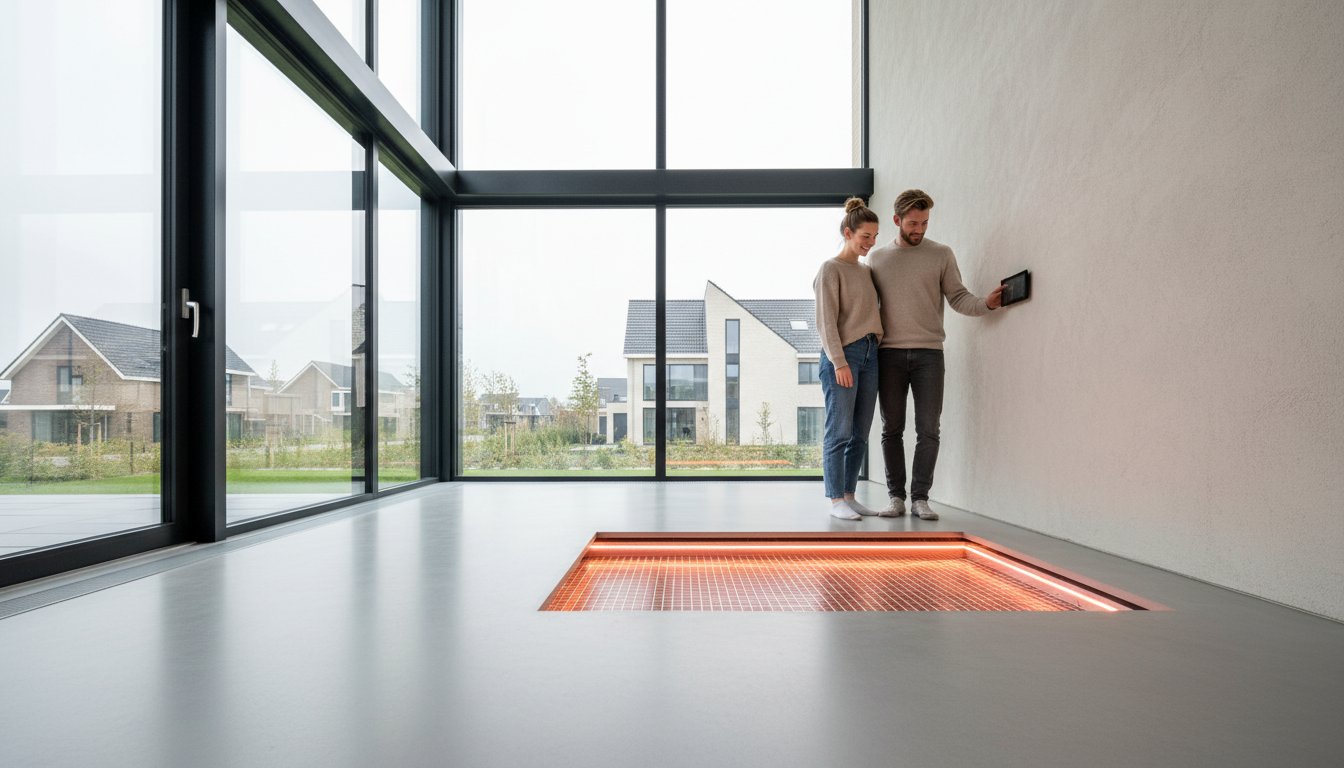
Electric underfloor heating requires a complete floor plan. Suitability depends not only on the heating element but also on the substrate, insulation, finish and controls. First distinguish a warm floor used as a supplement from heating intended to maintain the whole room temperature.
Key points
Choose a system demonstrably suitable for the complete floor assembly. Film and cable mats are not freely interchangeable. A thin heating element does not establish the total build-up height, consumption or installation time.
How electric underfloor heating works
Electric resistance elements heat the floor assembly. Heat travels through the layers above to the floor surface, which then releases heat into the room. This differs from an exposed infrared panel that can radiate directly towards the user. The air also warms up. The system does not make the room dust-free or treat allergies.
Comparing film, cables and mats
Some film systems are intended for specific dry floor assemblies; cables and mats may, depending on the product, be embedded in approved adhesive, levelling or screed layers. Check the instructions for both the heating and floor finish. Not every film is suitable beneath every vinyl, timber or tile product. Insulation, protective layers and any moisture barriers must also suit the combination.
Assessing use and available floor area
Determine which parts of the floor may actually be heated. Fixed cupboards, sanitary fittings, floor anchors and insulating coverings may create restrictions. For main heating, the permitted heat output of the complete floor must cover calculated heat loss. Additional power may be limited by the finish’s temperature limits. Supplementary heating is a design choice, not an automatic solution for every room.
Layout, checks and controls
Record heating runs, connections, sensor and unheated areas before covering the floor. Have the required measurements and checks performed at the specified stages and keep the layout plan. Install the sensor for access and replacement as the system requires, without treating replaceability as a universal guarantee. The thermostat must suit the load and sensor type and limit floor temperature according to the strictest applicable product conditions.
Have the electrical installation and wet-room protection assessed by a competent professional. No universal 2,000- or 3,000-watt threshold determines what every existing circuit can safely supply. Observe drying and curing times for adhesives, levelling compounds and screeds: heating must not automatically be switched on immediately after installation.
Advice for your flooring project
We help private and business end users, installers and wholesalers bring together the necessary product information. Send a floor plan, substrate and finish details and the intended use. We can then discuss the system, components and any further assessment needed. Low costs or fast installation cannot be promised without project details.
Compare consumption too
For a cost comparison, use actual power and operating time with your electricity tariff. A fixed annual consumption for an average bathroom is unreliable without usage and heat-loss data. Compare other heating options at the same comfort level too. Thin film or a smart thermostat does not prove automatic savings; solar generation is not available at every heating moment.
View electric underfloor heating · Request advice and a quotation
Frequently asked questions
Can underfloor heating go beneath vinyl or wood? Only when both manufacturers permit the complete combination. Check thermal resistance, temperature limits, installation method and controls. A general 27°C limit or the name “infrared film” does not prove suitability for every floor.
How quickly does the floor warm up? That depends on the complete assembly, starting temperature, heat loss and controls. Element thickness alone does not predict warm-up time. Have the total build-up height assessed too, including underlayers and finish.