
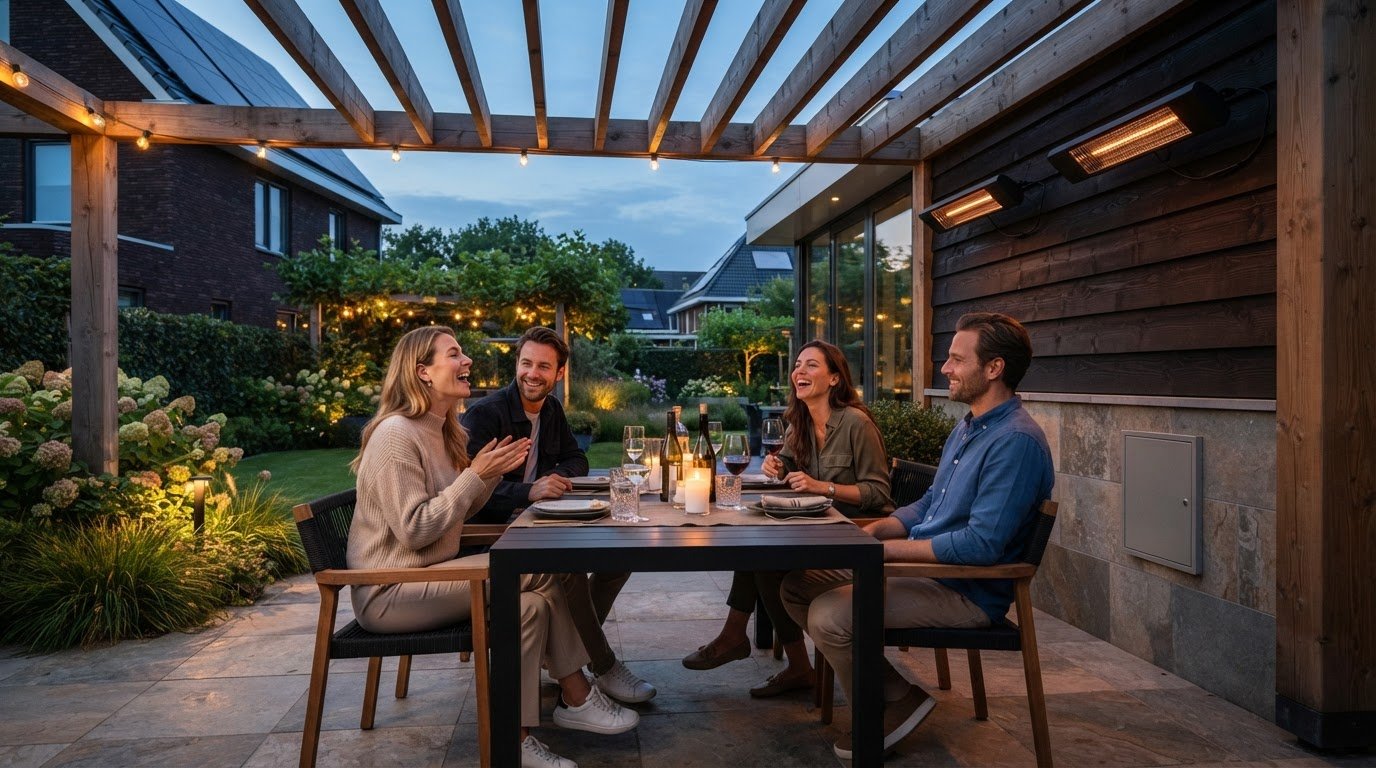
Choose electric patio heating for the seating area you want to use, not the largest number on the box. Shelter, wind, distance, visible light and controls matter alongside output. This guide helps plan the electrical setup and everyday use for home or a hospitality terrace.
Start with a plan and a list of appliances using electricity simultaneously. Then compare suitable heaters and controls. We support private and business end users, installers and wholesalers with selection and identify what the installer still needs to assess.
Key points
Heat only occupied areas and times. Check outdoor approval and electrical requirements per model. Calculate costs from actual kWh and your tariff. An IP code, dimmer or low nominal output alone guarantees neither suitable positioning nor low costs.
When does electric patio heating suit?
An electric heater needs no gas cylinder at the appliance but does require suitable electrical supply. It adds energy use for outdoor comfort rather than replacing home heating. Sustainability and costs depend on heater, supply, operating time and actual need.
Compare infrared technology and visible light
Short, medium and long wave describe parts of the infrared spectrum, not quality classes. The complete heater, reflector and arrangement determine distribution. Assess the model’s stated application, visible light and mounting data for your open terrace or sheltered veranda.
Infrared radiation can reach people and surfaces without first warming all outdoor air. However, no terrace arrangement is independent of its surroundings. Wind cools people and surfaces and affects perceived warmth. Do not directly equate an open terrace with a sheltered veranda or enclosed garden room.
Consider visible light and viewing direction as well as heat. Low-glare does not necessarily mean invisible light. A dark heater without a visible glow still needs assessment of application and position. Ask about the actual version and permitted conditions rather than follow a universal ranking of technologies.
Capacity and placement for your seating
Measure the occupied seating area and record tables, routes, roof, open sides and wind direction. Check fixings and obstructions. Choose heater quantity and type together with direction, distance and permitted height. A generic watts-per-square-metre figure cannot replace this assessment.
Several heaters can serve separate seating areas, but their coverage must match the layout. More watts do not automatically fix poor positioning. Changing tables or large terraces may benefit from separate zones if appliances and controls support this.
Prepare installation and maintenance
Assess total simultaneous power together with supply, protection, wiring and other loads. A spare socket does not prove a powerful heater or several appliances can be connected together. Do not use a generic circuit rating as a design calculation; have uncertainty assessed by a qualified installer.
Check fixings and clearances in the manual, especially around wood, umbrellas, fabrics and furniture. The IP code describes protection against solids and water but does not guarantee every outdoor location. Assess connection, controls, corrosion conditions and manufacturer-permitted exposure too.
Use, controls and costs
Check dimmer, timer, receiver and sensor compatibility. At continuous full power: kilowatts × hours = kWh. A 2 kW heater operating fully for two hours uses about 4 kWh. Multiply actual use by your tariff; a dimming level cannot be converted into an exact saving without product data.
Clean and inspect only as instructed. Switch off and allow cooling where specified. Low maintenance does not mean fixings, cables, elements or controls never need attention. Check outdoor storage and protection conditions rather than routinely covering every heater.
Prepare a patio solution with us
Send terrace dimensions, photos, shelter and intended seating. Include mounting points, hours and known electrical data. We help compare heaters and controls and discuss supply for your terrace or customer project. Advice is available remotely; visits to our premises are not possible.
From selection to daily use
Ensure mounting and connection are correct before use. Then check seating coverage and practical controls. Match operation to occupancy and weather and compare comfort with actual consumption. There is no universal best heater or guaranteed lowest bill.
Electric patio heating questions
What wattage suits 15 square metres?
Floor area alone cannot reliably answer this. Assess occupied seats, shelter, wind, distance, mounting and model coverage. Ask for a comparison using these details.