
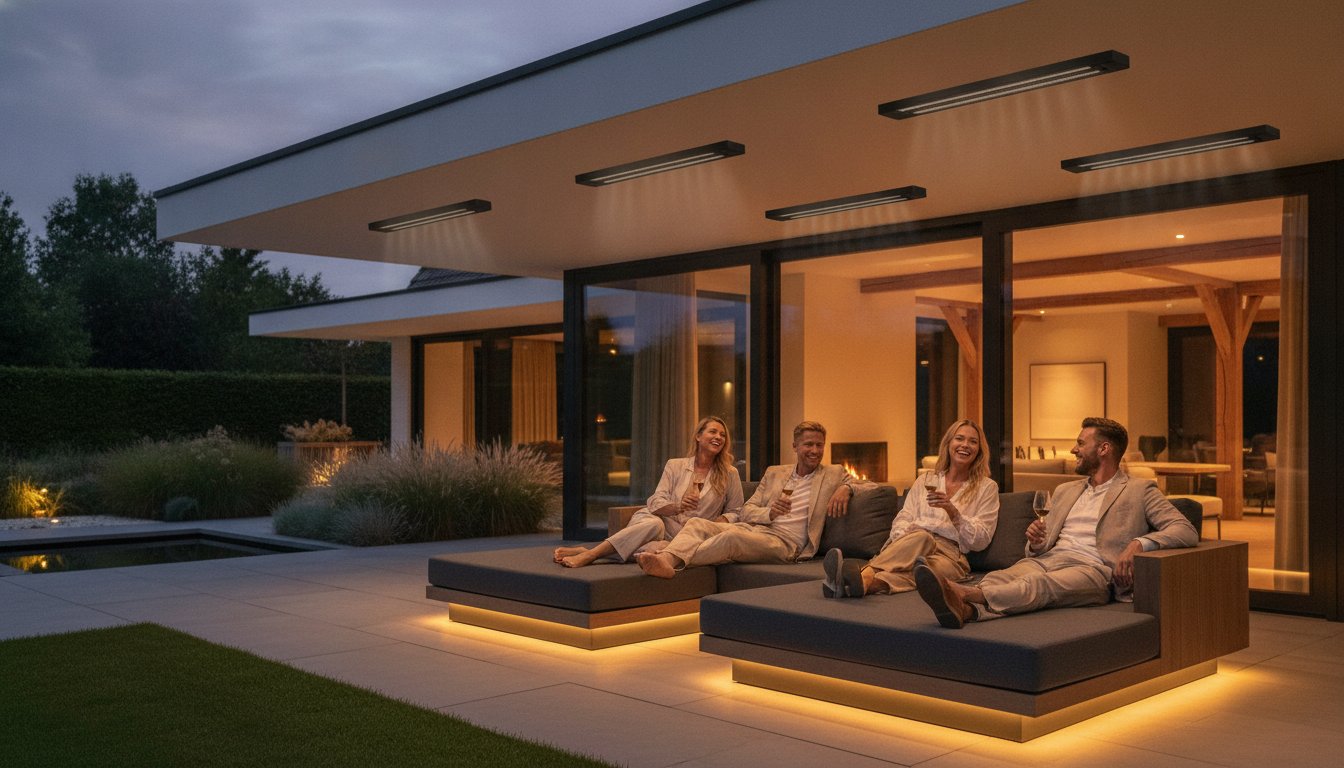
Illustration: the light beams beside the patio heaters have been added. They show direction schematically and do not measure heat coverage.
The best patio heating suits your seating, shelter and mounting position. High wattage alone does not tell you whether guests will be comfortable. First map the terrace: open sides, wind, canopy, table layout and available electrical connection. Then choose an appliance the manufacturer intends for those conditions.
This guide helps compare technology, visible light, controls and installation for a private garden, veranda or hospitality terrace. We advise end users and support installation companies and wholesalers with product selection and terrace-project preparation.
Key points
Use these five questions to choose the best patio heating:
- Where do users sit? Map seats, distances and open sides.
- Where may the heater be mounted or stand? Check fixings, shelter and clearance.
- What heat and light effect do you want? Compare the version in the intended position.
- How do you want to control it? Choose only compatible controls and accessories.
- Is the electrical installation suitable? Have output and combined load assessed.
An IP rating is not unlimited protection against weather. Wind, distance and seating position continue to affect comfort. Do not assume universal wattage, coverage or lowest running costs.
What is the best patio heating for your situation?
Infrared radiation can reach people and surfaces without first heating all outdoor air. Still, no terrace setup is unaffected by surroundings. Wind cools people and surfaces and changes heat sensation. Do not directly compare an open terrace with a sheltered veranda or enclosed garden room.
Electric heating requires no gas cylinder at the appliance but does use electricity. Assess emissions and climate impact together with the energy supply and use. Fewer heating hours or fewer unused heated zones can limit unnecessary consumption. Electric is not automatically cheapest or most sustainable in every situation.
Comparing technical specifications
Compare input power, element type, reflector, heat distribution, weight and permitted mounting. A short-, medium- or long-wave label alone does not say which terrace an appliance serves well. Use specific-model data for the desired distance and arrangement. Origin or material alone does not prove wider coverage, lower consumption or longer life.
Alongside warmth, assess visible light and users’ viewing direction. Low-glare does not necessarily mean invisible light. A dark heater without visible glow still requires assessment of application and placement. Ask about the actual version and suitable conditions rather than following a general technology ranking.
Fixed, freestanding and built-in versions
A fixed wall or ceiling position can suit fixed seating. A freestanding appliance requires attention to stability, cable route and moving according to instructions. Recessed installation needs an approved version and its installation conditions. A standard heater cannot simply be concealed in a ceiling or canopy.
Controls and zones
Dimming, remote controls, timers and presence detection may help if appliance and controls are compatible. Not every heater may be combined with every dimmer or thermostat. Check necessary receivers and multi-appliance loading too. Automation does not provide a fixed savings guarantee.
Determining output and placement for your terrace
Prepare a plan with seats, walkways, open sides, shelter and possible mounting points. Record desired operating hours and existing supply. Then have quantity, output, direction and permitted height assessed together. Standard watts per square metre do not fully account for wind, distances and selected appliances.
Check load-bearing capacity and clearances from people, furniture, parasols, fabric and other materials according to the manual. Have a qualified installer assess supply, protection, cables and combined load. A spare socket or general circuit rating does not prove the whole setup suitable.
Our patio solutions and product advice
We offer Heliosa patio heating from Star Progetti among other versions in our range. We assess which series suits using product documentation and your terrace details. State whether you are a private customer, business end user, installer or wholesaler and what support you need.
Comparing the best patio heating by total costs
Compare purchase, mounting, controls, maintenance and energy use for the same situation. Warranty and weather suitability vary by model. Low-maintenance still means cleaning, inspection and checks may be needed. Only use covers, storage or cleaning products as the manufacturer permits.
Frequently asked questions about patio heating
Can a heater always stay outdoors?
Only under the specific model’s permitted outdoor conditions and installation. An IP rating alone does not prove unlimited protection from rain, salt, condensation or corrosion. Check the manual and conditions and seek confirmation if unsure.
How do I calculate electricity costs?
A 2,000-watt appliance operating continuously at full power for one hour uses about 2 kWh. Multiply actual consumption by your tariff and include other appliances. This is a worked example, not a comfort or cost prediction.