
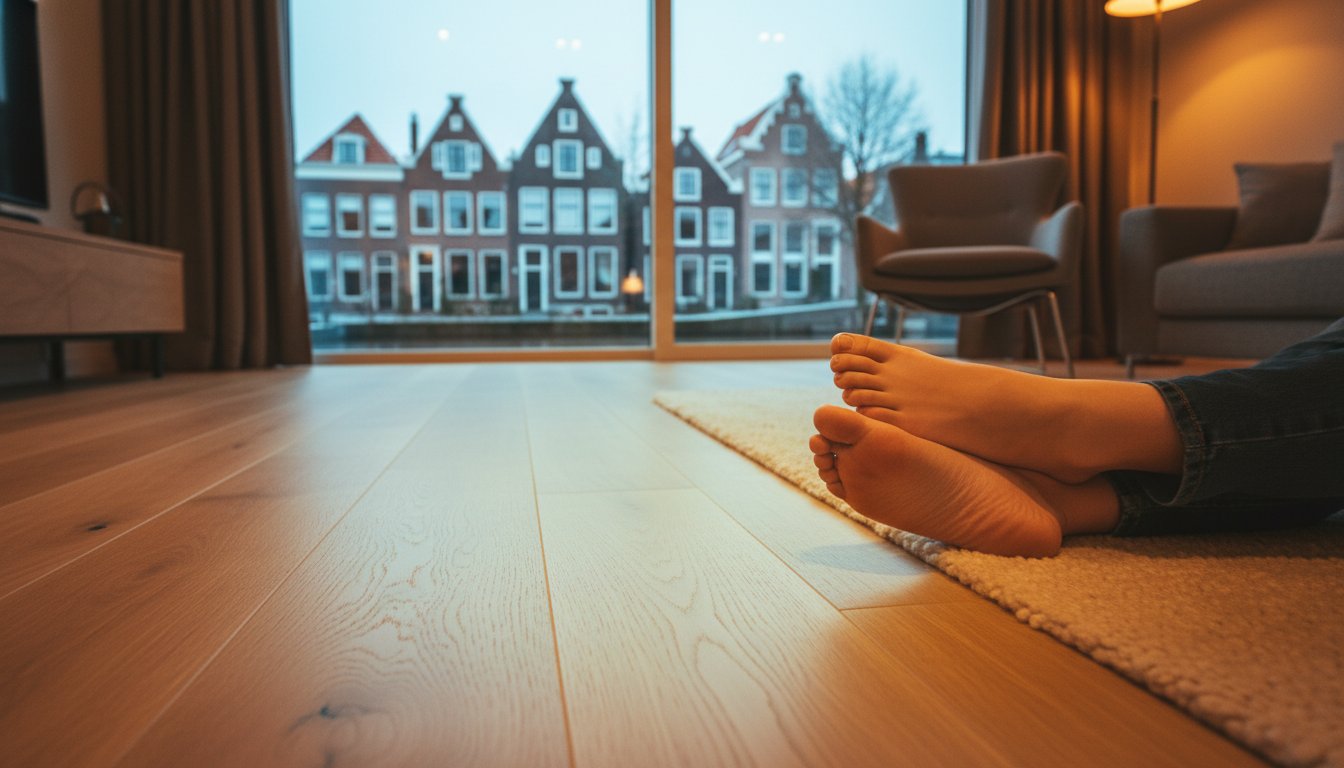
Warm feet in winter require attention to where you sit or stand, not only the room thermostat. A cold floor, air moving under a desk or sitting still for long periods can affect comfort. Heating here concerns thermal comfort; cold feet do not have the same cause for everyone and are not necessarily solely a building problem.
Key points
First consider where and when discomfort occurs. Distinguish contact with a cold floor from general heating demand. Compare insulation, floor construction and targeted supplementary heating. An overhead panel does not guarantee that the floor beneath your feet becomes warm enough.
Why does the floor feel cold?
A thermostat’s reading is not the floor temperature or the air temperature at ankle level. Materials also differ in how they draw heat from feet on contact. Gaps, cold surfaces and vent positions can affect local sensation. Assess these conditions where you actually sit or stand.
Insulation reduces heat loss but is not a heat source. Directing radiation at a structural thermal bridge does not repair it. Discuss useful insulation or draught-proofing while retaining necessary ventilation. Avoid merely masking the effects with a local heater while leaving the cause untouched.
Heat transfer and comfort around the feet
Contact heat, radiation and air around the feet have different roles. An infrared panel warms irradiated people and surfaces and also emits convective heat. It does not eliminate all airflow. A desk, sofa or table may block direct radiation even when the panel reaches the rest of the room.
A ceiling panel is not underfloor heating. Heat reaching the floor depends on setup, distance, flooring and obstacles. A pleasant local sensation is also not a uniformly warm floor. Identify the actual spot to heat beforehand and check the result in practice.
Possible ways to keep feet warm
With a new floor, electric underfloor heating may be an option. Mat, cable or film must suit the complete floor construction and all material instructions. Check temperature limits, thermal resistance and loading. A thin heating element does not mean no extra overall height or that every existing floor can remain.
At a fixed workstation, a suitable desk panel or approved heating mat may provide more targeted comfort. Check permitted distance, positioning and covering. Floor mats, foot warmers and room panels are not automatically interchangeable. For a desk, see for example the product specifications for our desk heater with dimmer and check that mounting and working distance suit your workstation. Choose controls to match use, not an assumed medical effect.
Installation and controls for the occupied spot
Have output matched to the comfort goal and, for room heating, to heat loss. Fixed watts per square or cubic metre do not tell you whether warmth reaches your feet. Match sensor and schedule to the technology. Warming a complete floor differs from warming a panel surface.
Hot surfaces and prolonged exposure need attention. Keep prescribed distances and avoid unintended contact, especially with children, pets or reduced heat sensitivity. Use only approved mounting and keep cables out of walking and trapping routes. In damp spaces, assess model, position and complete connection together.
Supplementary heating can limit unnecessary heating elsewhere only if the other heating is adjusted appropriately. Calculate total kWh and costs from actual duration and your tariffs. Extra equipment without changing existing use may increase totals. For example, an appliance drawing 150 watts continuously for two hours uses 0.15 × 2 = 0.3 kWh. Multiply actual kWh by your electricity tariff; this example predicts neither daily operating time nor savings. Solar panels do not guarantee winter heat demand is covered by your own electricity.
Advice on personal thermal comfort
We help private and business end users, installers and wholesalers choose the right application. Share photos of the seating or work area, flooring, existing heating and hours. We can discuss a solution for the actual spot without recommending the same panel or floor construction everywhere.
Checking comfort in daily use
After commissioning, check warmth at foot level and sensor and control operation. Adjust schedules and settings gradually within product limits. Consider the heat source when moving furniture or rugs. Follow cleaning and visual inspection instructions; low maintenance does not mean maintenance-free.
Frequently asked questions about comfortable heating
Must I replace the whole floor for extra comfort?
Not necessarily. Options depend on the cause, intended spot and approved products. A local solution may suit, while renovation may allow a different floor construction. Have both assessed without assuming a panel gives the same result as underfloor heating.