
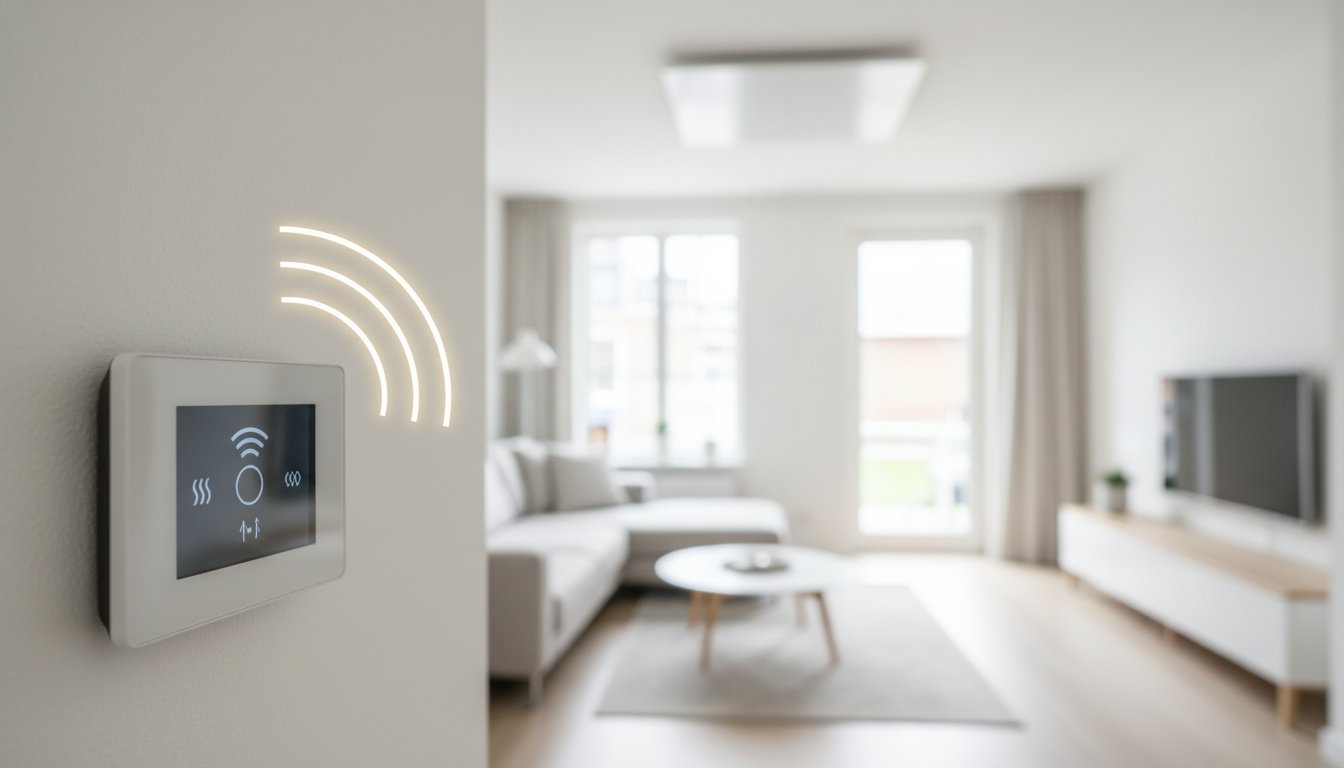
A wireless thermostat lets you position the temperature sensor away from the receiver. This can help during renovation or when existing wiring is not at a suitable measuring location. The connection, receiver and panel must still be selected as a complete compatible system.
This guide focuses on the wireless connection: communication between components, permitted receiver load and installation checks. Wireless does not mean the heater needs no power cable or that every system continues working without internet.
Key considerations
Check the exact transmitter-receiver pairing, switching load, sensor placement and behaviour when communication fails. Test the connection at the final location. Range, battery life, zone count and app features depend on the model.
What does a wireless thermostat control?
The thermostat compares a measured temperature with the setting and sends a heat demand. The receiver then operates the connected load as permitted. The panel transfers heat by radiation and convection; air-temperature measurement does not fully describe comfort at every location.
Hysteresis, measurement accuracy and display increments are different properties. A small displayed increment does not guarantee equally small temperature variation throughout the room. Suitable controls may limit unnecessary heating but prove neither fixed savings nor longer panel life.
Direct radio links and network control
A system may use a direct radio link, a gateway or direct Wi-Fi. These arrangements are not mutually exclusive; Wi-Fi is also radio technology. Frequency alone does not establish interoperability between two devices.
Check protocol, series, version and gateway requirements. Ask whether schedules are stored locally and what remains available when internet, Wi-Fi or the transmitter link fails. Offline behaviour can differ by function; a direct radio link alone is not a complete guarantee.
Reinforced concrete, metalwork, equipment and the final mounting position can limit range. An open-field rating is not a promise for your building. Test before permanent fixing and use only approved repeaters or gateways.
Matching receiver and load
Not every thermostat directly switches mains voltage. An output may provide only a control signal or dry contact. Check the wiring diagram and the exact receiver’s permitted load for the heater type. A general ampere rating does not authorise every load.
With several panels, assess total load, wiring, protection and any additional switching equipment together. The number of paired receivers or zones is separate from one receiver’s switching capacity. Have larger or fixed installations designed and connected by a competent installer.
Plug-in, surface-mounted and recessed versions have different installation requirements. A receiver must not be placed behind a hot panel or in any back box without checking suitability. In damp rooms, every component and the complete connection must suit the location and exposure.
Sensor placement and commissioning
Place the sensor as instructed in a representative location, avoiding unwanted influence from radiation, sunlight, draughts or other heat sources. There is no universal height or distance for every panel. Consider whether a portable transmitter could later be moved to an unsuitable spot.
Pair each device with the correct zone and check which panels actually respond to demand. Test shutdown, schedules and documented loss-of-link behaviour. Record paired devices and settings for user or facilities-manager handover.
Follow battery inspection and replacement instructions. Battery life depends on model, settings and use; a universal interval is unreliable. After replacement, check whether temperature, clock, schedule and pairing are retained or require resetting.
Support in choosing a compatible system
We help private and business end users, installers and wholesalers. Send panel brand, model, power and quantity, plus existing receiver or thermostat details. We can then discuss compatibility and available versions without promising universal pairing.
Ask which components, app or account requirements, installation and warranty terms are included. Establish who administers the system and how access or settings can later be transferred. Lead time, support and warranty are confirmed for each product.
From selection to verified operation
A suitable wireless control system needs more than a strong transmitter: measurement, receiver, electrical installation and settings must work together. Your room and appliance details allow us to advise on a practical, manageable solution.
Frequently asked questions
How many panels can one thermostat control? Check both paired-receiver limits and permitted load per output. These are different limits. Adding panel watts or using a generic ampere rating is insufficient for a complete installation assessment.
Will it work without Wi-Fi? Only the selected system’s documentation establishes which functions remain local. Check internet outage, local network failure and receiver-link loss separately.
Can I connect everything myself? Follow instructions and have fixed wiring or uncertain loads and protection assessed by a competent installer. A plug-in receiver does not make every location or application suitable and does not replace checking the complete system.