
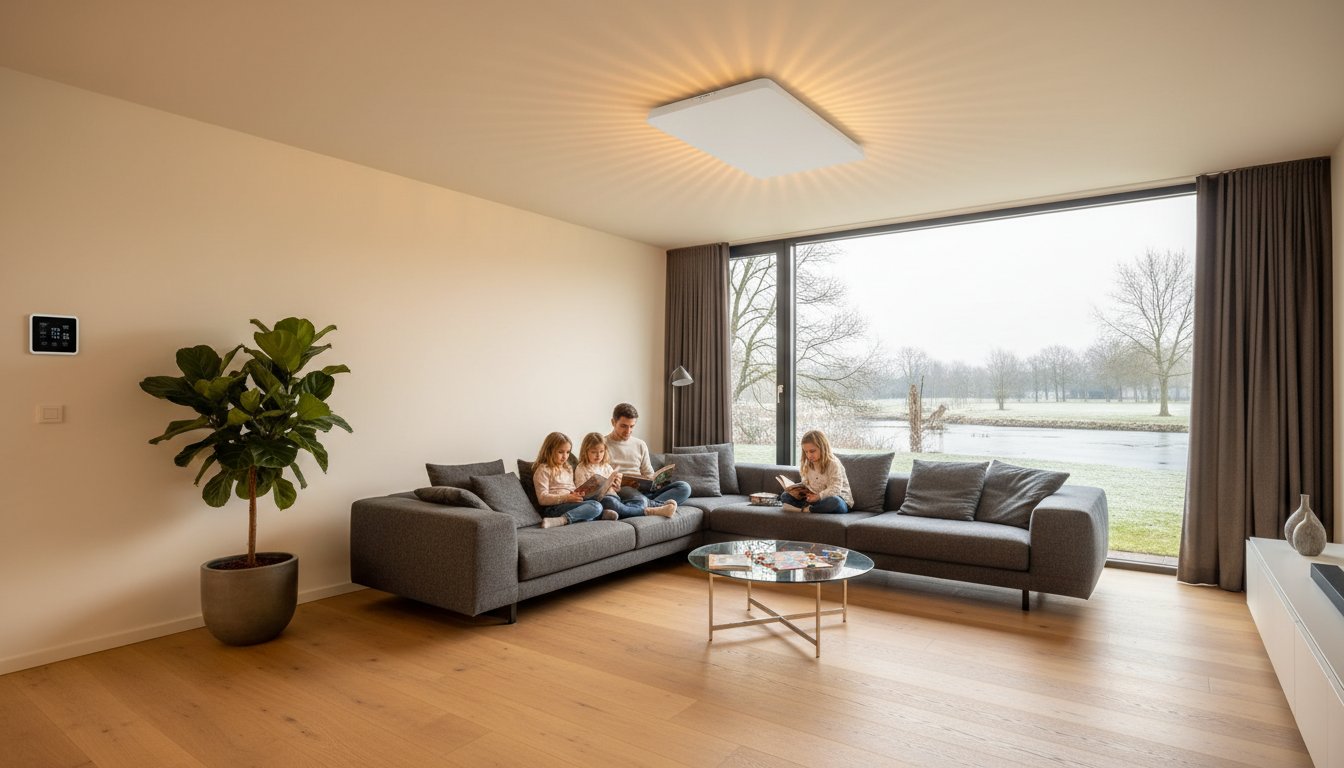
The cheapest way to heat electrically depends on the application. First define whether you mean lowest purchase price, annual bill or total cost over several years. These questions can lead to different choices.
An occasional workstation may need a different solution from continuous whole-home heating. Compare direct electric heating and heat pumps for the same comfort demand. No product category is always cheapest without this assessment.
Key considerations
Compare identical demand and hours. Separate power in watts from energy in kWh. Include installation, controls, maintenance and replacement. Use your tariffs and test lifespan and solar assumptions rather than one generic example.
Start with demand and use
Heat-loss assessment includes insulation, glazing, ventilation, temperature and outdoor conditions. An energy rating, area or generic wattage factor is not a complete calculation. The same room does not suddenly require several times more heat because another electric emitter is used.
Power affects heat-delivery rate. Energy use depends on input power and actual duration. Lower wattage may operate longer and is not automatically cheaper. Higher output does not guarantee fewer kWh either.
Comparing resistance heating and heat pumps
Almost all resistance-heating electricity ultimately becomes heat. This applies to infrared panels and many convectors and electric radiators. Placement, controls and distribution matter, but do not justify claiming infrared always uses much less electricity.
Heat pumps transfer environmental heat and can deliver several units of heat per unit of electricity. Use expected seasonal performance under relevant conditions. Maintenance or higher purchase cost does not automatically cancel that energy advantage.
Infrared panels emit radiation and convection; radiators can also provide radiant heat. Ventilation and air movement remain with both. Panels do not remove pollen or mites or guarantee a healthier dust-free room or equal comfort at a fixed lower temperature.
Compare total costs over the same period
Compare purchase, installation, electrical upgrades and controls with expected energy costs. Include maintenance, parts and replacement. Use the same horizon and residual-value assumptions for every option. Longevity of the heater alone does not mean controls and other parts never need replacing.
Service life and warranty differ. European origin or no pump does not guarantee decades without faults. Low maintenance is not maintenance-free: follow cleaning and checks of appliance, connections and controls.
Compare scenarios for tariffs, hours and performance. Payback exists only where an additional investment produces sufficient net savings. Generic house prices, annual-use examples or assumed maintenance costs are not a quote for your building.
Reducing unnecessary heating
Match temperatures and schedules to use without neglecting ventilation or moisture. Central systems may also have room or zone controls. First examine existing controls and insulation improvements before adding appliances.
Local heating requires suitable coverage, obstructions and duration. A panel near glazing does not automatically eliminate downdraughts or increase perceived temperature by a fixed amount. Mounting, clearances and load must suit the model and location.
Solar panels may cover some demand, but winter heating and production do not always coincide. Self-generated electricity has value and is not automatically free. Account appropriately for exports, self-use, imports and any battery.
Measure total use after installation and compare representative periods accounting for weather and occupancy. Apps may measure or estimate; check what they record. A short isolated test does not prove whole-season savings.
Advice for your home or business
We advise private and business end users and support installers and wholesalers. Share plans, insulation, existing system, hours and consumption. We can discuss intended functions and options and identify assumptions needing further assessment.
Choose through a complete comparison
The proposal should state included work and expected energy performance. Going gas-free also requires hot water and other gas uses to be addressed. Remove existing heating only after assessing the complete plan, capacity and responsibilities.
Frequently asked questions
Is infrared always cheapest? No. Low investment may matter for occasional use; electricity matters more with frequent use. Heat pumps may use less electricity for the same demand. Compare both with installation costs.
Is an electric boiler inherently much less efficient? It often also uses resistance heating. Overall performance depends on installation, distribution, controls and losses. A fixed claim of three times panel consumption requires a comparable calculation.
Are panels economical without solar? Calculate for the situation, comparing purchase, supply, tariffs and use with alternatives. Having or lacking solar alone guarantees no advantage.