
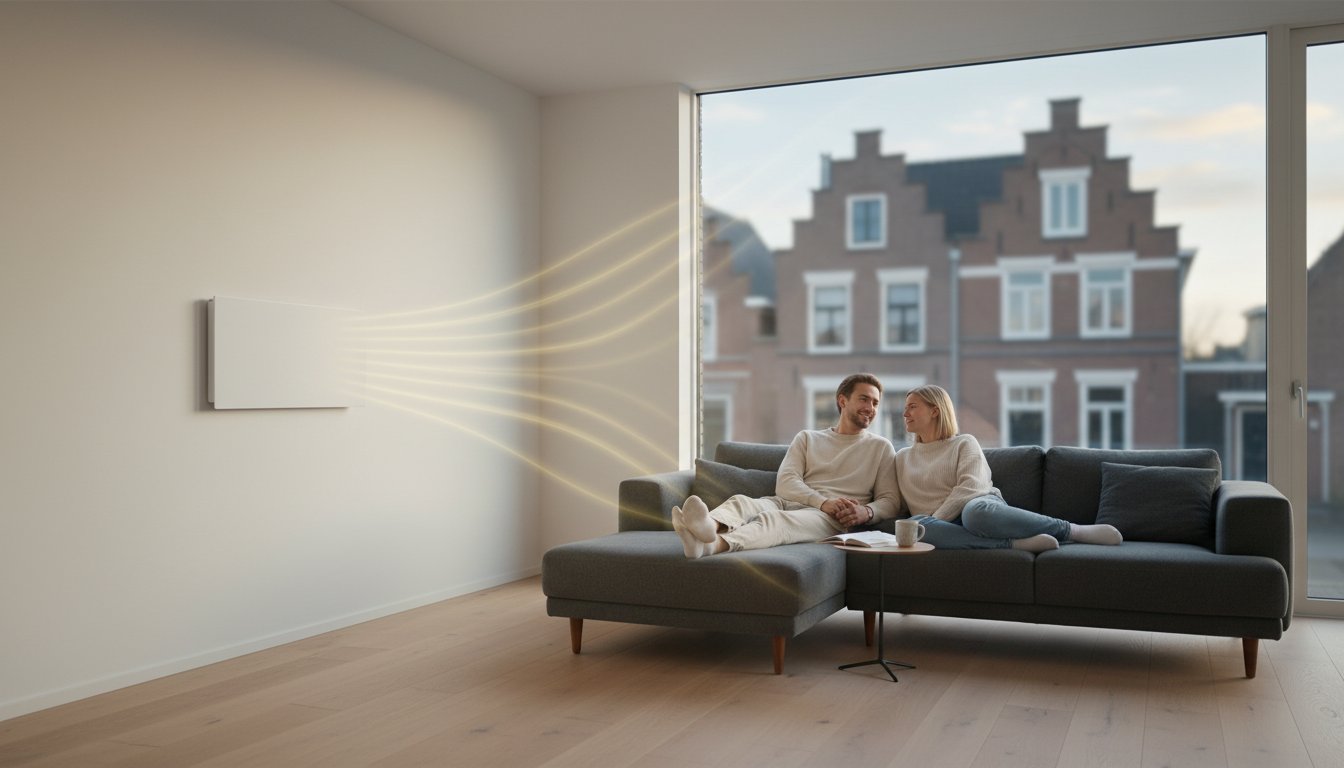
What counts as efficient electric heating depends on the job it must do. Adding warmth at one workstation is different from keeping an entire home at temperature. Start with heating demand, use and the existing installation. Then compare technologies, controls and total costs. Low wattage, a compact design or a smart app alone does not prove lower consumption.
Key points
Compare equivalent comfort under comparable conditions. Distinguish electricity-to-heat conversion, the distribution of that heat and actual annual consumption. Include a heat pump when planning heating for the entire home. Support savings claims with calculations and measure actual use where possible.
What determines efficient electric heating?
Assess heat loss through the roof, walls, floor, glazing and ventilation. Establish which rooms need warmth and when. Main heating must provide the required heat under design conditions; supplementary heating has an additional role. Construction year or floor area alone does not reliably determine the capacity required.
Insulation and draught reduction can limit heat loss. The thermal mass of walls and floors affects how quickly temperatures change, but does not make energy use free or eliminate heat loss. Assess desired temperature, warm-up time and operating time together. A construction year or one insulation value is not a complete heat-loss calculation.
Radiation, convection and efficiency
An infrared panel transfers heat through radiation and also convection. Radiation can reach people and surfaces; warmed surfaces then release heat to their surroundings. A convector primarily heats air, which circulates through the room. The distinction is therefore not an absolute separation between air heating and radiant warmth.
Electric resistance heating converts almost all input electricity into heat. This applies to infrared panels and other electric resistance appliances. The radiant share is a different quantity from total conversion into heat. A high radiant share therefore does not prove a fixed reduction in annual consumption.
Emissivity, radiant share and electricity-to-heat conversion are different quantities. High emissivity does not mean the same percentage of all input energy reaches your occupied area as useful radiation. Use measurements for the exact model and avoid a general ranking based only on material or finish.
Compare systems for the same heating demand
A heat pump works differently: it uses electricity to move heat from the environment. Therefore, do not compare only two resistance appliances when planning heating for a whole home. Assess heating demand, performance under relevant conditions, investment, installation and running costs for each system. No form of heat delivery eliminates losses through ventilation or inadequate insulation.
Compare more than purchase prices and wattages. Include controls, installation, maintenance, energy tariffs and the overall heating arrangement. Electric supplementary heating is not automatically cheaper than gas heating or a heat pump. The outcome depends on the systems and the heat demand you actually replace or add.
Treat purchase and installation as investment costs, and energy, maintenance and possible replacement as operating costs. Use the same period and comfort level. Infrared panels do not automatically have zero maintenance costs; controls, connections and other components count too. Expected service life is not a warranty, and a material choice does not prove a fixed advantage after a certain number of years.
Electric underfloor heating suitability depends on the system, substrate, floor finish and controls. Combining it with a wall panel may serve a purpose, but is not always necessary or more efficient. Check both manufacturers’ documentation and temperature limiting. Do not change controls or installation based on general assumptions about films or mats.
Match placement and controls to actual use
Position the appliance for the occupied area. Furniture, high shelves and other obstacles can restrict direct radiation. Wall or ceiling mounting is an option only if the chosen model permits it. Check clearances, structural support, environment and electrical connection in the manual. Warm-up time and perceived warmth vary by model and situation; do not expect universally guaranteed instant room heating.
Check compatibility between controller and appliance and which functions are actually available. Schedules, occupancy sensors, adaptive start and open-window detection may be useful, but do not work identically on every model. Detection thresholds and switching loads are product-specific. An app or energy-management link does not guarantee savings; incorrect settings can increase consumption.
Compare measurements with similar operating time, outdoor temperature and settings. The main meter also includes other appliances. Where appropriate, use a suitable energy meter or a reliable appliance measurement function. Allow for accuracy and any changes to existing heating; a single meter reading does not prove savings.
Product advice for homes, businesses and customer projects
We supply private and business end users, installation companies and wholesalers. Describe the room, existing heating, the area to warm and operating times. Include dimensions, insulation details and preferences for wall, ceiling or another version. We help compare suitable products, mounting requirements and controls.
We help compare panels, mounting and suitable controls using your information. For a whole home, also discuss hot water, other electrical loads and connection capacity with the installer. An existing supply is not automatically adequate without assessment. Warranties, expected service life, certificates and any building-management integration must be checked for the specific product.
Heating provides thermal comfort and does not treat allergies, asthma or other conditions. Ventilation, cleaning and addressing sources of moisture remain necessary. A different heat-delivery method should therefore not be presented as a guarantee of healthier indoor air or a dust-free room.
Choose using a substantiated comparison
Solar panels change the cost calculation, but do not generate enough electricity at every heating moment. Consider simultaneous generation and demand, winter use and contract terms. Dutch net metering ends on 1 January 2027; do not calculate future consumption as if annual generation and use could be offset without limit.
For businesses, 2026 EIA code 270103 covers local heating of indoor spaces averaging over 4 metres high. Films, mats and infrared lamps are excluded. Have all application conditions checked.
Check current subsidy and tax conditions with the administering body and do not assume support is guaranteed in advance. Describing a product as efficient does not establish investment eligibility. We help with product information; have your specific application and financial outcome assessed separately.
Efficient electric heating: frequently asked questions
How much does a 600-watt panel consume?
One hour of continuous operation at rated full output uses about 0.6 kWh. Multiply actual kWh by your electricity tariff. Under thermostat control, operating time depends on heat demand, settings and conditions. A fixed 15–20 minutes per hour does not apply to every room.
Does a more powerful panel always use less?
No. Output and operating time together determine consumption. An example in which an appliance runs for less time does not prove a larger panel is always cheaper at equal comfort. Size for actual heating demand and compare under the same conditions.
Which technology is always the most efficient?
No single technology is the most economical for every application. Compare heat demand, placement and controls. A solution for one workstation requires a different assessment from a system maintaining the temperature of a whole room.