
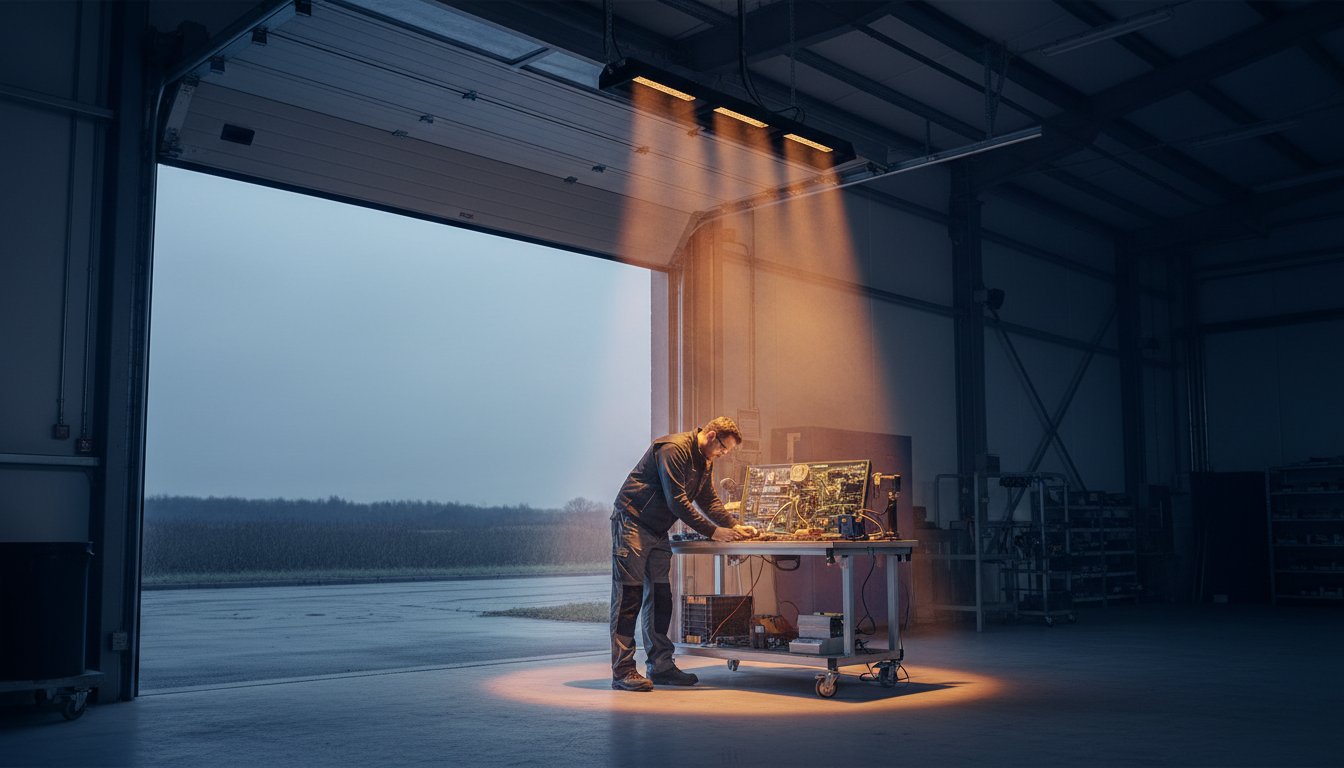
Would you like to heat a workshop with infrared? We first look at where people work, how long warmth is needed and the conditions in the building. Targeted heating can be practical for fixed workstations. Whether it is also more economical than the existing heating requires a comparison for your situation.
Key points
- Match the heaters to the work zones, mounting height and surroundings.
- Have the power rating, electrical connection and protection assessed for the chosen installation.
- Combustible dust, vapours or gases require a separate risk assessment. An IP code does not prove explosion safety.
- Ventilation, dust extraction and cleaning remain necessary.
How does infrared heating work in a workshop?
An infrared heater emits radiant heat to people and surfaces within its range. Convection also occurs and the air warms up too. Obstacles, distance and positioning affect how much warmth someone feels. Heat loss continues when an overhead door is open; no heating system makes a building immune to draughts.
Which version suits the space?
We compare factors including radiant intensity, visible light, controls and permitted mounting arrangements. A heater for a high building is not automatically suitable for a low office. Warm-up time, range and maintenance vary by model. Use the manufacturer’s data and manual for the chosen version.
A separate office or canteen may require a different solution from the workshop floor. Also see our information about ceiling heating and the range.
Work zones and operating times
With zone heating, we direct warmth to the places where it is needed, such as a packing table or fixed machine workstation. We take walkways, racking and employees’ positions into account. The rest of the space may still have its own heating needs, for example for processes or frost protection.
A cost comparison requires the heat demand, operating hours, controls, energy tariffs and existing installation. We do not give a fixed savings percentage, fixed payback period or guaranteed productivity increase without supporting evidence. Solar panels do not automatically make electricity consumption free or CO2-neutral.
Power, mounting and connection
The required power does not depend on floor area alone. We also look at insulation, building height, door openings, ventilation, desired temperature and work-zone dimensions. A general value in watts per square metre does not replace an assessment of these conditions.
Mounting height, mounting angle and clearances are specified in the manual for the exact appliance. Have the supporting structure and fixings assessed. Hot surfaces must not cause unintended contact or an ignition hazard. Only use permitted brackets or suspension systems and do not cover an appliance.
A qualified installer assesses the power supply, wiring, earthing, protection and simultaneous load. The rated power alone does not determine whether an existing socket or particular circuit breaker is suitable. We therefore do not prescribe a general cable cross-section or C characteristic for all installations.
Extra care with wood dust, sawdust and combustible substances
Combustible dust can create fire and explosion hazards. Hot surfaces or electrical sparks can also be ignition sources. Before selecting a product, have an expert assess the conditions and any potentially explosive zones. Only use equipment demonstrably suitable for the identified environment, including the required certification and conditions of use.
An IP rating concerns protection of the enclosure against ingress of solid objects and water. It does not replace an ATEX assessment or prove that a heater is safe around wood dust, solvents or other combustible substances. Dust extraction, ventilation, cleaning and prescribed inspections remain necessary. An infrared heater does not make a workshop dust-free.
Advice and supply for your project
We supply business end users and support installation companies and wholesalers in choosing industrial infrared heating. Private customers with a garage or hobby workshop are also welcome. Include the dimensions, photographs, mounting height, work zones and relevant environmental risks with your enquiry. We then discuss the options and any information still needed.
We discuss lead times, installation support and availability for each enquiry. Contact us for product advice or a quote.
Discuss heating your workshop
Request a quote or contact us for advice on your project.
Frequently asked questions
Can I heat an entire industrial building with infrared?
That depends on heat demand, layout and available electrical capacity. We assess whether full heating or targeted workstation heating is appropriate.
How high should a heater be mounted?
This varies by model and application. Follow the manufacturer’s prescribed mounting height, clearances and mounting method.
Is a heater with a high IP code suitable for a dusty workshop?
Not automatically. Where combustible dust is present, have the risks and any potentially explosive zones assessed first. A high IP code alone is not proof of explosion safety.
Is infrared always cheaper than gas heating?
No. Compare investment and operating costs for the same heat demand and operating hours. Energy tariffs, controls and the existing installation influence the result.