
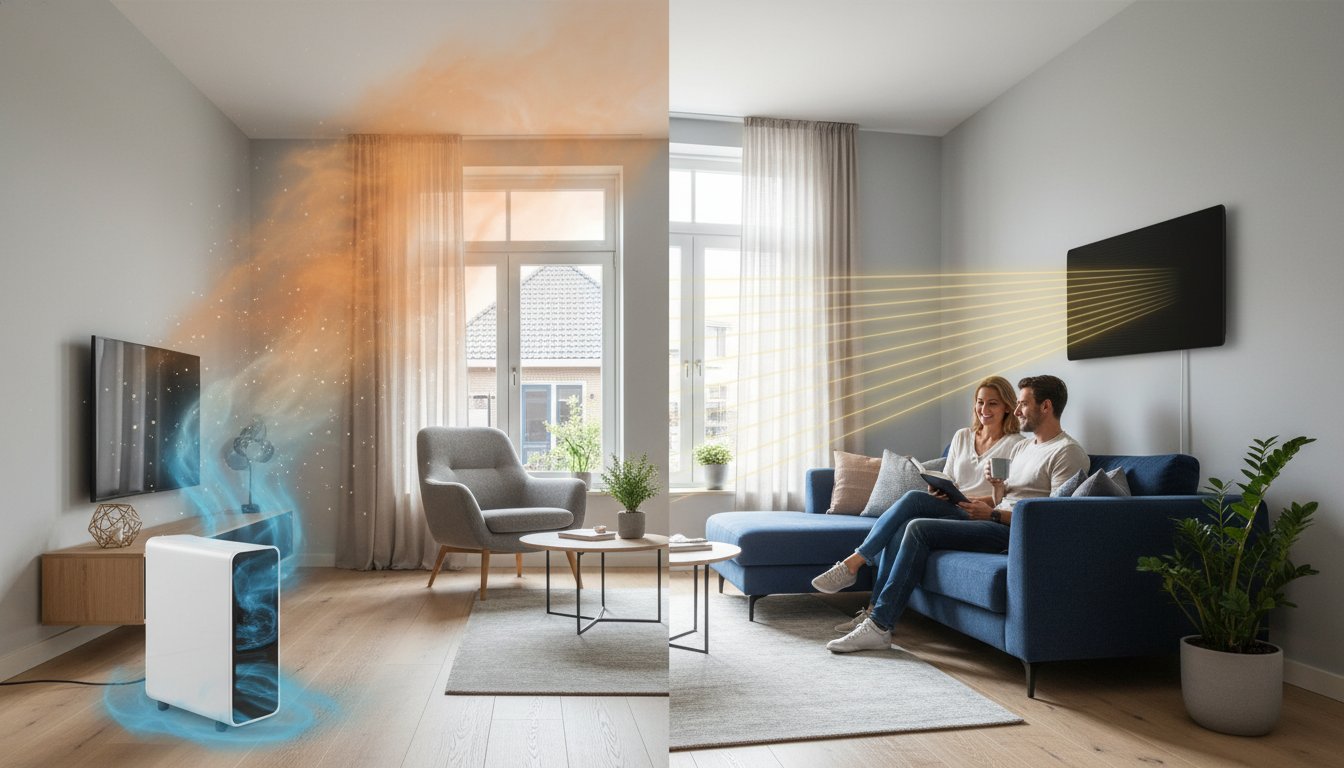
An infrared panel is also an electric heater. Compare actual appliances, heat distribution, controls and applications. Do you need warmth at one position or a whole room heated? No type is better, cheaper or more comfortable in every situation.
Key points
Compare equal comfort, use and heat loss. Rated wattage alone does not predict kWh: operating time matters. Include mounting, sound, clearances and controls. Claims that smaller panels always replace larger convectors need situation-specific evidence.
Differences in heat distribution
Convectors mainly warm air moving past an element; fan heaters assist with a fan. Infrared panels radiate part of their heat towards reachable people and surfaces but also produce convection. These are not completely separate heat-transfer mechanisms.
Direct radiation may suit seating or work, but furniture can obstruct it and users may feel different warmth. Air heating distributes differently. Assess actual layout and multiple positions; ceilings do not eliminate every obstruction.
Which costs should you compare?
Resistance heating ultimately converts almost all input to heat, not just in infrared panels. Useful heat location and operating time can differ. Electrical conversion therefore does not prove lower energy for your aim.
Measure or calculate actual power times operating hours with your tariff. Controls may cycle, so connected and heating hours differ. Include existing heat. Lower gas use is not total saving if extra electricity exceeds the benefit.
Include purchase, mounting, electrical changes, controls, maintenance and replacement. Life expectancy differs from warranty. Fanless devices still have connections and switching parts. No universal lifetime-cost winner follows without comparison.
Assess comfort and indoor conditions
Comfort depends on air and surface temperature, movement, clothing and activity. A fixed lower setting does not suit everyone. Compare positions and users and room warm-up. A hot panel is not a warm room.
Panels treat no conditions or guarantee dust-free air. Convection, ventilation and movement still move dust. Warm surfaces may condense less, but deep drying or mould prevention is no general feature. Investigate sources and maintain ventilation.
Fan noise may matter during work or sleep. Fanless panels avoid it but relays or expansion may be audible. Compare actual models, indicators and controls. Do not assume complete silence.
Application determines the comparison
Brief work, prolonged sitting and primary heating are different tasks. Assess losses, ventilation and temperatures for primary heating. Standard area or volume rules are insufficient. Tall or poorly insulated buildings still lose heat regardless of technology.
Bathrooms need model suitability for moisture and full connections; IP alone is no permission. Bedrooms require overnight approval, access and bedding clearances. Do not choose only from advertising room labels.
Workshops, halls and offices need posture, changing layouts, dust and moisture assessed. Industrial and domestic appliances are not interchangeable. Plan approved operation and safe capacity for projects.
Choose with clear criteria
Choose the arrangement that supplies desired heat within practical and financial limits. Include alternatives such as improving heating or insulation. Infrared may suit but is no universal whole-home or budget winner.
We advise private and business end users and support installers and wholesalers. Share rooms, heating and use. We discuss options and limitations and can prepare a quote. Define calculation, mounting and connection responsibilities.
Check results after choosing
Test comfort, controls and energy in representative conditions. Maintain clearances, access and care as instructed. Assess faults. Revisit comparison when layout, schedules or existing heat change.
Comparison questions
Does infrared always stay warm longer after switch-off?
Not automatically. Construction, stored heat, initial temperature and loss determine cooling. Turning off radiation may be noticeable immediately at the occupied position. Other systems also store heat in materials. Compare actual conditions rather than assigning storage exclusively to one technology.