
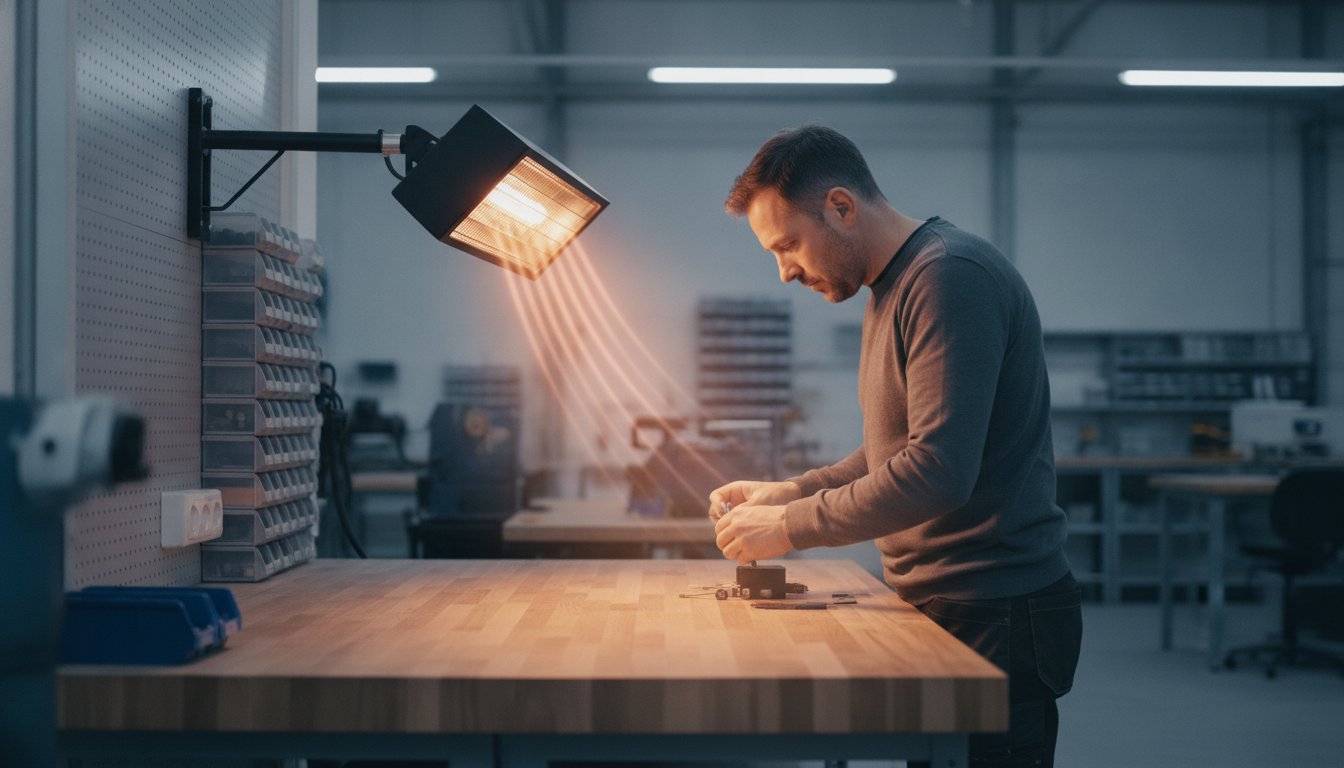
A radiant heater directs warmth towards an occupied area. The term includes different appliances for homes, workshops and patios. A powerful patio heater is not automatically suitable in a bathroom or above a desk. Choose according to the environment and manufacturer’s instructions.
This guide explains useful technical data and selection and installation checks. It uses no fixed energy price or general savings promise. Total costs and comfort depend on appliance, positioning, running time and the heating used for comparison.
Key points
Check intended use, heat distribution, approved mounting and controls. Assess electrical load and environment before purchase. An IP code alone does not prove suitability for every outdoor location, bathroom or dusty workshop. Hot parts and specified clearances remain essential.
How does a radiant heater transfer energy?
An electric element heats and emits infrared radiation among other heat transfers. People and surfaces absorb some of it. A reflector may guide distribution where included in the design. Convection also occurs; the heater does not warm objects only. Spectrum, element temperature and construction vary.
Short-, medium- and long-wave labels describe infrared spectral regions, not complete performance or safety classes. Elements emit spectra, not just one wavelength. Also check coverage, visible light and application data. The category alone does not determine suitability for your workshop or living room.
Where can targeted warmth help?
Targeted heating may suit seats or workstations with different needs from their surroundings. Results depend on distance, obstacles and occupant heat loss. Some heaters produce rapid warmth, but no universal warm-up time applies to all panels and elements.
Electric resistance appliances ultimately turn almost all electricity into heat. Radiant fraction is a separate quantity requiring model measurements. Compare consumption for the same comfort objective and total use, including other heating. No fan does not eliminate dust, air movement or maintenance.
Homes, patios and businesses need different choices
In bathrooms, model, exact position, IP protection and installation must suit together. A higher IP number does not mean universal waterproofing or permission in every zone. For patios, check outdoor approval, orientation and shelter. Radiation is not blown away like warm air, but wind still cools people and surfaces.
For workshops and halls, assess work positions, routes, height and substances present. Wood dust, paint mist or combustible materials require expert risk assessment beforehand. An IP code does not prove fire or explosion safety. Establish any special zones and required suitability. Maintain extraction, ventilation and cleaning; heaters do not make workshops dust-free.
Local office warmth may help where the model suits the distance and arrangement. Powerful industrial heaters are not automatically desk heaters. Match presence detection to seated work to avoid unintended loss of heat.
Checking mounting and electrical provisions
Follow the exact model’s height, orientation and clearances. A general 2.10-metre height or fifty-centimetre clearance is not a universal safety rule. Check support, weight and fixings. Avoid directing heat at combustible materials and prevent accidental hot-surface contact.
Assess supply, combined load, cables, protection and any starting current. Fixed connections do not eliminate every overheating risk. Use suitable controls or dimmers only; arbitrary relays or smart plugs are not automatically suitable. Have fixed wiring and alterations done by a qualified installer.
Advice for private and business applications
We help end users at home and work and also supply installers and wholesalers. Share dimensions, photographs, occupied areas and environmental and electrical details. We discuss suitable models, distribution and controls. Check certification, warranty and care for the version; origin alone does not prove these properties.
Check operation and maintenance in practice
Test coverage and controls in typical use. Check that empty zones do not remain heated accidentally. Follow care and inspection requirements and cool before cleaning. Inspect cables, fixings and seals as instructed. Low maintenance does not promise no wear or no inspections.
Frequently asked questions
What does a thousand-watt heater consume?
One hour continuously drawing 1000 watts uses about 1 kWh. Multiply by your tariff. Controls and actual power alter the result; lower rated wattage does not prove equal comfort or lower total costs.