
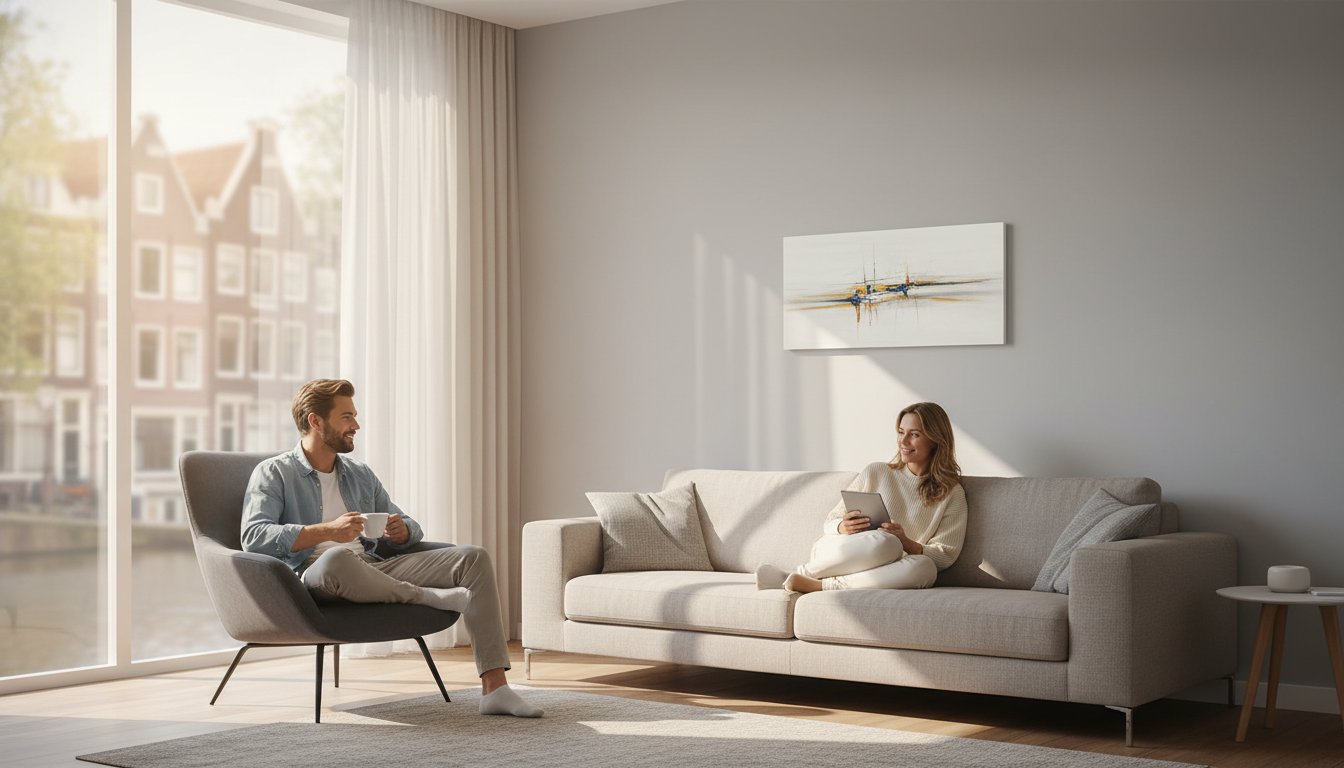
Choose a living room heating panel for the way you use the space. Do you want targeted warmth by the sofa or to keep the entire room at temperature? That distinction determines the information needed for output, positioning and controls. An attractive finish alone cannot predict suitable comfort.
This guide considers the living room as a whole: furniture, windows, occupied locations, insulation and electrical provision. We advise private and business end users and support installation companies and wholesalers in selecting suitable products. Photos and a floor plan help discuss the options for your space.
Key points
Make primary and supplementary heating explicit. Calculate required capacity and check an unobstructed radiation path to actual seating positions. Assess design together with permitted mounting and safe clearances. A thermostat helps control heating, but does not demonstrate fixed savings or guarantee identical comfort everywhere.
How does a living room heating panel work?
An electrical element warms the panel surface. This releases heat through radiation to accessible people and surfaces and through convection to the air. Ordinary radiators also release both types of heat. In the living room, the main consideration is how the actual arrangement affects comfort by the sofa, dining table or reading chair.
Furniture and building elements can absorb heat and release it later, but heat losses do not disappear. Opening doors, ventilation and cold external surfaces still affect the heating plan. An air temperature two or three degrees lower with the same comfort is not a general panel characteristic. Assess perceived comfort with the residents.
Materials and model data
Metal, glass, mirror and printed finishes differ in appearance and construction. Warm-up time, surface temperature and radiant share must be established from model-specific data; the material name alone does not predict them. Almost all electricity drawn becomes heat, but radiant share is a different quantity. Use certificates or measurements only within their stated scope.
Weighing living room comfort and electricity use
Targeted warmth can be pleasant at a fixed seating position, especially when the rest of the home is used differently. Whether it saves energy depends on what the existing heating then does. Adding a panel without reducing heating elsewhere adds its consumption. Compare systems for the same duration and comfort requirements, considering a heat pump or improvements to existing controls where appropriate.
A panel without a fan has no forced airflow, but does not make the room dust-free. Heating can change relative humidity and does not replace ventilation. The appliance does not treat allergies, asthma or dry eyes. Persistent damp or mould requires investigating ventilation, moisture sources and building causes rather than a general warmth promise.
What output does your living room need?
For primary heating, the installation must offset calculated heat losses under the chosen design conditions. Gather dimensions, insulation, glazing, external surfaces, ventilation and desired temperature. Ceiling height and volume are information, not a complete calculation. An energy rating or fixed watts-per-cubic-metre table is insufficient for product selection.
A 40 m² living room with a height of 2.5 metres has a volume of 100 m³. That volume alone does not determine required heating output. The same volume can have different heat demand with different insulation and external surfaces. Then distribute calculated capacity across positions reaching the occupied zones, avoiding arbitrary excess capacity presented as a savings measure.
Targeted supplementary heating
For warmth by the sofa, also describe distance, sitting posture and duration of use. This does not necessarily require the same output as heating the entire room. Keep other residents and neighbouring areas comfortable and assess interaction with background heating. In an open kitchen, separate settings do not guarantee two separate air temperatures.
Positioning a heating panel near a sofa or dining table
Draw the sofa, chairs, dining table, curtains, cupboards and windows on the floor plan. A panel behind a sofa or curtain does not reach the user like an unobstructed panel and may breach safety clearances. Wall and ceiling mounting each offer possibilities; choose according to the space and the model’s permitted orientation, not an assumption that one position is always superior.
A coloured or photographic panel can match the interior when that finish is available for the product. Have aspect ratio, cropping and any proof confirmed beforehand. Do not paint the surface yourself or add a frame, fabric or covering without approval. Even decorative panels require attention to hot surfaces, access by children and pets, and the prohibition on covering.
Controls, electrical installation and maintenance
A suitable thermostat with a representative sensor can control the panel according to demand. Wi-Fi, apps and smart-home connections differ by model and are not necessary for every living room. Choose functions you actually use and check offline operation, compatibility and local controls. A motion sensor must also account for people sitting still and warm-up time.
Have load-bearing capacity, fixings, electrical supply and simultaneous loads assessed. Brackets, suspended ceiling, lighting connection and socket position must each suit the chosen version. Follow mounting and clearance instructions and have fixed electrical work carried out competently. Combined lighting also requires suitable light distribution and permitted independent operation.
Follow the manual for cleaning and inspection. First switch the panel off safely and let it cool. Check cables, fixings and controls, and have damage or abnormal behaviour assessed. Low-maintenance does not mean every component works for decades without checking. Include warranty, service and possible control replacement when choosing.
We help you plan your living room heating
Share dimensions, insulation, existing heating and where you usually sit. State whether you need primary heating or supplementation and which finish you want. We can review panel selection and controls with you and coordinate necessary product information with your installer or wholesaler. Then request a proposal with clear mounting and operating conditions.
Frequently asked questions
How quickly does the living room feel warm?
That depends on the model, starting temperature, distance, positioning and whether you mean local warmth or an entirely warm room. First feeling radiation is not the same as reaching the desired room temperature. Do not therefore use a general promise of five or ten minutes for the entire living room.
How do I calculate daily consumption?
An appliance actually drawing 1 kilowatt for one hour uses 1 kilowatt-hour. For a day, use actual heating hours or a suitable measurement and multiply by your tariff. Nominal output alone does not yield a fixed winter daily cost; weather, heat demand, controls and use change the outcome.