
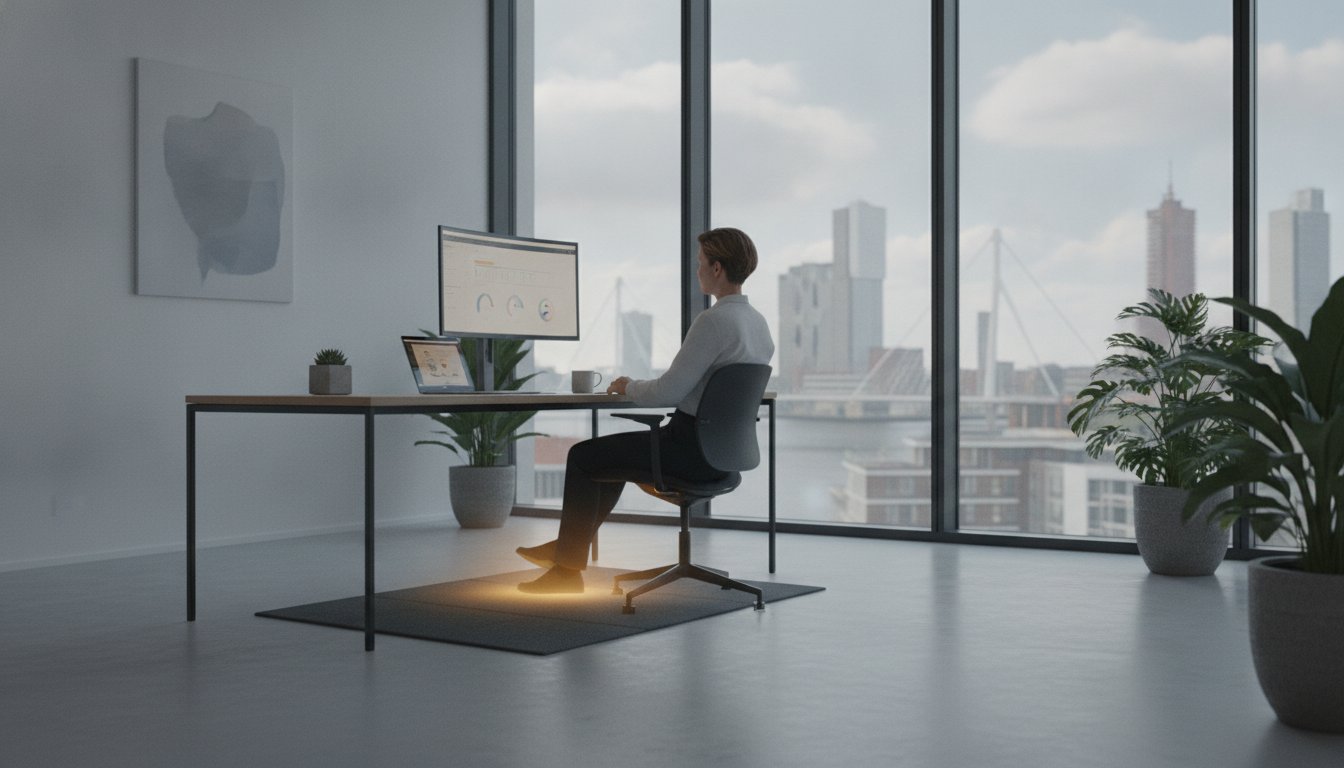
Illustration: the warm glow around the feet has been added.
A heating mat with a thermostat can provide local warmth, for example at a workstation. However, “heating mat” covers different products: a loose foot mat, a mat for under a rug or a built-in underfloor-heating mat. Do not treat them as interchangeable. Start with the exact model’s intended use.
This guide focuses on personal supplementary heating and questions to ask before use. A mat warming the feet does not prove the whole room can be heated. Also check the substrate, permitted loading, controls and any contact with shoes or bare feet according to the manual.
Key points
Choose the right mat type and use only the specified power supply and controls. Do not place it under furniture, rugs or other layers without approval for that combination. Check cable routes and temperature restrictions. A thermostat does not replace protection against misuse or mechanical damage.
How does a heating mat with a thermostat work?
Electric elements warm the mat. Heat may transfer through direct contact, heated finishes, radiation and convection, depending on construction. The word infrared does not mean a mat beneath material radiates directly through those layers onto people. Check the intended contact surface and application.
Controls may use mat temperature, ambient temperature or another sensor value. Not every thermostat measures both room and mat. Check which quantity you set and what limitation is available. Use only compatible sensors and place them as the manufacturer specifies; do not assume a universal position between elements.
Which heating mat suits home or office?
A purpose-designed foot mat may suit a desk. Keep chair castors, shoes and cables within operating conditions; trapping or heavy loads can damage a mat. Keep controls accessible and prevent trips. At a shared workstation, users must know which product is present and what is prohibited.
Under-rug use requires a specifically approved combination. General advice to put every mat under fabric is unsafe. Check material, total insulation, floor compatibility and permitted furniture. Extra insulating underlay is not always correct: it can also change heat build-up. Follow the complete design.
An office product may not automatically be moved to a garage, bathroom or outdoors. Assess moisture, dust, mechanical loading and any flammable substances. The manufacturer must permit the application and the connection must suit it. An IP code alone does not prove every location safe.
Calculating consumption of a thermostatically controlled heating mat
A low-output mat can provide local comfort but does not heat the same area as a larger heater. Do not simply compare 100 watts with 2,000 watts. Calculate added consumption and assess what actually changes in primary heating. Without that comparison, fixed savings or a room-temperature reduction cannot be promised.
As an example, a 100-watt mat operating continuously at that power for eight hours uses about 0.8 kWh. Multiply by your tariff. With thermostat control, actual on-time counts. An active eight-hour programme does not automatically mean eight hours of heating consumption, and the display may show an estimate.
A heating mat is intended for thermal comfort, not medical treatment or guaranteed improvements in circulation and concentration. Ventilation and cleaning remain necessary. Assess comfort individually and do not exceed permitted temperature to compensate for a cold room.
Safe preparation and commissioning
Read instructions for substrate, operating position, supply and permitted controls. Check mat, cable and plug for damage before use. Do not fold, cut or puncture unless the manufacturer permits a specific action. Route cables away from chair castors, trapping points and walkways. Do not use an unknown power supply or arbitrary smart plug.
A thermostat or overheat protector does not automatically make covering or prolonged contact safe. Also follow restrictions for children, pets and unattended use. Stop if damaged, unexpectedly hot or behaving unusually and have the product assessed. Switch off and cool before storage as instructed.
Built-in mats or alterations to a fixed installation require a laying plan, prescribed measurements and a qualified installer. Do not confuse their instructions with those for a loose foot mat. A certification mark or CE marking does not replace instructions or prove a fixed savings percentage.
We help you choose a suitable heating mat
We help private and business end users and supply installers and wholesalers. Share photos, floor type, operating hours and desired comfort. State whether you need a loose mat, under-rug product or built-in system. We review available models and conditions still needing checking. Ask about service and warranty for the specific version. A separate thermostat is only an option if the manufacturer permits those controls for the mat.
Keep use verifiable
Check mat and cable regularly, especially after moving or storage. Clean only as instructed and do not use a damaged product. Do not change a mat, rug and substrate combination without reviewing conditions again. Low-maintenance does not mean parts last indefinitely or need no checks.
Frequently asked questions
Is a wooden floor automatically suitable?
No. Check both mat and flooring conditions, including temperature, protection and possible discolouration or heat build-up. A fixed 27-degree limit or added insulation does not prove every combination safe. Request confirmation for the exact products.