
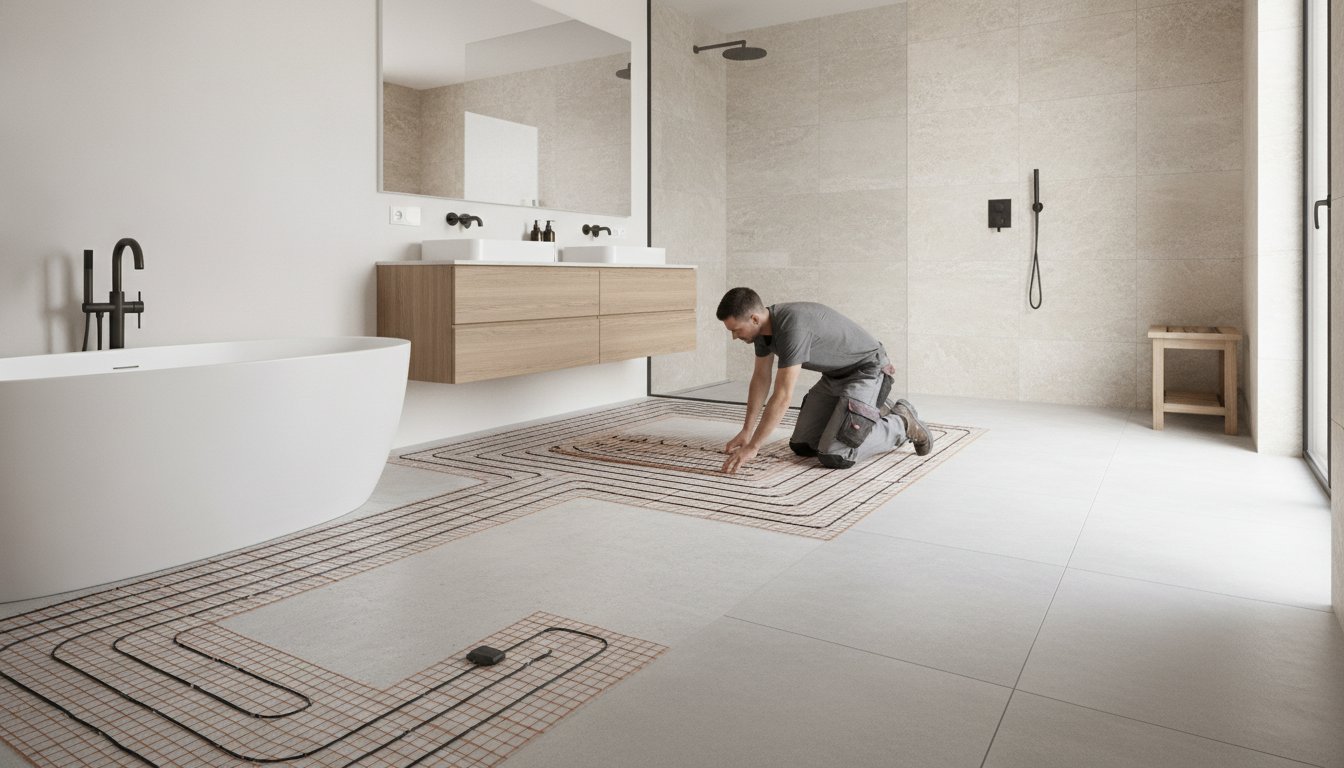
A warm bathroom floor can be pleasant when showering and dressing. Whether electric floor heating suits your bathroom depends on floor construction, available heated area, heat demand and electrical installation. This guide distinguishes floor comfort from whole-room heating and explains the information needed for a proposal.
The key choices
First choose the intended function and floor finish. Then have power, mat area, insulation, waterproofing, controls and electrical protection assessed together. A 150 W/m² heating mat has a specified installed power; this is not fixed hourly consumption and does not prove it can heat the entire bathroom.
Floor comfort and a pleasant bathroom
The heated floor emits heat through radiation and convection. Warming up takes time: insulation, mass, finish, starting temperature and power determine its response. A general promise of a few minutes or fifteen to thirty minutes is therefore inappropriate. Adjust schedules to your floor’s actual response.
Heating does not guarantee a mould-free bathroom or better health. Warmer surfaces can help limit condensation, but shower moisture also needs removal. Ventilate, limit moisture at source and repair leaks or building defects. A wet floor still needs attention; heating does not automatically make it hygienic or slip-free.
How does electric floor heating work?
An electric heating cable or mat heats the floor construction. In a wet room, use only a system approved for that application and construction. Heating film for a floating dry floor is not automatically suitable for bathroom applications or tile adhesive. Substrate, insulation, adhesive, levelling compound, waterproofing and finish must be compatible.
With electric resistance heating, almost all input electricity ultimately becomes heat. Some can flow downwards or into adjoining spaces. Good insulation can limit these losses; a reflective layer is not automatically a substitute for thermal insulation. Running costs depend on heat demand, controls and electricity tariff, not solely on conversion efficiency.
Power, floor finish and heated area
Choose mat size from the permitted unobstructed floor area and laying instructions. Fixed furniture, sanitary fittings or other coverings can trap heat. A smaller installation area can limit available heat output. Whether floor heating is sufficient as main heating requires comparison with bathroom heat loss; 200 W/m² is not a universal standard or guarantee.
For tiles, natural stone, PVC or resin flooring, check approval from both flooring and heating manufacturers. Consider thermal resistance, maximum temperatures, adhesive and full build-up height. Mat thickness alone is not total floor height. Do not shorten, cross or overlap heating cables on your own initiative; follow the exact laying instructions.
Safe installation and controls
Have a competent installer assess bathroom suitability, electrical protection, connection and required tests. The Netherlands and Belgium have their own installation rules. Tile adhesive alone is not guaranteed waterproofing. The waterproof layer and its position in the construction must follow the chosen system. Keep test records, layout and manuals for future maintenance or repair.
Use compatible controls with the required floor sensor and temperature limit. Some controls measure air, others the floor or both. Set the permitted floor and system limits. Wi-Fi and app control are not standard on every version. First switch on only after the prescribed curing of adhesive, screed and finish.
A wall or mirror panel may provide supplementary heat where supported by calculation and placement. Coordinate both systems to limit unnecessary simultaneous heating. A normal anti-fog heated mirror is not automatically a room heater. Bathroom positioning and manufacturer instructions remain decisive for an additional panel too.
Advice for residents and professional partners
We supply private and business end users, installers and wholesalers. Send bathroom dimensions, usable installation area, floor construction, insulation data and intended function. We will discuss suitable products and any additional technical assessment for your home, business premises or customer project.
An informed choice for your bathroom
Compare not only purchase costs but installation, required alterations and expected use too. Electric heating does not automatically mean low costs or carbon-neutral operation. Check product-specific warranty and maintenance, keeping controls and connections accessible where the installation requires.
Frequently asked questions
How do I calculate consumption?
As a calculation example, four square metres of 150 W/m² mat has 600 watts installed power. Two hours continuously at full power is approximately 1.2 kWh. Actual operating hours depend on demand and controls. This example is not an annual forecast.
Which temperature and schedule are suitable?
Follow the limits of the complete floor system and intended comfort function. A constant low setting is not always more economical than a schedule. Compare response and consumption for your use and avoid exceeding the floor finish’s temperature limits.