
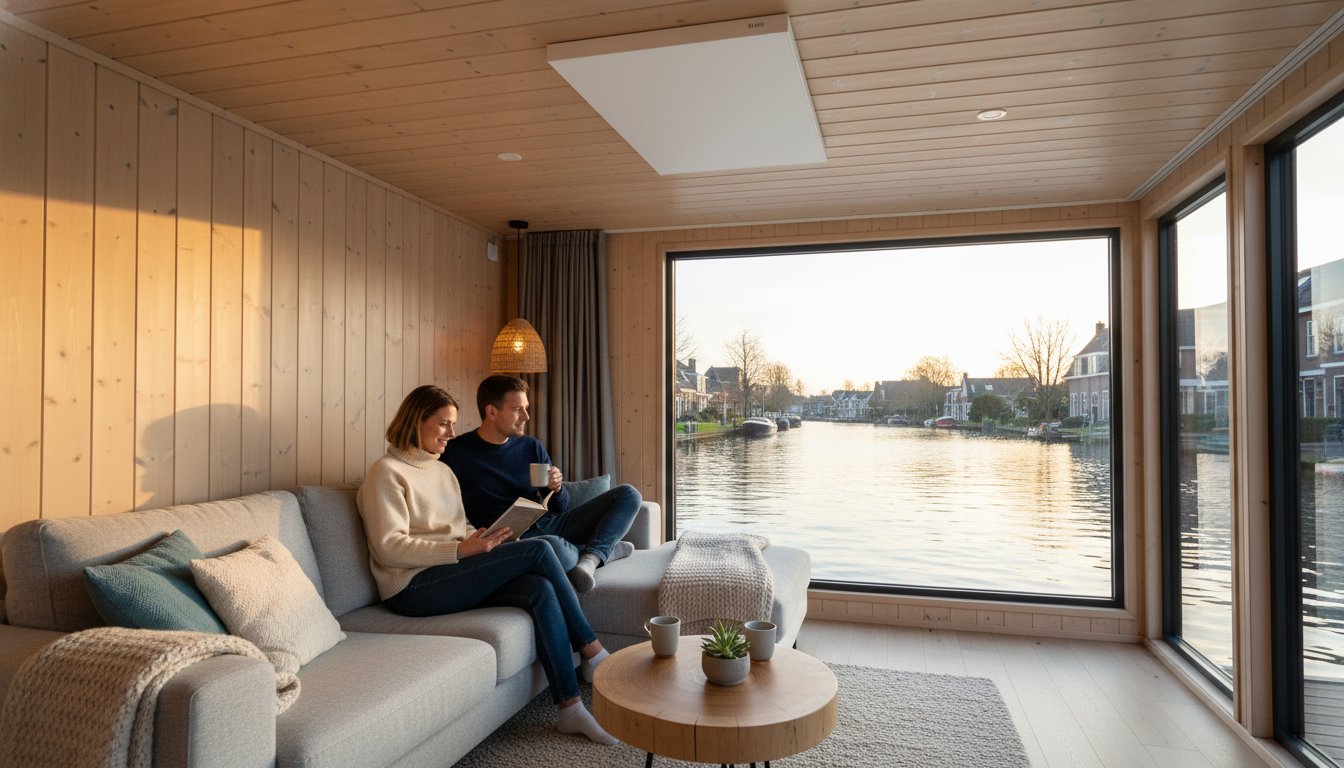
A houseboat may be a navigable vessel, converted boat or fixed floating home. Construction, mooring and electrical services vary widely. Choose heating for the actual situation and assess onboard suitability separately. A domestic panel is not automatically a marine product.
Key questions
Record the envelope or vessel structure, moisture sources, available supply and use. Decide between local supplementary heating and the whole houseboat. Coordinate product selection with a specialist in the actual installation. An IP code or rated wattage alone is insufficient.
Heat loss and moisture aboard
Assess hull or flotation structure, superstructure, glazing, thermal bridges and ventilation. Steel, concrete or wood alone does not establish heat loss; build-up and insulation matter. One figure per cubic metre for all houseboats cannot reliably size heating. Calculate demand for the actual construction.
Heating does not remove airborne moisture. Investigate ventilation, leaks, condensation and other sources in a damp interior. A panel does not prevent corrosion or mould without further measures. Maintain suitable ventilation and address building or vessel defects at their source.
Comparing systems without assuming a winner
Compare existing hydronic heating, panels and a suitable heat pump for the same demand. Heat pumps can deliver equal heat with less electricity, but space, sound, source and mounting must suit. Not every heat pump uses surface water and not every panel needs little installation work. Request equally scoped quotations.
Include installation, supply, controls, energy, maintenance and replacement. Solar power is not always available on winter evenings. Use actual contract terms and consumption timing; annual yield does not prove free or fully climate-neutral heating.
The role of local radiant heat
Panels warm exposed people and surfaces and also produce convection. Assess from seating or work areas whether cupboards, furniture or beams obstruct warmth. Local supplementation may meet a comfort need but does not automatically protect hidden pipes or heat the whole vessel without design.
Do not expect dust-free air or treatment of respiratory conditions. Panels do not replace ventilation and cleaning. Select settings for comfort and construction conditions; fixed room-temperature or total-consumption promises require project-specific assessment.
Checking onboard supply and mounting
Have the entire supply assessed by a specialist in the onboard installation. Include shore power, wiring, protection, other loads and any inverter or battery. A nominal current rating is not freely available heating capacity. Upgrading or automatic load management is not a universal solution; it must be feasible and permitted.
Confirm manufacturer suitability for moisture, ambient temperature, corrosion and any movement. IP44 or metal alone does not demonstrate marine suitability. Use approved brackets and structural support without uncontrolled changes to the hull or critical components. Ceiling mounting needs separate checks of model, fixings and clearances.
Match thermostat, receivers and panels and test each zone. Define behaviour after shore-power, network or communication loss. Frost mode does not guarantee protection of every water pipe. Review winter procedures and checks with the responsible manager.
Product advice and interior choices
We discuss products with private and business end users, installers and wholesalers. Send photos, construction details, supply information and plans. Choose mirror, printed or illuminated versions only after technical suitability and mounting are established. Use towel rails only where the combination is approved; textiles must not contact an ordinary heating surface.
Planning handover and maintenance
Agree comfort criteria and checks and test in representative conditions. Follow the management plan for cleaning, inspection, fixings, connections and controls. A product without fluid or fan is not free of every fault. Life and warranty depend on the actual product, use and terms.
Request advice and a houseboat-heating quote
Frequently asked questions
Is a panel automatically suitable below the waterline?
No. Assess the actual space, moisture exposure, product application and electrical system. A general domestic or bathroom classification does not replace onboard technical assessment.