
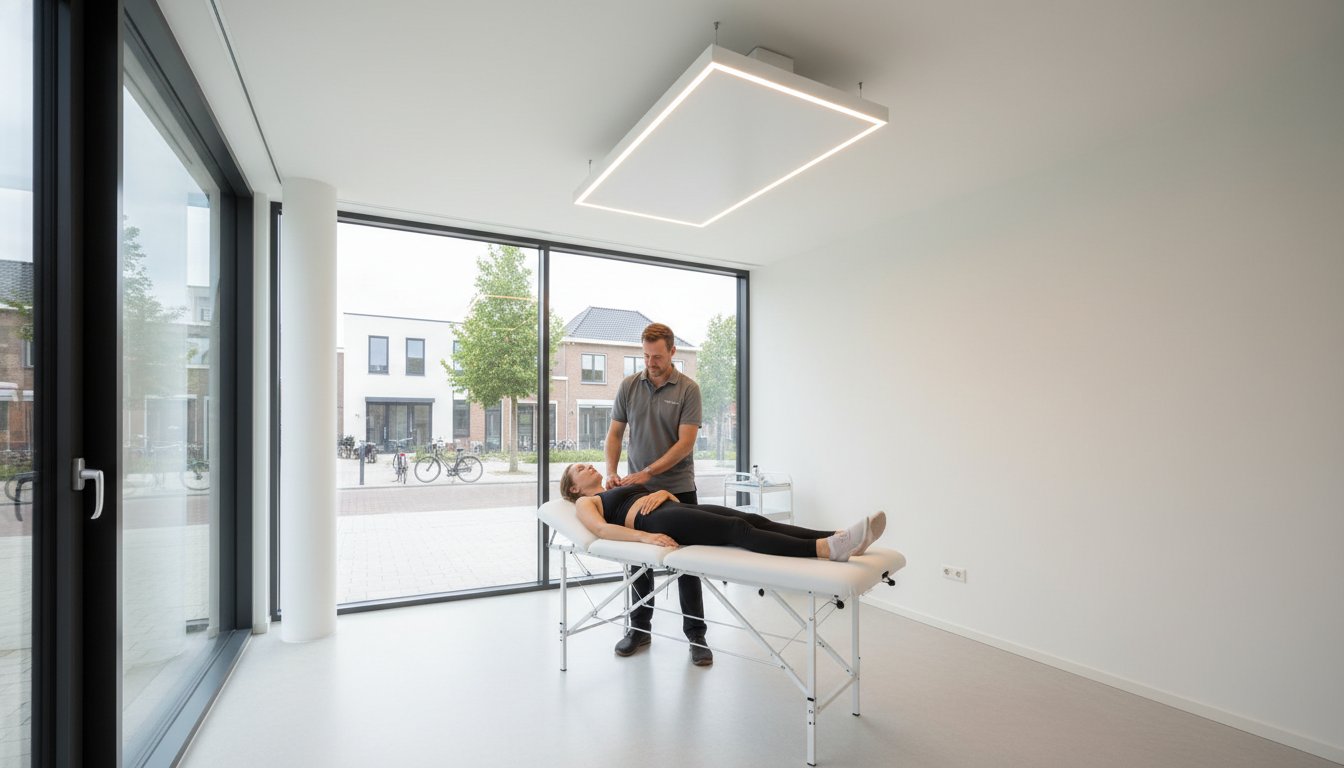
A physiotherapy practice has different heating needs: a person on a treatment couch may need different comfort from an active patient or receptionist. Infrared panels can form part of space heating. They provide thermal comfort and are not treatment equipment for pain, muscle relaxation, circulation or recovery.
Key points
Create use profiles for treatment, exercise and waiting rooms. Assess patient and staff positions, heat loss, ventilation and controls. Safe use must suit users and instructions. A room panel provides no universal suitability guarantee for every patient or medical device.
Comfort during different activities
Map room schedules, usual clothing and posture and the practice’s intended temperatures. Ask about comfort during normal activities. Do not replace assessment of the practice and patients with a universal treatment-room temperature.
Investigate draughts, cold windows and existing heating. Local warmth may help without removing the cause. Keep ventilation appropriate for room use; do not reduce it solely to lower panel consumption.
What infrared panels do as space heating
Panels radiate towards accessible people and surfaces and also produce convection. Furniture, screens and equipment can obstruct radiation. Perceived warmth also differs from measured air temperature. Assess comfort without attributing therapeutic effects.
Ceiling mounting above a treatment position is no universal standard or guarantee. Consider patient position, access, distance and permitted exposure. For vulnerable users or medical-device questions, follow responsible clinical assessment and relevant manufacturer instructions. The term infrared establishes no general conclusion about pacemakers or implants.
A fanless heater does not remove dust or microorganisms. Natural convection, ventilation and movement still move air. Plan cleaning and access according to practice procedures and instructions. Panels do not replace hygiene or ventilation provisions.
Compare alternatives and total costs
Compare existing-system improvement, supplementary panels and replacement for the same demand and hours. Include works, electrical capacity, controls, energy, maintenance and replacement. Low purchase cost or fast panel response does not prove lower running costs than boilers or heat pumps.
Determine consumption from actual input and operating time using your tariff. A thermostat may cycle again to replace losses; do not assume a fixed fraction each hour. Check incentives for the specific investment against current official criteria.
Plan each treatment space
Gather dimensions, insulation, glass, ventilation and target temperature by function. Assess heat loss and distribution for primary or supplementary use. Fixed area values or standard panel counts are not full calculations. Include moving couches and exercise equipment.
Check load support, fixings, clearances and complete electrical connection. Grid integration requires approved models and support. Keep light, air supply, detection and maintenance accessible. Check actual grid dimensions, not merely nominal panel size.
Choose compatible controls and representative sensors. Align schedules with appointments, preparation and cleaning. A still patient must not unintentionally be treated as absent. Test manual operation and any building integration, including failure behaviour.
Our support with product selection
We advise private and business end users and support installers and wholesalers. Share room data, intended use and practice requirements. We discuss suitable models and controls. Clearly define and coordinate clinical, building design and installation responsibilities.
Colours, mirrors and lighting may suit the interior where available. Check function and use: heated mirrors can be hot and are not automatically suitable for every exercise arrangement. LEDs must suit tasks and independent control varies by model.
Commission and evaluate with the practice
Test normal postures and ventilation. Ask about comfort without equating it to treatment outcomes. Hand over settings, manuals and maintenance and reassess layout changes. Assess damaged fixings, cables or surfaces before reuse.
Practice heating questions
Can existing heating be removed?
Only after assessing full demand and functions. Local comfort does not prove all rooms remain adequately heated. Check other existing-system functions and resilience before deciding replacement.