
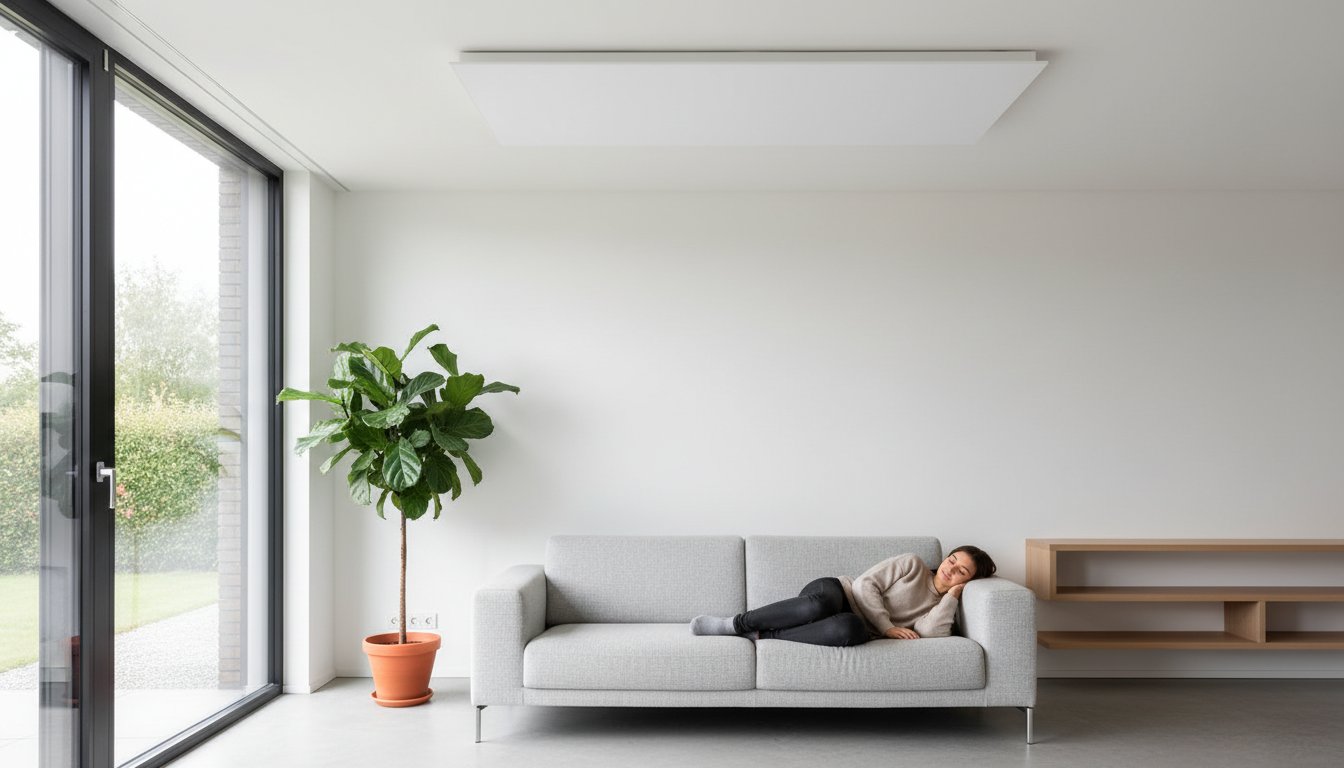
Are you looking for heating for a home where someone has allergies or asthma? It is important to assess thermal comfort and air quality separately. Infrared panels can heat a room or seating area, but they do not treat allergies or purify the air. We will gladly help you choose a suitable heating solution, taking the room, controls and daily use into account.
Key points
- Infrared panels deliver heat to people and surfaces. The air also warms up and air movement continues.
- Ventilation, cleaning and addressing moisture problems remain necessary, regardless of the type of heating.
- Power rating, mounting position and thermostat control are among the factors determining thermal comfort and electricity consumption.
- A panel does not guarantee fewer allergens, better breathing or a better night’s sleep.
Heating and indoor climate
Temperature is one aspect of the indoor climate. Ventilation, sources of moisture, cleaning and the structural condition of the home also play a role. Choosing a heating system based on promised health benefits is therefore not a sound basis. If you have persistent health complaints, you can ask your GP for advice.
Ventilation remains essential
The GGD recommends continuous ventilation, supplemented by airing out rooms. Follow the instructions for the ventilation system in your home. Additional moisture extraction is important when cooking and showering. Do not close ventilation openings to retain heat.
Dust and maintenance
Keep heating surfaces and the surrounding area clean according to the manual. A smooth panel can be practical for cleaning, but it does not remove dust, pollen or dust mites from the room. There is no generally substantiated percentage by which switching to infrared panels reduces the amount of dust in your home.
What infrared heating does and does not do
Infrared panels emit radiant heat towards people and surfaces within their range. Convection also occurs and the air warms up as well. Ventilation, temperature differences and occupants’ movements also cause air movement. A room with infrared panels therefore does not become free of air movement or dust.
How comfortable the warmth feels depends on factors including positioning, distance, air temperature and insulation. We do not promise a fixed number of degrees by which the thermostat can be lowered. Nor does the heating method guarantee fewer allergy symptoms, calmer breathing or deeper sleep.
Moisture and mould require their own approach
Heating does not replace ventilation and does not repair leaks or structural moisture problems. Recurring damp or mould requires investigation and treatment of the cause. A panel is not a mould treatment and does not guarantee that condensation or mould will stay away.
Heat output, cleaning and consumption
Radiators and infrared panels both emit heat through radiation and convection; the ratio varies by model and situation of use. Assess the specific product and the room’s heating demand. Browse our range of heating products to compare models.
Targeted heating and control
A suitable panel and thermostat can be a practical way to provide warmth where and when you need it, for example at a workstation or in the living room. The required power rating follows from heating demand. Electricity consumption and costs depend on factors including heat loss, operating hours, control and energy tariff. We cannot provide a fixed savings percentage or payback period without a calculation for your situation.
Cleaning and installation
Check the product information to see what cleaning and inspections are required. A simple radiant panel generally has no air filter, but it does not replace a ventilation system or air purifier either. Follow the mounting instructions and have the suitability of the electrical connection and supporting structure assessed. Wall or ceiling mounting must be permitted for the chosen model.
Applications by room
Bedroom
For infrared heating in the bedroom, we consider the desired temperature, operating times and a permitted mounting position. Take furniture and the manufacturer’s instructions into account. A panel is intended for thermal comfort; improved sleep or reduced allergens has not been demonstrated by this.
Bathroom and kitchen
For infrared heating in the bathroom, product suitability, mounting location and electrical safety are important. Have the positioning assessed against the manual and the requirements for the room concerned. A heated mirror can combine heating with a mirror function; operation varies by model. Continue removing moisture after showering and cooking.
Living room and workplace
We tailor power rating and positioning to usage and the room. We consider insulation, window area, obstacles and existing heating. In addition to metal and glass models, there are infrared panels with an image. Available finishes and mounting options are listed with the relevant product.
Advice on your situation
We advise private and business end users and support installation companies and other business partners in their product selection. When making an enquiry, specify the room concerned, how it is used and what heating is already present. This allows us to discuss the options and considerations for thermal comfort.
Would you like to know which heating suits your home or project?
Request a quote or contact us for advice on power rating, positioning and control.
Frequently asked questions
Is infrared heating a treatment for allergies or asthma?
No. We offer heating products for thermal comfort. We cannot promise symptom relief or medical effects. Discuss health complaints with your GP.
Does the air remain still with infrared panels?
No. Convection occurs alongside radiant heat. Ventilation and movement in the room also move air. A panel does not make the room dust-free.
Do I need to keep ventilating?
Yes. Ventilation remains necessary with every heating system. The GGD provides practical guidance on continuous ventilation, additional airing and extra extraction when cooking and showering.
Can infrared heating serve as primary heating?
This requires an assessment of heating demand, insulation, available electrical capacity and control. A general power rule per square metre is no substitute for that assessment.
Does a panel remove dust mites or mould?
A heating panel is not intended as a pest or mould treatment. Continue cleaning and address moisture problems at their source. We do not guarantee fewer dust mites or the disappearance of mould.
What should I consider for safe use?
Follow the manual for mounting, distances, use and cleaning. Take hot surfaces and users’ circumstances into account. ICNIRP describes how excessive exposure to infrared heat can damage skin and eyes; exposure duration and intensity play a role.