
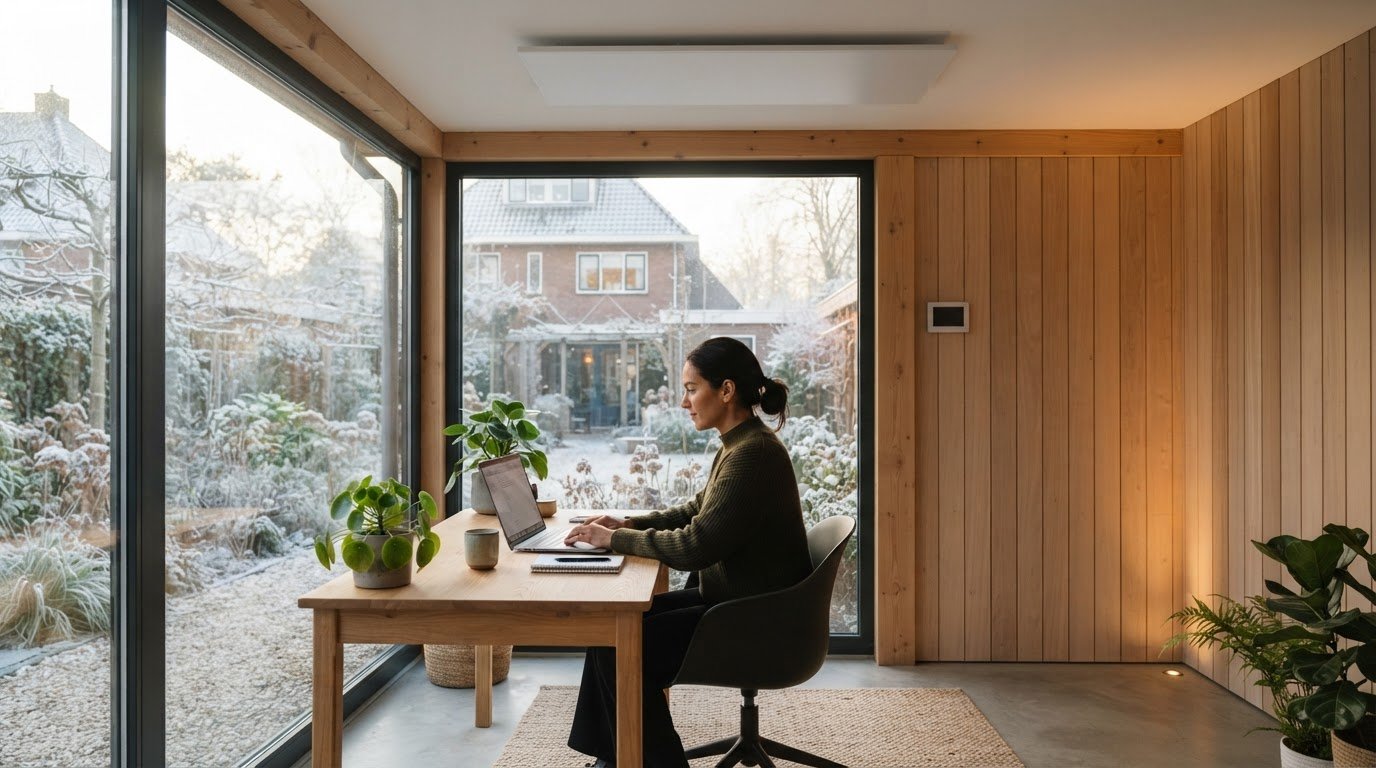
Heating a garden building starts with its function: storage, occasional seating or daily workspace? These uses need different heating. Start with use, insulation and the desired comfort zone, then choose suitable heating, positioning and controls. Dimensions or wattage alone provide insufficient information.
Key points
Limit heat loss, distinguish local comfort from whole-space heating and check mounting and connection conditions. Infrared panels can suit targeted uses but are not automatically best or cheapest for every garden building. Results depend on building, appliance, controls and use.
Heating your garden building starts with insulation and use
Inspect roof, walls, floor, windows, doors and joints. Gaps can cause draughts and poorly insulated parts lose heat. Identify improvements before choosing a larger heater. Heating does not repair poor insulation. Retain suitable ventilation: reducing draughts does not mean closing every vent.
Record whether the space is storage only, occasional use or a daily office or hobby room, and when and how long you stay. Guest accommodation also requires assessment of its suitability as an occupied space. Decide whether only a desk or seat needs comfort or the whole room must maintain temperature.
How does infrared release heat?
An infrared panel transfers heat through radiation and also convection. Radiation can reach people and surfaces; heated surfaces then release heat to their surroundings. A convector mainly warms air, which spreads through the room. The distinction is therefore not an absolute separation between air heating and radiant heat.
Match position to the occupied zone. Furniture, high shelves and other obstacles can limit direct radiation. Wall or ceiling mounting is only possible if the chosen model permits it. Check distances, load-bearing capacity, environment and electrical connection in the manual. Warm-up time and perceived heat vary by version and situation; do not expect generally guaranteed immediate room heating.
Heating your garden building: which technology suits?
An infrared panel can suit a fixed workstation; a convector may suit room-air heating. Both can form part of fixed heating. Fixed describes installation, not a separate heat-transfer technology. For prolonged use, assess other suitable systems too and compare equal temperature, duration and conditions.
Compare purchase, mounting, controls, maintenance and energy use. At constant full power: watts × hours ÷ 1,000 = kWh. A 1,000-watt appliance running continuously at full power for two hours uses about 2 kWh. Costs are kWh × your electricity tariff. A thermostat changes actual on-time; two hours of occupancy do not automatically mean two hours at full power.
Heating a garden building: establish heat demand
Measure length, width and height. Record windows, doors, insulation, possible draughts, desired temperature and operating times. Draw where you sit or work and available mounting positions on a floor plan. Photos help assess furnishings and obstacles. A general watts-per-square-metre rule does not replace heat-loss assessment.
Identify the electrical supply and other connected appliances. Have supply, protection and installation assessed for combined load and conditions. Check appliance and controls for damp or low ambient temperatures. Do not simply use an indoor panel in an unheated, damp or outdoor setting.
A suitable version and controls
Metal, glass and printed panels differ in appearance and construction. Do not prioritise design over mounting suitability, output and position. Check required controls and whether included for each model. Schedule actual use; air-temperature controls need careful positioning for useful measurements.
Low-maintenance does not mean maintenance-free. Follow the manual for cleaning and checking appliance, fixings, connection and controls. Do not cover a heater and maintain prescribed clearances. Recurring damp, mould or draughts require assessment of the cause; heating is not a general solution to such building or ventilation problems.
Heating your garden building with a suitable plan
We supply private and business users, installers and wholesalers. Send dimensions, photos, insulation, hours and intended comfort zone. We help compare suitable products, mounting and controls. Using photos and a plan, we discuss your situation and assist remotely.
Frequently asked questions about garden-building heating
Can infrared provide primary heating?
This needs assessment of heat loss and the desired temperature throughout the space. A panel making a desk comfortable is not automatically enough for the whole building. Match sizing and controls to its function.
Should a poorly insulated garden building be improved first?
First identify losses and draughts. Useful improvements depend on construction and use. Targeted heat adds local comfort but repairs neither gaps, damp nor insulation. Assess heating together with the building’s condition.
Is infrared always cheaper than an electric heater?
No. Compare the same demand, hours and conditions, including controls and installation. Local heating may help if it genuinely reduces heating elsewhere. Added heating alongside an unchanged system also adds consumption.
Where should I place a panel near a workstation?
Choose an approved mounting position directed usefully at the occupied zone. Avoid unnecessary obstacles and follow model-specific clearances and connection conditions. Both the room and appliance manual determine a suitable wall or ceiling position.
Further reading and sources
Mainly heating a fixed seat or workstation? Read Milieu Centraal’s explanation of local supplementary heating with infrared panels. Always assess the options together with your garden building’s insulation and use.