
Plan shed heating according to use and surroundings. Do you occasionally want to work at the bench, heat the entire space daily or protect vulnerable pipes? Write those goals down separately. A comfortable workplace does not automatically mean every storage corner remains frost-free or dry.
This guide develops a practical plan for private and business end users, installation companies and wholesalers. Infrared is one possible heat source, but environmental risks, insulation and electrical capacity remain decisive. Compare options without identifying one technology in advance as the only cost-effective solution.
Key points
Investigate the building envelope and moisture sources and maintain necessary ventilation. Assess combustible dust, vapours and storage before product selection. Calculate capacity for the chosen goal and check electrical supply alongside other appliances. Maintain model clearances and maintenance access, and document management of controls and frost-sensitive positions.
Recording requirements and environmental factors
Record dimensions, roof and wall construction, glazing, doors and known insulation. A large door opened regularly can have a major effect. Assess useful draught sealing and insulation together with ventilation. Connecting to existing central heating, an independent system or targeted heat has different costs in each situation; none is always uneconomical without calculation.
Moisture can originate from leaks, ground, wet belongings or ventilation problems. Heating can change relative humidity and surface temperatures but does not remove those sources. Have persistent condensation, mould or corrosion investigated. No panel guarantees that radiation protects all tools, electronics or building elements.
Frost protection as a separate task
Map pipes, connections and other vulnerable positions. A thermostat measuring five or seven degrees at one point does not guarantee a pipe behind a cupboard or at an external wall remains above zero. Protection requires appropriate assessment, sufficient capacity, available power and additional measures where necessary. Do not rely only on a general frost setting.
Assessing targeted radiant warmth
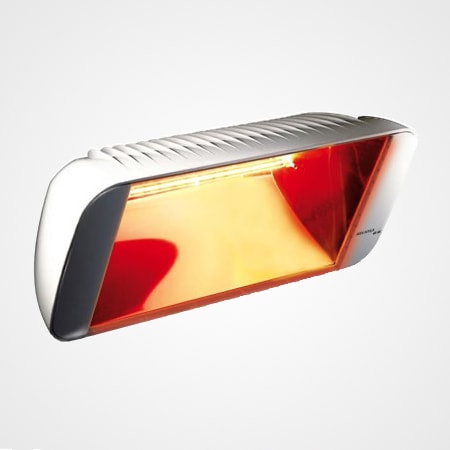
Infrared can heat people and surfaces within reach and also emits convective heat. Warmth at a workbench depends on distance, posture and obstructions. A machine, tabletop or rack can shield areas. Assess the location with the actual work process, not just an empty room in a drawing.
Wind and ventilation can still remove heat from people and surfaces. Heat stored in a floor or wall is not loss-free. A fanless panel does not make a workshop dust-free or replace extraction. Local warmth may be useful, but a multiple of the electrical efficiency of another resistance heater is not a general characteristic.
Comparing systems for their application
Compare a convector or fan heater, a non-glowing panel and a targeted radiant heater for the same use. Consider heat distribution, warm-up time, noise and controls. The words heatstrip, metal or industrial do not prove a fixed distance or suitability. Compare actual specifications and mounting requirements for each version.
A higher ceiling may require different coverage or distribution, but ceiling mounting is not automatically best. Assess permitted orientation, load-bearing capacity and maintenance access. A metal enclosure is not automatically impact-resistant. Use only an appliance whose environmental requirements suit the shed and work.
Wood dust, paint and other combustible substances
With combustible dust, sawdust, mist or vapour, have the environment expertly assessed before selecting a heater. An IP code does not prove fire or explosion safety. Hot surfaces and electrical components can be ignition sources. Keep extraction, ventilation and cleaning in order, and have any hazardous zones and required product suitability determined.
Developing capacity and installation
For room heating, use an appropriate heat-loss assessment covering insulation, glazing, doors, external surfaces, ventilation and desired temperature. A fixed table of sixty to one hundred and fifty watts per square metre is not a complete calculation. Floor area alone therefore does not determine how many panels you need.
Have electrical supply assessed with machines and other simultaneous loads. Circuits, cables, protection and switching equipment must be suitable. A general limit of three thousand or 3,680 watts does not replace this assessment. Keep cables away from work and walking routes, and have fixed work carried out competently.
Fixing and clearances follow the exact appliance’s requirements. A wooden garden building needs attention to combustible surfaces; twenty or thirty centimetres is not a universally safe distance. Also check moisture, dust, corrosion and permitted ambient temperature. Have an uncertain combination confirmed first.
Controls and handover
Position the sensor representatively and choose compatible controls. Test the workplace, programmes and recovery after power or connection failure. A motion sensor must suit the work and warm-up time. Record who changes settings and how the system is switched off when the shed is not in use.
Discussing your shed project with us
Send photos, a floor plan, usage hours and information on insulation, electricity and work activities. Identify stored materials and frost-sensitive positions. We discuss possible products with you and, where relevant, the installer or wholesaler. Ask for a proposal clearly identifying mounting, controls, scope of supply and conditions still to be checked.
Monitoring maintenance and changing use
Clean and inspect according to the manual after safe shutdown and cooling. Check cables, fixings, dust build-up and controls. Low maintenance is not a guarantee of unlimited service life or no service costs. Reassess when new machines, different storage or work involving dust or paint are introduced.
Frequently asked questions
Can an uninsulated shed be comfortable?
Targeted warmth may sometimes suit a workplace, but high heat demand and cold surroundings still matter. Also assess building improvements and the costs of heating the whole space. No technology guarantees comfort everywhere or frost protection without design. Do not compare a local solution as though it brings the entire shed to the same temperature.
How do I calculate hourly costs?
One kilowatt actually drawn for one operating hour uses one kilowatt-hour. Multiply that by your own electricity tariff. With controls, use actual operating time or suitable measurement. A tariff from a general text and a promised fixed warm-up time do not form a reliable budget for your shed.