
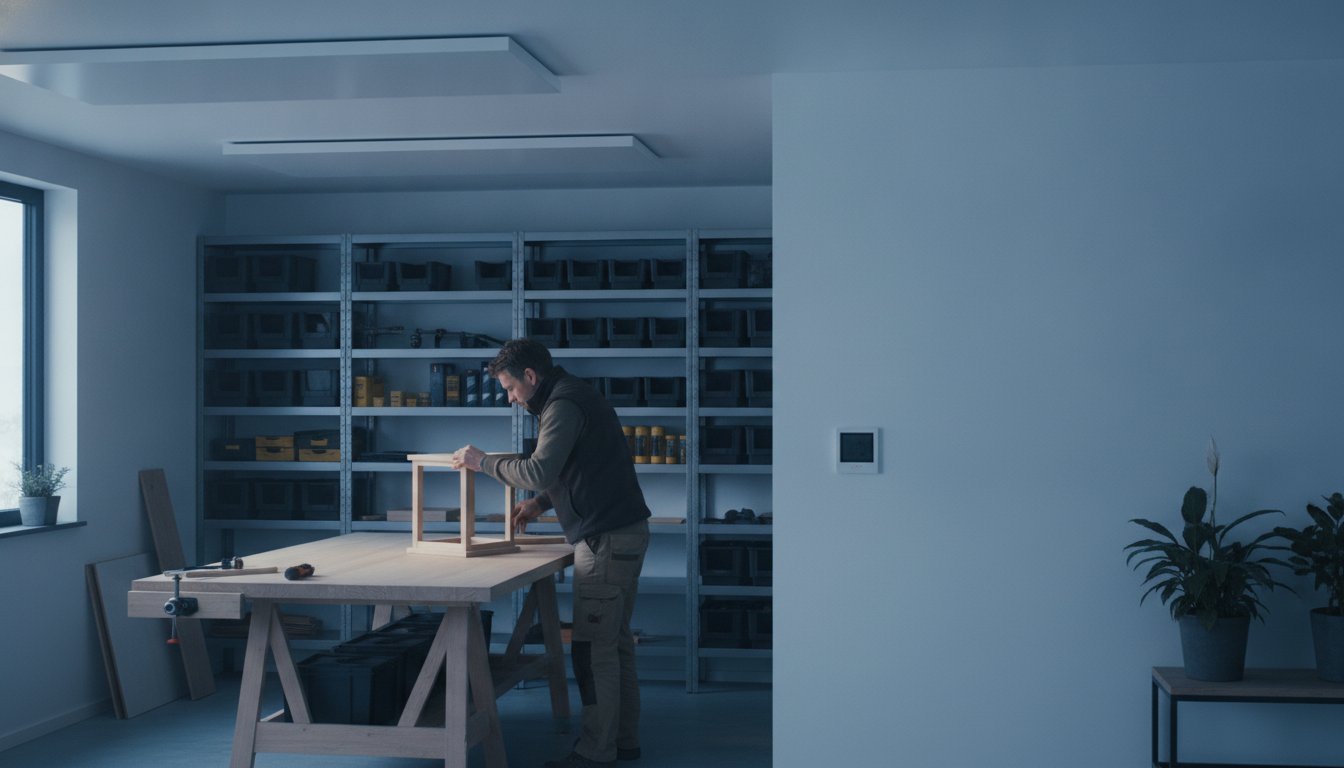
A garage may be used for storage, hobbies or as a professional workshop. These uses do not require the same heating. First decide whether you want temporary comfort in a working zone, heating for the whole space or protection of sensitive items from cold. Here we explain the information needed for a suitable choice.
Start with use and environment
Record dimensions, insulation, door use, target temperature and working hours. Also assess moisture, dust, flammable substances and the available electrical connection. A fixed power rule per cubic metre or a panel photograph does not provide a complete heating assessment.
Electric heating: when does it fit?
An electric device can be practical where there are no water pipes or gas connection. This does not automatically make it the cheapest or most sustainable choice. Compare investment and running costs for your actual usage time and energy tariff. For prolonged heating, a suitable heat pump may also be an alternative. Insulation and avoiding unnecessarily open doors can reduce heat demand.
Compare air heating and radiant heating
A convector or fan heater mainly heats air. An infrared device directs a larger share of its heat as radiation towards people and surfaces within coverage; convection also occurs. Both systems lose heat through the building envelope and ventilation. Infrared does not prevent an open door or cold draught from affecting comfort. A device without a fan does not replace dust extraction or ventilation.
Heating a work zone with infrared
Targeted heating may suit a fixed workbench used for only a few hours. Check whether the chosen device reaches the working position from its permitted installation height and is not blocked by a vehicle, rack or machine. Response time and perceived warmth vary with device and placement. A low-temperature domestic panel and an industrial infrared heater are not automatically interchangeable.
Dust, vapours and flammable materials
Where paint, solvents, fuel or combustible dust are present, an expert risk assessment is needed first. Hot surfaces or electrical components can be an ignition source. An IP code does not establish suitability for an explosive atmosphere. Have the environment and required device specification assessed before selecting heating. Include ventilation, extraction and material storage in that assessment.
Assessing power and running costs
For whole-space heating, consider heat loss through roof, floor, walls, windows, door and air exchange, alongside the target temperature. Twenty square metres or fifty cubic metres alone does not yield reliable wattage. Local heating also requires assessment of distance, coverage and user position. More power does not replace a suitable device and good placement.
A 1.5 kW device running continuously at full power for two hours uses approximately 3 kWh. This is a calculation example, not a forecast for your garage. Multiply actual consumption by your total electricity tariff. Compare systems at the same comfort level, accounting for warm-up time, controls and any background heating.
Installation, connection and controls
Follow the manual for fixings, load capacity and clearances. Universal distances of twenty or fifty centimetres do not apply to every model. Keep the device accessible for cleaning and inspection. Have a competent installer assess the combined load of heating and machinery, protection, wiring and connection. Having a socket does not automatically make a garage suitable.
Choose compatible controls and a sensor position according to the instructions. Wi-Fi, an app, presence detection and energy monitoring depend on the model. A frost setting does not guarantee every object or water pipe stays frost-free, especially with an open door, power failure or unsuitable sensor location. Assess protection of sensitive items separately.
Advice for your garage or customer project
We supply private and business end users and work with installers and wholesalers. Send a plan or photographs, dimensions, insulation data, working hours and details of substances or machinery present. We can then discuss available solutions and necessary next steps.
Frequently asked questions about garage heating
Does heating help with condensation?
Warmer surfaces can help limit condensation. Moisture from a wet vehicle, leaks or work must also be removed or limited at source. Heating does not replace ventilation or repairing leaks.
Is ceiling installation always better?
Ceiling installation can free wall space, but height, coverage, obstructions and the model’s permitted mounting determine suitability. Wall installation may better suit a specific working position. A warm floor or even warmth around the body is not guaranteed.