
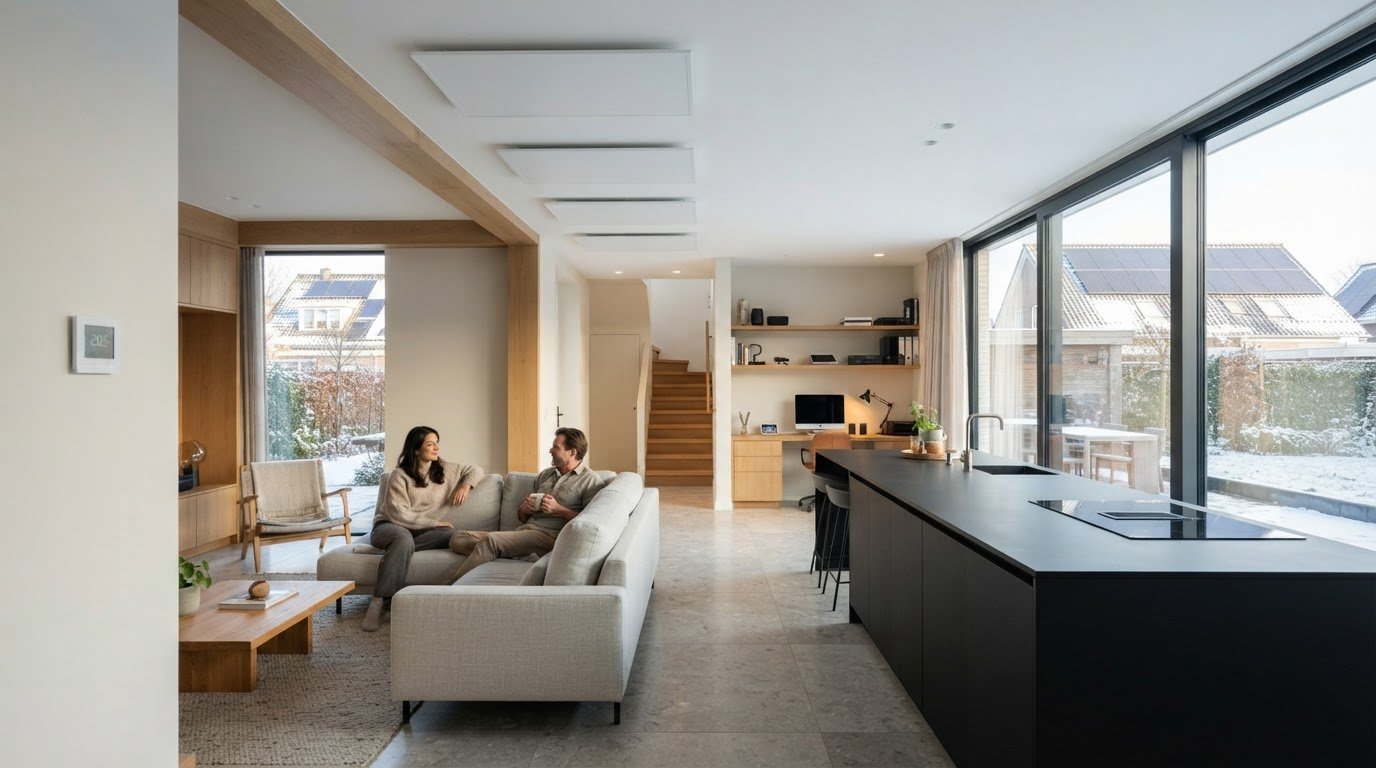
Heating without natural gas starts with a building plan. Establish heating demand, existing installation and intended use before choosing appliances. Infrared panels can play a role in local heating or a suitably designed system. They are not a universal replacement for every central-heating installation.
This guide helps compare direct electric heating fairly with other gas-free options. Consider installation, controls, maintenance and costs alongside comfort. We advise private and business end users and support installers and wholesalers in product selection for buildings and customer projects.
Key points
Gas-free does not automatically mean sustainable or cheap. Assess insulation, ventilation, demand and energy supply. Distinguish space heating, domestic hot water and cooking. Check electrical capacity and compare complete systems at the same demand and comfort.
What does gas-free heating mean for your building?
A building without natural gas requires more than a different room heater. Check how bathroom and kitchen water are heated and whether cooking still uses gas. A fully electric heat pump, connection to an available heat network and direct electric solutions have different requirements. Assess the building rather than choose one technology for every situation.
Insulation and limiting unwanted draughts can reduce demand; ventilation remains necessary. Changing heat delivery does not eliminate heat loss. Water-based systems can also use room controls. Zoned heating is therefore not exclusive to infrared panels.
How does electric infrared heating work?
An infrared panel uses electricity to warm a surface. That warm surface releases energy through thermal radiation and also convection. People and surfaces absorbing the radiation become warmer. Perceived warmth ultimately depends on the panel, distance, direction, layout and room conditions. The technology does not remove the need for insulation, ventilation or suitable controls.
Infrared panels also provide convective heat, and radiators also provide radiant heat. Comfort depends on position, distance and surface temperatures. Heating does not remove moisture or automatically make air dust- or draught-free. No fixed air-temperature reduction with equal comfort applies to every building.
Compare heat pumps and infrared fairly
A heat pump uses electricity to move heat from a source such as air or ground. Direct electric resistance heating converts input electricity into heat. This matters for electricity use at equal heat delivery. Compare the actual heat pump and distribution installation with the complete panel system, not merely one appliance’s purchase price.
Alterations vary by building and system. Heat pumps require assessment of source, emitters, space and any noise considerations. Panels require assessment of heat loss, mounting positions, controls and electrical load. Neither automatically avoids installation work, maintenance or faults. Compare service, warranty and replaceable components too.
A room-by-room heating plan
1. Gather building and use data. 2. Assess heat loss. 3. Compare systems at equal comfort. 4. Design emitters and controls per room. 5. Assess combined electrical load and supply. 6. Include hot water, ventilation and cooking where relevant before ending gas supply.
Occupancy and demand differ in living rooms, bedrooms, bathrooms and workshops. Desk panels must be designed for that use; bathroom products require position and installation assessment. Open doors, airflow and mounting height affect comfort in halls. An industrial heater is not automatically equivalent to a domestic panel.
Product advice and support for your building
Tell us which room you want to heat, when you use it and whether a panel or controls are already installed. Include model details and your preference for local operation, schedules or remote control. Business partners can also discuss product selection across several rooms and the components required. We confirm which functions and combinations are available for the selected model.
From heating need to an informed plan
Compare more than purchase prices and wattages. Include controls, installation, maintenance, energy tariffs and the overall heating arrangement. Electric supplementary heating is not automatically cheaper than gas heating or a heat pump. The outcome depends on the systems and the heat demand you actually replace or add.
Agree which product advice we provide and which installation or building assessments remain necessary. Use current tariffs and check any subsidy conditions separately. Solar panels do not generate at every heating moment; assess simultaneous generation, demand and any storage without assuming free winter heating.
Gas-free heating questions
Is my existing electrical supply sufficient?
Assess this using all simultaneous loads, the installation and selected controls. A generic connection rating or the assumption that rooms never heat together is not evidence. Have it checked before ordering a fully electric installation.
What happens during a power cut?
Electric heating cannot then supply new heat. Many other modern systems also need electricity for controls or pumps. Cooling speed depends on construction, insulation, outdoor temperature and stored heat, not only the heating type.