
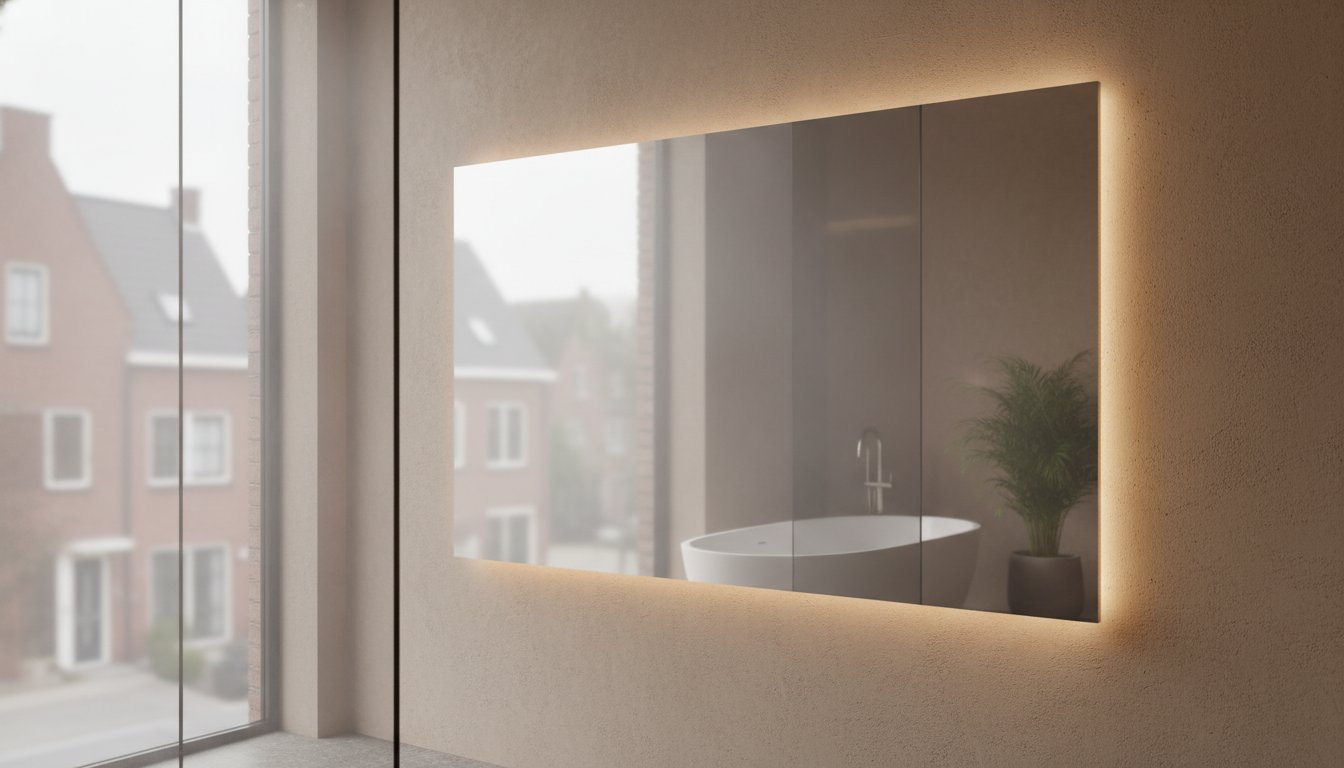
A heated mirror can serve two purposes: warming glass to limit condensation, or also contributing to room heating. Not every product does both. Define the function before choosing size, output and controls.
Key points
Compare usable heating capacity, not mirror dimensions alone. Check mounting, electrical suitability and controls. A warm mirror is not automatically primary heating, and always condensation-free is no general guarantee.
How does mirror heating work?
Electricity becomes heat in the element and warms the mirror surface. Room-heating panels then emit radiation and convection, warming air too. Construction, material and permitted application vary by version.
Condensation may occur below surrounding air’s dew point. Warming the glass can limit it. Warm-up, environment, humidity and heated area determine results. The dew point is not cancelled and mirrors do not dehumidify bathrooms.
Practical benefits and limits
A combination can replace a separate radiator or mirror if capacity and location suit, keeping walls uncluttered. It remains a heater: consider touch, clearances and cleaning. Decorative appearance changes none of those conditions.
Mirror panels provide no automatic health benefit, humidity regulation or dust-free air. Ventilation remains necessary. Check glass, coating and recyclability claims for the product; they do not establish primary-heating suitability alone.
Choosing a mirror for bathroom, hallway or business
Bathroom viewing height, sight and coverage must align. Hallway doors and people influence position. Hotels and business spaces also need multi-user operation, cleaning and service. Do not choose mounting solely for a pleasing basin image.
Whole-room heating needs loss calculation. Desired mirror size may provide insufficient heat, requiring another or additional source. Extra electricity beside unchanged primary heating adds consumption, not automatic savings.
Preparing safe mounting and connection
Have bathroom zones, position, water protection and connection assessed together by a qualified installer. IP alone permits no shower-side or overhead location. Use the exact manual rather than general zone-two or zone-three statements.
Check wall loading, brackets, clearances and service access. Fixed or hidden connections need proper installation; fixings and cables must not damage finishes. CE is the manufacturer’s compliance declaration, not EU safety approval for every mounting. Check certificates for the exact version.
Coordinate heat, lighting and controls
Check lighting independence and dimming support. Wi-Fi, apps or a wireless protocol are not standard everywhere. For room heating choose compatible controls and representative sensing. Linking to a light switch is not automatically suitable for all heating functions.
Our advice for your mirror solution
We help private and business users, installers and wholesalers. Share photos, plan, insulation and desired functions. We compare available sizes and power and discuss extra components.
Assess the complete delivery
Ask the quotation to identify mirror, lighting, controls, mounting and connection work. Read component warranties. Lifespan expectations are not guarantees. Clean after cooling as instructed and have damage or loose mounting assessed.
Frequently asked questions
How soon is the mirror clear?
That depends on version, initial temperature, moisture and heated area. Five to ten minutes is not universal. Schedule for your routine and check in use. Ventilation remains needed when glass is clear.
How much electricity does the mirror use?
For an illustrative example, a device drawing 500 watts continuously for an hour uses 0.5 kWh. Use your model and actual hours; add light separately. Annual energy or savings do not follow only from size or a thermostat.