
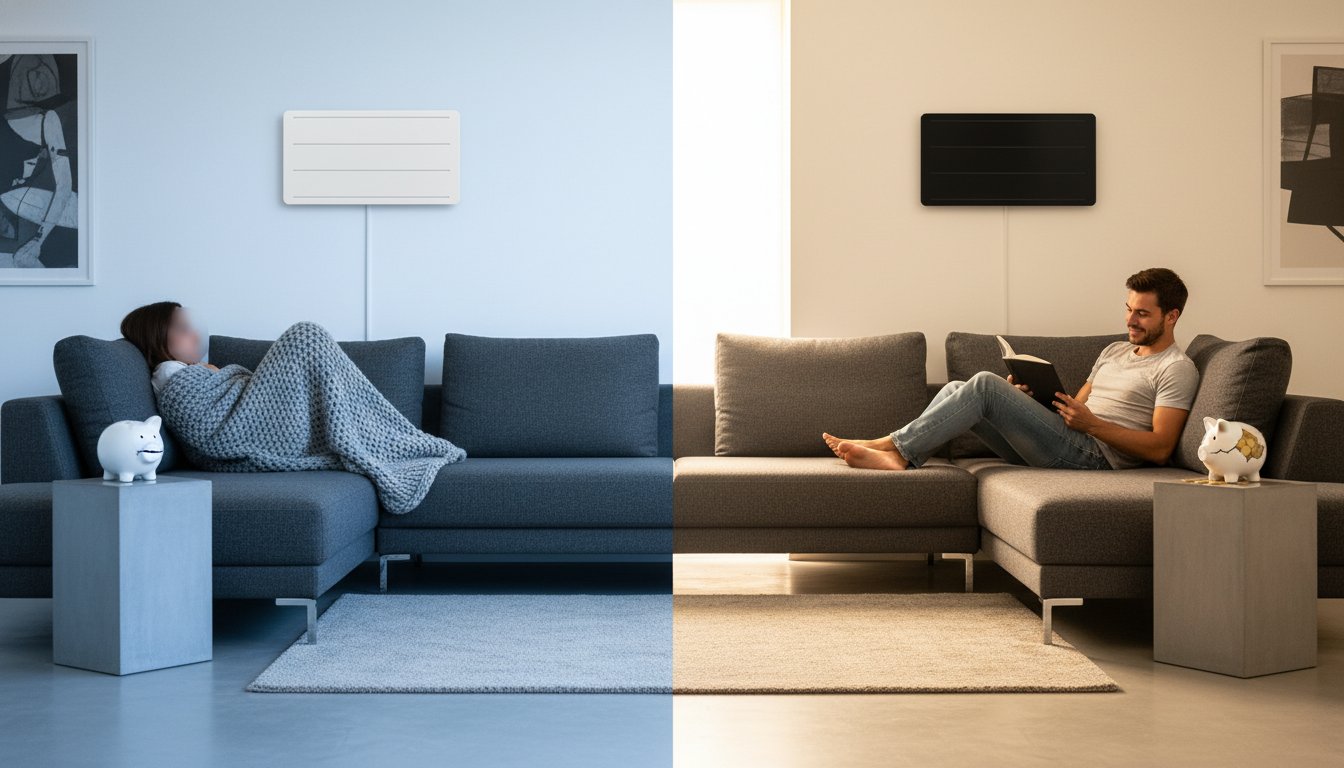
Infrared panels can be useful but do not automatically suit every room or purpose. Consider obstruction, distance, electricity costs, controls and existing heating before buying. Some limits belong to local radiant heat; others come from poor selection, faults or incomplete design. Advice cannot make every limitation disappear.
Key points
Do not confuse electrical conversion with comfort, radiant share or savings. Assess room and model together and compare equal outcomes. Higher price or European origin does not prove lower bills. Evaluate documented performance, works, controls and maintenance.
Recognise limitations beforehand
Panels radiate towards reachable surfaces and people and also produce convection. One seat may feel warm while another receives less. Multiple users and changing layouts may require more than one directed panel. Do not replace radiators one for one without assessment.
Sofas, tables, curtains and cabinets may block direct radiation. Ceiling mounting may avoid some obstacles but guarantees no clear path everywhere. Check occupied positions and required clearances after layout changes too. Include hot surfaces and access.
Heat loss, distance and warm-up
Insulation, glass and ventilation still determine demand. Radiation does not prevent outdoor losses. Material mass affects heating and cooling, but operation is not wholly dependent on heavy construction. Lightweight materials and glass can absorb heat too; assess their properties correctly.
Panel surfaces may warm before the whole room. Preheating depends on initial conditions, use and losses. Distance and source area affect perception; a simple point-source formula does not reliably locate every panel. Use model data and actual-room assessment.
Controls must measure representatively and switch compatibly. Direct panel heat may bias a sensor. Match schedules to use and investigate rather than always heating longer. Insufficient output, placement, faults and settings are different possible causes.
Assess quality without price myths
Ask for documentation, mounting conditions, warranty, service and parts. Price and origin prove neither poor quality nor faultless operation. Certification applies within its scope and does not replace assessment. Compare evidenced performance instead of claims about cheap imports.
Different emissivity or radiant share does not mean input electricity simply disappears. Resistance heating ultimately turns almost all of it into heat. Where and how that heat is useful may differ. Compare radiant measurements under matching methods and conditions.
Include mounting, electrical work, controls, consumption, maintenance and replacement. Expected life is not warranty duration. Controls or connections may need attention before the panel surface. Check repair and service conditions.
Have plans assessed before replacement
Start with purpose, losses and mounting locations. Primary heating needs whole-building assessment including ventilation and simultaneous loads. Quick calculators use assumptions and do not prove winter capacity. No universal area figure replaces assessment.
Select appliances approved for actual conditions and coordinate structure and electrics. Bathrooms require suitable models, exposure and full connections. Check clearances and access. Correct mounting does not permit covering or unintended touching.
Suitable context is not a general guarantee
Local heating may help when it genuinely reduces heating elsewhere. Otherwise panel energy is added. Solar power and dynamic tariffs may affect costs but extra heating is not automatically free or efficient. Consider when solar generation is available.
Compare alternatives at equivalent comfort and include total energy. Infrared choice proves no building compliance, carbon neutrality or health benefit. Keeping heating, improving insulation or another technology may be better in a particular situation.
Questions we can help assess
We advise private and business end users and support installers and wholesalers. Share room data, needs, existing systems and cost or use concerns. We discuss options and limits. Ask for clear assumptions and agree design, installation and checks before purchase.
Questions about limitations
Is infrared always safe or healthy?
Heaters provide comfort. Safety depends on design, distance, duration and correct use; hot surfaces can injure. Follow model instructions and assess special circumstances. General medical or dust-free promises are not product features.