
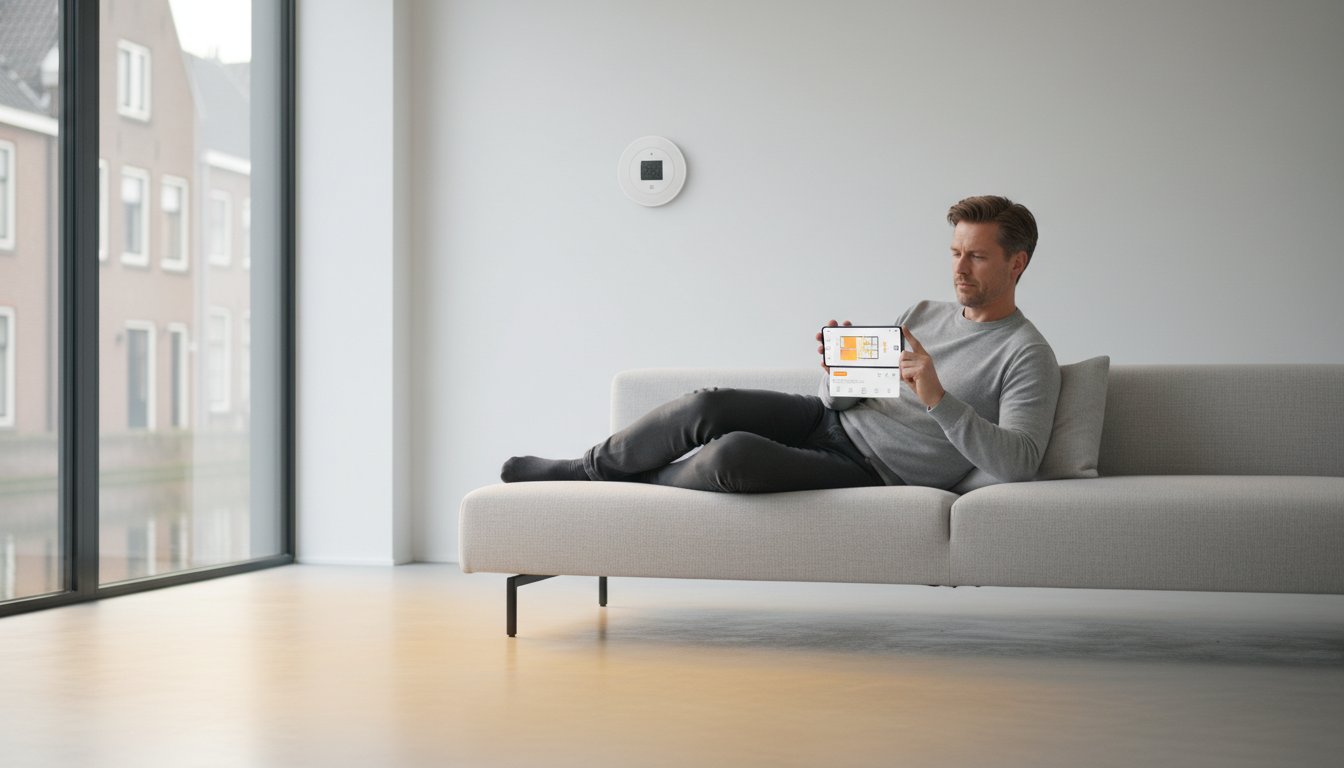
A wireless thermostat for underfloor heating can allow controls in a different location without a signal cable between thermostat and receiver. Wireless does not mean all wiring disappears, however. Heating, receiver, power supply and any floor sensor must still be connected correctly.
Assessing a wireless thermostat for underfloor heating
When looking at thermostats, first check which combination suits the type of underfloor heating, switching capacity and sensors. Test reception at the final location and check what happens with flat batteries, signal loss and an internet outage. A wireless model is not automatically more economical or accurate than a wired model.
Thermostat and receiver have different roles
The thermostat measures a temperature and determines heat demand according to the configured controls. The receiver carries out a compatible switching command. With electric underfloor heating, the receiver must be able to switch that load. A controller for water-based underfloor heating or a central heating boiler is therefore not directly interchangeable with an electrical switching unit.
Wireless operation can be convenient if the existing thermostat is poorly positioned or during renovation. To choose reliably, you also need to know the receiver’s location and its connection to the floor sensor. A wireless room sensor does not automatically replace the prescribed floor temperature monitoring.
Radio connection, Wi-Fi and compatibility
Manufacturers use different frequencies and protocols. Two devices that are both wireless or operate at the same frequency are not automatically pairable. Wi-Fi may add a connection to a network or app while a separate radio signal handles local control; the architecture differs by system.
Two-way communication may allow acknowledgement of reception, but the manual must explain fault handling. No frequency guarantees interference-free reception through every wall. Metal, concrete, distance and receiver position can affect reception. Use only a supported repeater when the system permits one.
Sensors and control behaviour
Check the floor sensor type, compatible measurement characteristics and the ability to set floor limits. An existing sensor is not automatically usable with a new thermostat. Self-learning start, PID or other algorithms are not standard in every appliance and cannot resolve an unsuitable floor build-up or insufficient output.
Zone control and realistic savings
Room-by-room control can prevent unused rooms remaining unnecessarily warm. Savings depend on previous use and connections between rooms. Closed doors, different temperatures and warm-up times therefore belong in the plan. Wireless communication itself provides no extra heat or fixed savings.
Zone control is not the same as actively limiting electrical power. Several zones can demand heat simultaneously and increase the maximum load. Check simultaneity and any power management separately. App consumption figures may be measured or calculated; ask what the figures actually represent.
Installation and reliable commissioning
Have the fixed electrical connection and switching load checked by a qualified installer. Position the receiver where temperature, access and reception meet the manual’s requirements. Install the floor sensor in the prescribed location; cable and film systems may have different instructions.
Pair every device with the correct zone and test the response from the final thermostat position. Check behaviour during signal loss, flat batteries and power restoration with the installer. Do not assume a universal fallback mode: some systems react differently and the correct setting must be clear beforehand.
Combining underfloor heating and infrared panels requires a designed control strategy. One thermostat cannot automatically switch both systems safely or monitor different temperature limits. Check sensors, receivers and total load together. In a bathroom, all components and their mounting locations must also be suitable.
Our advice when choosing or replacing
We help private and business end users, installation companies and wholesalers. Send the brand and model of the existing heating, thermostat and sensor, plus photos and connected output. We can then discuss which parts can remain and which information is still missing.
Record operation and maintenance arrangements
Keep manuals, zone arrangements and settings. Ask how to replace batteries, recognise faults and operate manually. For an app or gateway, check which account, network or cloud services are needed. Simple local controls may be suitable if you do not need remote operation.
Frequently asked questions
What is the range, and how long do batteries last?
Both depend on product and situation. A stated free-field distance is not a guarantee indoors. Battery type, transmission behaviour and functions affect operating life. Follow your appliance’s alerts and replacement instructions; do not generally assume thirty to fifty metres or a fixed two-year period.