
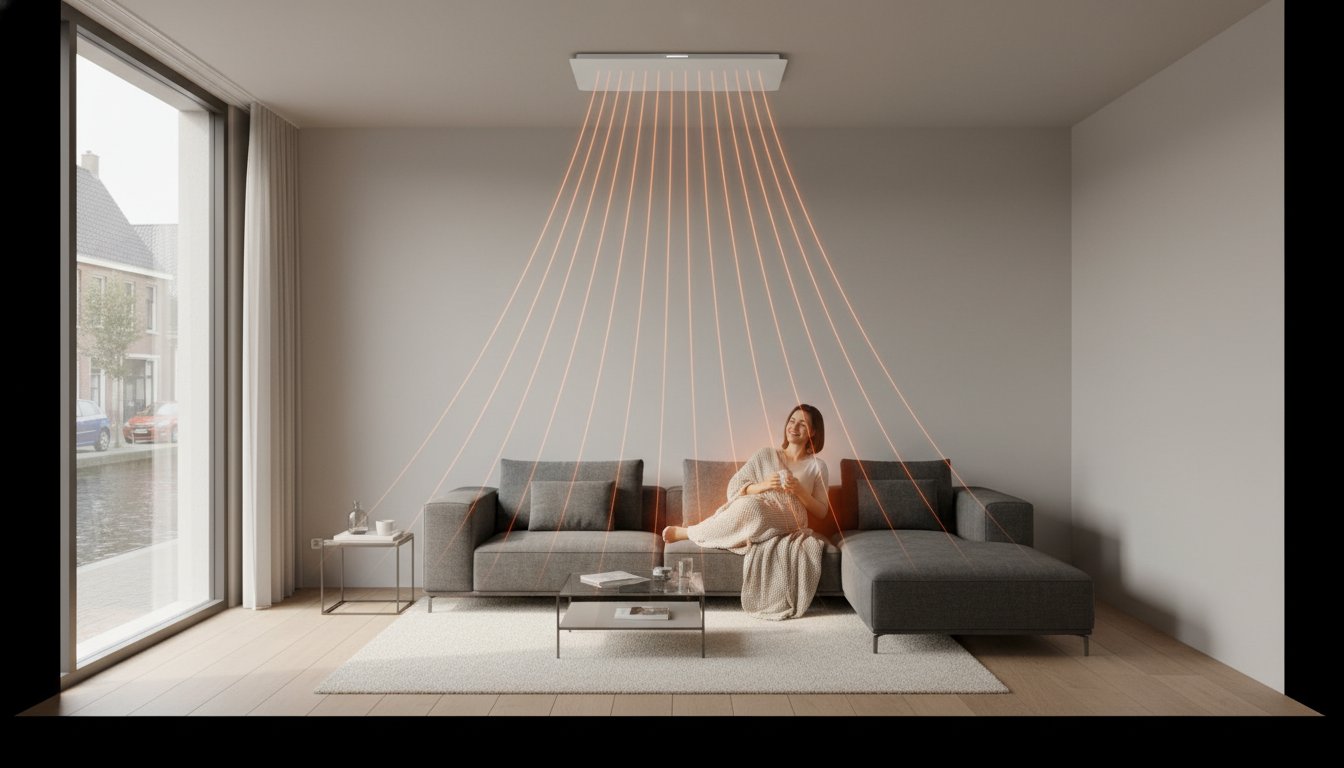
Illustration: the orange lines explain the principle of radiant heat. Infrared radiation itself is invisible.
Radiant heat is a way in which heat is exchanged between surfaces. You notice it near a warm stove or heated panel, for example. To choose heating appropriately, distinguish this heat transfer from the heat source, electricity consumption and room comfort. This guide explains the relationship for homes, workspaces and customer projects.
Three concepts to distinguish
Heat generation describes where heat comes from. Heat transfer describes how it moves. Comfort describes how people experience the conditions. A high radiant share therefore does not automatically demonstrate low electricity consumption or better health.
How does radiant heat work?
Surfaces emit thermal radiation and absorb radiation from their surroundings. With heating, the net heat exchange is particularly important. Temperature, area, material properties and the surfaces’ mutual line of sight play a role. A warm panel can therefore heat people and objects within reach without needing air as a transport medium. The panel also warms air by convection.
The terms IR-A, IR-B and IR-C distinguish wavelength ranges. They do not create a general distinction between safe indoors and unsafe outdoors. Suitability and exposure must be assessed for the actual appliance, distance and duration of use. A domestic panel and industrial heater do not automatically have the same application.
Radiation, convection and conduction
| Principle | Transfer | Example |
|---|---|---|
| Radiation | Through electromagnetic radiation | Warm panel |
| Convection | Through moving air or liquid | Air passing a warm surface |
| Conduction | Through contact within a material | Heat through a panel plate |
These processes usually operate together in a building. A radiator does not release only convective heat, nor an infrared panel only radiation. Airflow from temperature differences, ventilation and movement continues. Heat lost through ventilation or the building envelope is not eliminated by choosing radiation.
What does thermal mass do?
Walls, floors and furniture can store heat and release it later, regardless of the heat source used. This can slow the temperature response. Storage provides no extra energy and does not repair missing insulation or thermal bridges. Assess warm-up time and schedules for the actual construction and use.
Assessing comfort, indoor climate and energy
People experience both air temperature and the influence of surrounding surfaces and air movement. Radiant heat can contribute to comfort, but a fixed reduction of two or three degrees in air temperature is not guaranteed. Uneven radiation or draughts can influence the sensation. Compare systems at the same occupied location and for the same comfort requirements.
A heating appliance is not a treatment for muscle, joint, respiratory or sleep problems. It does not remove dust or guarantee a natural moisture balance. Heating can warm surfaces, but ventilation and addressing moisture sources remain necessary with condensation or mould. When comparing products, ask for substantiation for the specific version and application.
Also compare generation: an electric resistance panel converts electricity into heat, whereas a heat pump can move environmental heat. Radiant share, conversion efficiency and running costs are different quantities. Include heat loss, controls, operating hours and the total energy tariff. A higher price or emissivity does not automatically demonstrate a lower energy bill.
From homes to workstations and industrial halls
Targeted heat may suit a seating area or fixed workstation. Heating an entire room or home requires a heat loss assessment. Industrial halls and terraces place different demands on appliances, coverage and mounting. A bathroom requires assessment of model approval, positioning and electrical protection; an IP code alone is insufficient.
Position the heat source according to the manual and desired zone. Consider furniture, walls, distance, load-bearing capacity and clearances from materials. Ceiling mounting is not always better than wall mounting. For custom work, printing, glass or mirrors, check the permitted version and mounting for each model.
Support for your heating requirements
We supply private and business end users as well as installation companies and wholesalers. Share a floor plan or photos, dimensions, insulation, existing heating and usage times. We discuss product selection, mounting and controls for your space or customer project. Have any building and electrical alterations assessed separately.
Check your proposal’s assumptions
Record the heat demand, design conditions and usage times assumed. Compare complete costs and ask for the report for the exact model when performance is claimed. Radiant heating also requires cleaning and inspection according to the manual. Expected service life is not a warranty and does not mean every part is maintenance-free.
Frequently asked questions
Will furniture and plants always remain unchanged?
No. Direct heat and temperature changes can affect materials and plants. Follow specified clearances and consider the requirements of the particular material or plant. Do not place objects against a hot appliance or present radiant heat as a general guarantee against drying or cracking.
Does radiant heat work without insulation?
A person can feel local radiant warmth in a cold environment, but heat losses remain. Whether an application is comfortable and affordable requires assessing the appliance, coverage, draughts, use and heat demand. Additional output is not a general substitute for better insulation.