
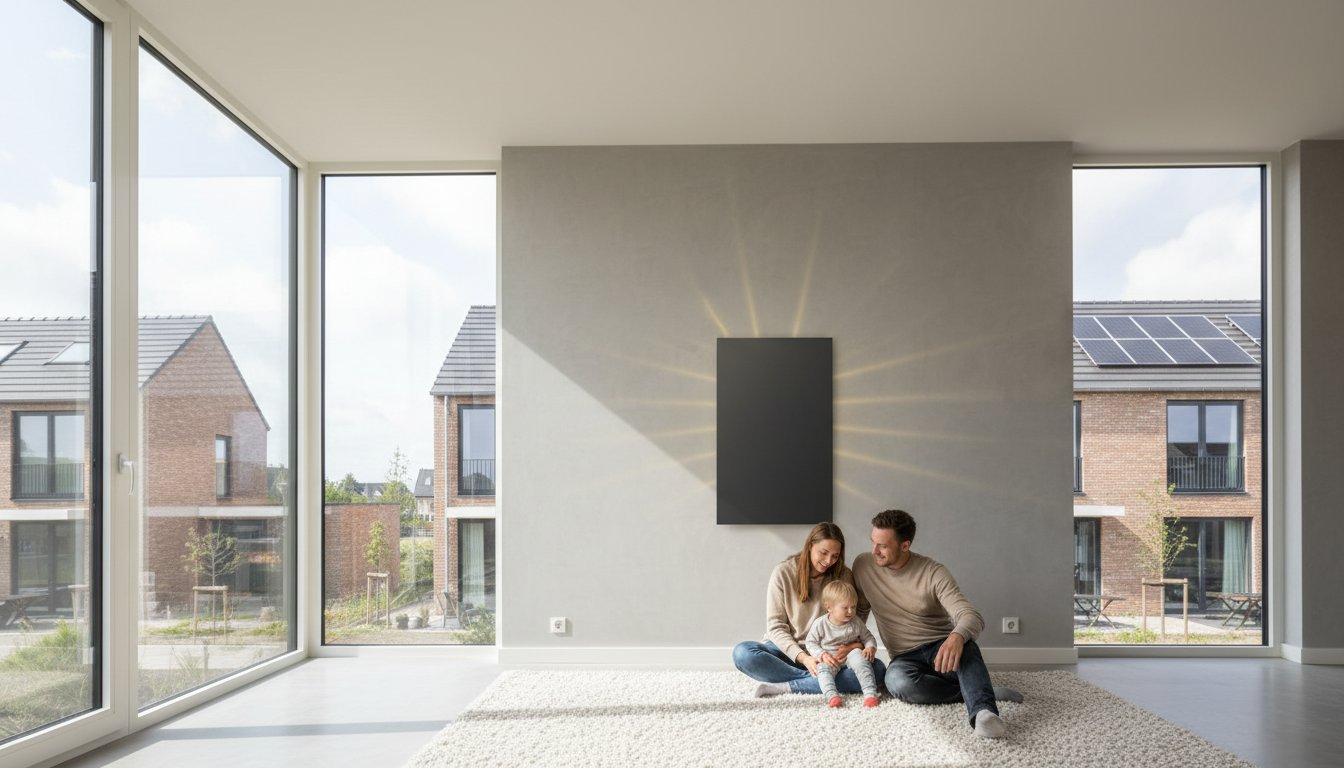
Assessing radiant panels takes more than wattage. Where does the heat reach, who sits or works there and what stands in between? This guide explains how radiation, design, positioning and controls together determine suitability.
Key principles
Define the comfort task, compare exact-model measurements and check approved mounting. Track heat loss, electrical load and controls separately. A high radiant fraction is not a fixed saving or guaranteed whole-room heating.
Radiation and convection work together
A panel radiates towards exposed people and surfaces but also heats air by convection. Other emitters, including radiators, radiate part of their heat too. There is no absolute divide between object and air heating. The balance and layout affect perceived warmth.
Distance, panel area, temperature and obstacles determine received radiant heat. Desks, cupboards and partitions alter exposure. Assess actual posture and duration. A clear line of sight helps but alone does not prove adequate comfort or safe distance.
Glowing heaters and non-glowing panels differ in temperature and use. Do not choose solely by wavelength or comparisons with sunshine. The manual defines approved applications and mounting. A terrace heater is not automatically a living-room or bedroom panel.
Comparing models and practical functions
Compare weight, dimensions including mounting, surface temperature and warm-up per model. Metal, glass or ceramic alone cannot prove speed, scratch resistance or life. Use specifications and relevant measurements rather than ranking materials generally.
Mirror panels may serve two roles, but distinguish room heating from demisting. Choose printing and colours as approved factory options. Do not paint or cover the heating surface yourself. With LEDs, also assess light output, switching and supply.
Wall and ceiling mounting each have opportunities and limitations. Ceiling mounting can free walls but does not automatically distribute heat best. Use approved mounting and assess occupied-area warmth. A floor receiving radiation is not equivalent to designed underfloor heating.
Distinguishing efficiency, costs and use
Resistance appliances ultimately convert nearly all electricity into local heat. Radiant fraction is a different measure. Heat pumps may deliver equal heat with less electricity by moving heat from another source. Compare full systems for the same comfort task and duration.
Calculate energy from actual kilowatts and on-hours, then apply your tariff. Include installation, controls, maintenance and replacement. Solar electricity is not available whenever heat is needed. There is no universal savings percentage, lower-air-temperature guarantee or payback period.
Zoning may limit unnecessary hours when matched to occupancy. Check compatibility and test sensors, schedules, switch-off and failures. Heating does not replace ventilation, eliminate dust or treat conditions. Investigate persistent damp rather than simply adding heat.
Preparing output and mounting
Primary heating needs heat-loss calculation using insulation, glazing, external surfaces, ventilation, height and temperature. Fixed W/m² by room type or one insulation threshold is insufficient. Supplementary heating also needs existing-system and exposure assessment. Surplus capacity guarantees neither lower use nor longer life.
Have support, brackets, clearances, cables and load checked. Follow the exact manual and prevent accidental hot-surface contact. Bathrooms need joint assessment of water, model, position and wiring; an IP code is not general placement permission.
Our help with a suitable model
We advise private and business end users, installers and wholesalers. Share plans, photos, construction and use. Compare panel, mounting and controls as a combination. Request model-specific documents and warranties; origin or quality slogans cannot replace them.
Documenting commissioning and maintenance
Test warmth and controls in representative use. Retain settings and manuals and check mounting, connections and controls. Low maintenance is not maintenance-free. Expected life is not a warranty or a reason to ignore damage or unusual operation.
Request a quote for your heating plan
Frequently asked questions
Is wattage the same as radiant output?
Not without further specification. Electrical input and measured radiant fraction are different data. Request the actual result and method when radiant performance is advertised.