
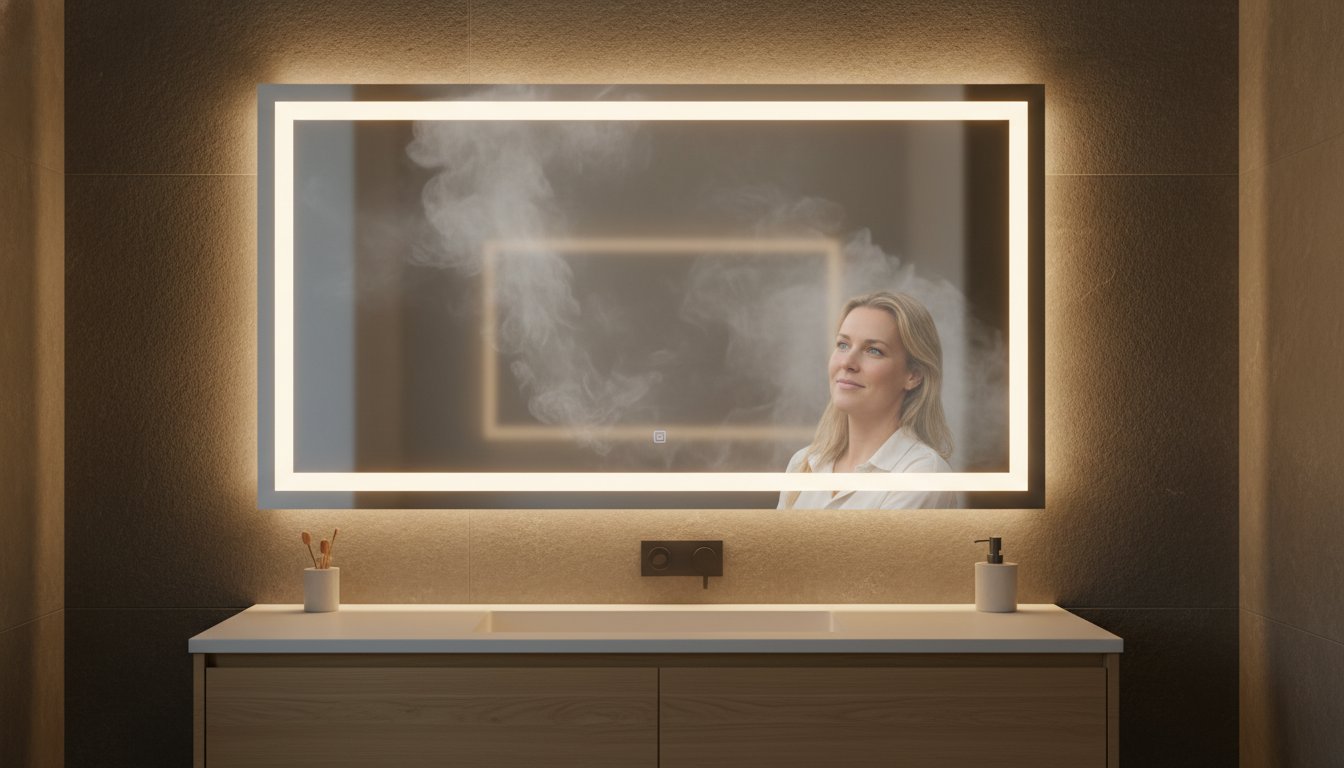
A mirror with heating and lighting can be useful above a basin, combining reflection, grooming and warmth. Start with daily tasks. Do you need light on your face, ambient light or both, and must the appliance also heat the room? These needs require different features.
Key points
Choose size and light distribution for actual users, then check heating. Compare independent operation, mounting, energy data and service. An LED frame does not guarantee useful facial light, and a demister mat does not automatically make a mirror a room heater.
Identify the model’s functions first
The product name covers different combinations. Some mirrors mainly warm glass to reduce misting; others deliver room heat. Check intended use, heated area and ratings. The word heated and overall size alone are insufficient.
Check switching for light, heating and any demisting. Can light operate without extra room heat? Which function follows the thermostat? Establish behaviour after a wall switch or power failure. Separate controls and memory are not universal.
Assess heating and demisting
A room-heating infrared mirror delivers radiation and convection, with model-specific distribution. A warm mirror can feel pleasant without adequately heating the whole bathroom. Assess heat loss, ventilation and target temperature for primary heating.
Demisting needs suitable conditions: the heated glass area must be warm enough relative to humid air. Showers, ventilation and switch-on time matter. Check usable reflection and expect no condensation-free bathroom guarantee. The appliance removes no moisture.
Choose light for grooming and atmosphere
Front lighting may illuminate the face; rear lighting mainly affects the wall. Surround lighting may combine both, depending on design. Check where light falls and how faces are lit in use. A rear glow alone may be inadequate for detailed grooming.
Compare output, colour rendering, colour tone and glare with other bathroom lights. There is no single necessary colour temperature for everyone. Check dimming, colour adjustment and retention of chosen settings.
Choose height and width for users and furniture, not symmetry alone. Include seated use and different heights where relevant. Keep controls accessible and assess edge and depth. Niches need explicit manufacturer clearances for heat and service.
Mounting, protection and consumption
Match substrate and fixings to full weight and instructions. Check rear space, locks, cables and electrical access. Protection depends on model, moisture and complete connection. An IP code alone does not approve every bathroom position.
Heating surfaces may become hot. Prevent unintended contact and maintain textile and material clearances. Assess the full electrical system, lighting and controls. A concealed connection is not inherently safe without considering cables, heat and moisture.
Calculate kWh from actual power and time for each function using your tariff. Size alone does not predict use. Heat and light often have different schedules; compare separately and together. A combined mirror does not automatically cost less to run than separate products.
Advice on the right combination
We support private and business end users, installers and wholesalers. Send wall and furniture dimensions, mirror and lighting needs and existing heating details. We assess options and controls. Colours, frames and custom sizes vary by model.
Ask about LED module, driver, controls and heating-part replacement. Rated operating hours do not guarantee the whole appliance lasts that long without failure. Warranty may differ by part. Repair according to manufacturer requirements to preserve protection and mounting.
Check the combination in daily use
Test light and heat separately and together during normal mornings and evenings. Check understandable controls and suitable schedules. Clean switched off and cooled as instructed. A heating mirror is no health treatment and does not replace ventilation or treatment of persistent damp.
Questions about light and heat
Can an existing mirror be upgraded?
Only with components and construction explicitly suited to it. Do not add heaters, light strips or controls without assessing glass, heat, connections and protection. Separate parts do not automatically replicate a factory assembly.