
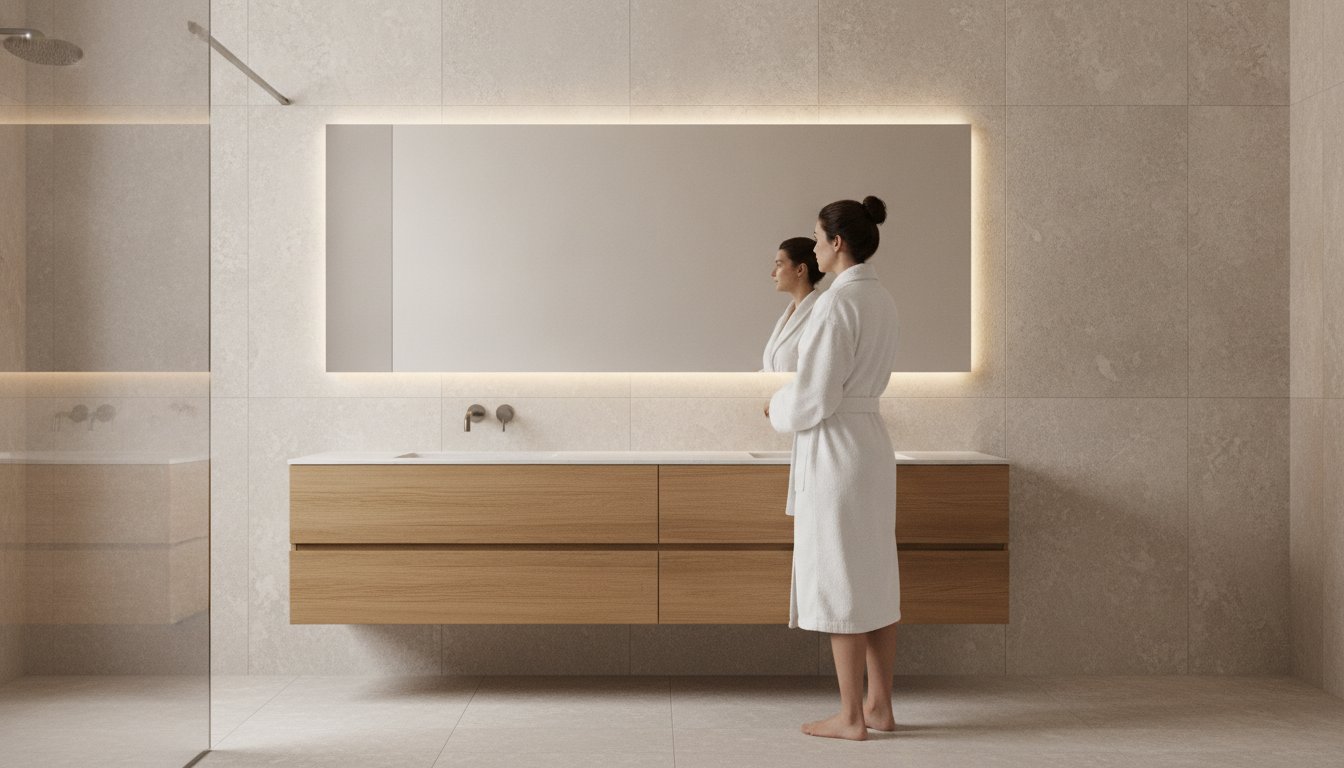
A heated mirror may serve two different purposes: reducing condensation on the mirror or also heating the bathroom. Not every heated mirror does both. Making this distinction before buying prevents a demisting function being mistaken for complete room heating.
Here we discuss operation, output selection, installation and controls. We help private and business end users and support installers and wholesalers in choosing a suitable mirror solution.
Key points
Check the exact product’s purpose, heated area and permitted mounting position. Demisting, lighting and room heating are separate functions. Heating does not remove moisture from the room, and an IP marking alone does not establish suitability for every bathroom location.
What is a heated mirror and how does it work?
An electric element heats part of the glass or a larger mirror panel. Raising the surface temperature above the local dew point may reduce condensation on the heated area. Whether and how quickly this happens depends on the design, starting temperature and moisture load. Edges outside the heated area may behave differently. Being fully clear within three to five minutes is therefore not a universal feature.
A mirror panel as a heat source
An infrared mirror designed for room heating releases heat through radiation and convection. People and surfaces receive some of the radiation, and the air warms too. A low-power demisting pad generally has a different purpose. Check whether product data identifies room heating as an intended use, not just whether the glass becomes warm.
Comfort and moisture: what can you expect?
A mirror combines functions in one wall position and can provide local warmth during grooming. This does not automatically make the floor feel warm or heat the entire bathroom evenly. Position, sightlines, distance and heat loss remain decisive. A lower air temperature does not feel equally comfortable to everyone.
Warmer glass may mist less locally, but moisture remains until ventilation removes it or it condenses elsewhere. Heating is not a remedy for leaks or mould and does not treat allergies or muscle complaints. Claims about deep penetration, muscle recovery, dust-free air or a healthier climate do not belong in a general heating description.
Assessing running costs
A 400-watt mirror panel running continuously at full power for half an hour uses approximately 0.2 kWh. Multiply this by your electricity tariff. Total consumption depends on functions, operating time and other bathroom heating. A compatible timer or thermostat may limit unnecessary operation, but fixed savings against other systems cannot be promised.
Comparing types of mirror heating
A separate demisting film must suit the specific mirror, backing, dimensions and mounting. Retrofitting a combination yourself is not always permitted. An integrated infrared mirror panel is a complete product with glass and heating designed together. For both options, ask about heated area, connection, operating duration and maintenance; choose according to purpose, not the assumption that more watts are always better.
Room heating needs its own calculation
To heat the whole bathroom, have heat loss, ventilation, desired temperature and usage assessed. A general range of 60 to 100 watts per square metre does not prove one mirror is sufficient. Also consider its position above the basin and whether furnishings obstruct radiation. Supplementary or different heating may sometimes be more appropriate.
Installation and safety of the heated mirror
Use the manufacturer’s mounting system and fixings suitable for the substrate and weight. Check clearances, ventilation space and access to connections. Glass type and safety features must be established from documentation; toughened glass cannot be assumed for every version. Have fixed electrical connections assessed and completed by a competent installer.
For a bathroom, product application, mounting zone and electrical installation must be suitable together. An IP44 marking is not general permission for installation in a shower or every damp position. Include any requirements for additional protection and switching equipment in the assessment. Hot surfaces remain a concern even when the product looks like an ordinary mirror.
Thermostat, lighting and maintenance
Check which functions switch separately and which external controller is permitted. A motion sensor, timer or app is not automatically suitable for every product. Place a room sensor in a representative position. Switch off and cool as instructed before cleaning; use only permitted products and keep moisture out of connections. Also inspect fixings and cable. Components may wear or need maintenance.
Our advice for your mirror solution
Tell us whether you want demisting, room heating, lighting or a combination. Using photos and dimensions, we discuss suitable products and controls. For installers and wholesalers, we also review project documentation. We confirm sizes, custom options, origin, glass construction and warranty for each product rather than making blanket promises.
Choose a mirror that suits its intended use
The right choice starts with a clear purpose and verifiable product description. Ask us for a proposal aligning construction, heating, controls and mounting requirements.
Frequently asked questions about heated mirrors
Is an LED mirror also an infrared heater?
No. LED describes the lighting. An LED mirror may also include demisting or heating, but these must be specified separately. Check the power ratings for lighting, demisting and room heating and which functions can operate together.
Can one mirror replace all other bathroom heating?
Only if the specific product and a heat-demand assessment support it. The mirror size fitting above a basin does not automatically determine the heating output needed. Have this calculated before removing existing heating.