
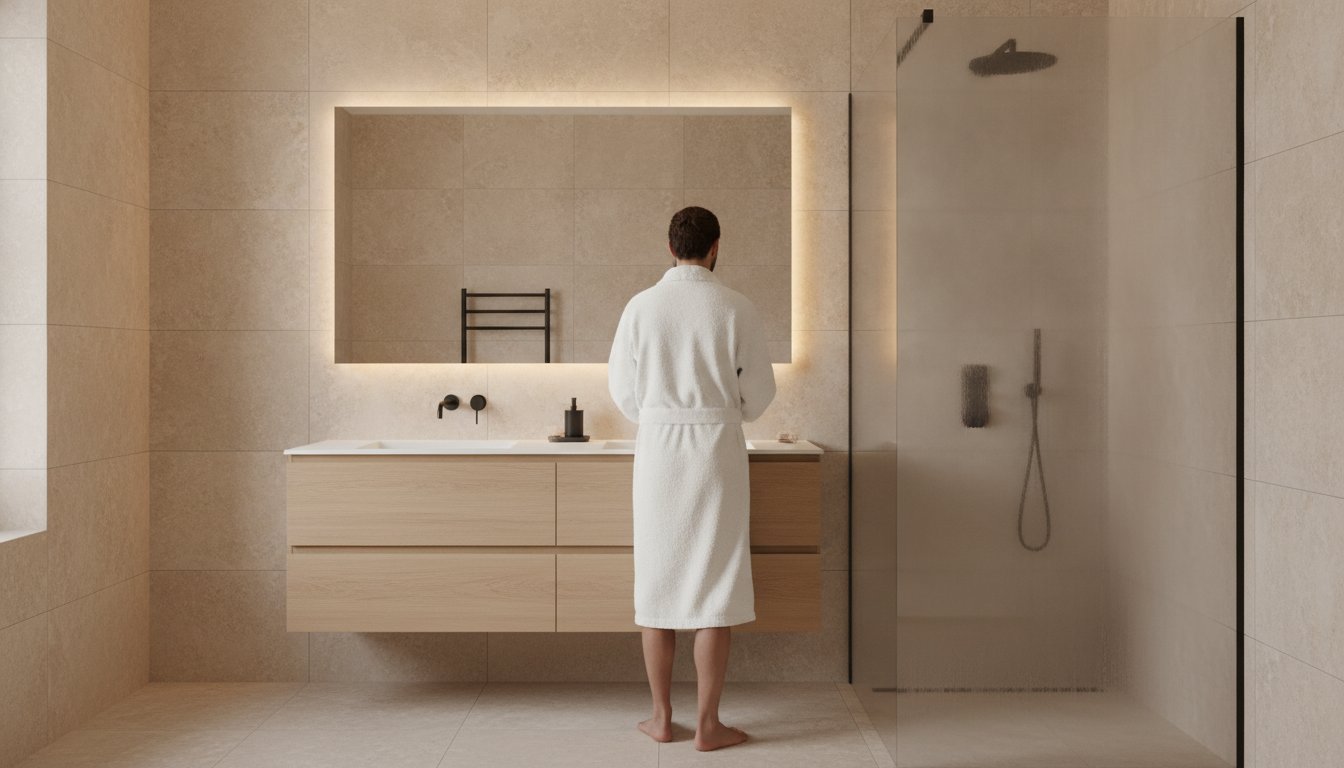
A mirror infrared panel combines a mirror surface with electric heating. It can save wall space in a bathroom, hallway or bedroom. Whether the chosen mirror supplies enough heat for the whole room needs a separate assessment. A convenient mirror size does not automatically match the required heating capacity.
This guide covers operation, condensation, output, controls and mounting. Always compare the specific version: not every heated mirror is a room heater, and not every infrared panel may be mounted anywhere in a bathroom.
Key points
Assess mirror use and heating needs separately. Check actual heating output, any lighting and approved controls. Have mounting position and electrical connection assessed. A warm mirror surface may reduce condensation but does not replace ventilation or guarantee a condensation-free bathroom.
How does a mirror heating panel work?
An electric element heats the panel, which transfers heat by radiation and convection. Construction, glass, surface temperature and rear design vary by model. Visible mirror reflection does not prove that the appliance reflects thermal infrared more strongly into the room. Assess heat output from product data, not its shiny appearance alone.
Even a panel without a fan does not automatically create a room without air movement. It provides warmth, not treatment for allergies or asthma. Heated surfaces may release heat later, but that energy was supplied earlier; thermal mass does not prevent ventilation heat loss. Ventilation and cleaning remain part of everyday use.
Mirror heating and bathroom condensation
Condensation can occur when the mirror surface is cooler than the surrounding air’s dew point. Heating the glass may reduce it while the surface is warm enough. Warm-up time, moisture levels and heated area vary. A clear mirror immediately after every shower or at every humidity level cannot therefore be promised.
A mirror demister film differs from a panel intended to heat the room. Check the product’s function and power input. Moisture that does not condense on the mirror has not disappeared from the bathroom. Ventilate, limit moisture production where possible and investigate recurring damp or mould problems.
Choosing output, dimensions and controls
For primary heating, assess heat loss using dimensions, insulation, glazing, ventilation and target temperature. For supplementary heating, also consider where extra comfort is needed. A general rule of 80 to 100 watts per cubic metre does not replace this assessment. One mirror is not necessarily enough for an average bathroom.
Compare your preferred mirror size with available wall space and safe mounting conditions. For lighting, check colour, controls and whether light and heat operate separately. Include lighting and control consumption in comparisons. Not every mirror panel has integrated LEDs or a built-in thermostat.
Choose controls explicitly compatible with the version. A schedule can limit heating to use periods, but room warm-up still depends on conditions. Check whether controls manage room comfort or only mirror heating, and whether app operation is actually supported.
Mounting and electrical safety
Have the exact bathroom location, zone, model approval, IP protection and connection assessed together. An IP code or certification does not permit mounting anywhere. Do not assume a general zone 3 or that every mirror is double-insulated. Required protection and any earthing depend on the appliance and installation.
Check weight, wall material and specified fixings. Supplied plugs do not automatically suit every wall. Maintain model-specific clearances and prevent doors, towels or furniture covering the panel. Preferred mirror height must respect safe mounting. Have fixed electrical work carried out by a qualified installer.
A concealed connection or receiver behind the mirror is acceptable only where instructions permit it and space, temperature and access are suitable. The surface may become hot enough to burn; consider children and pets. Switch off safely and allow cooling before cleaning. Follow specified products and methods to protect glass, coating and electrical parts.
Advice and supply for your project
We advise private and business end users and also work with installation companies and wholesalers. Share photographs, a floor plan, wall dimensions and your heating objective. We can then discuss suitable models, controls and considerations. Check certification and warranty for the specific version; origin does not prove every model carries identical marks or terms.
Combine mirror convenience with a considered heating plan
A mirror panel is particularly useful when its dual function suits the room. Assess heating needs and safe positioning first, then choose shape, lighting and controls. This keeps the design practical without inferring performance or safety from appearance alone.
Frequently asked questions
Is a mirror panel always more economical?
No. Consumption follows from power input and operating time. Suitable controls can reduce unnecessary hours, but a mirror finish does not automatically save energy compared with another electric appliance. Compare the same heating requirement and total use, including supplementary heating.
Does the mirror stay clear when the room thermostat switches off?
Not necessarily. As glass cools, condensation may return at sufficient humidity. Check the product’s control options and do not add an unauthorised separate supply to bypass the thermostat. If needed, choose a version with suitably separated functions.