
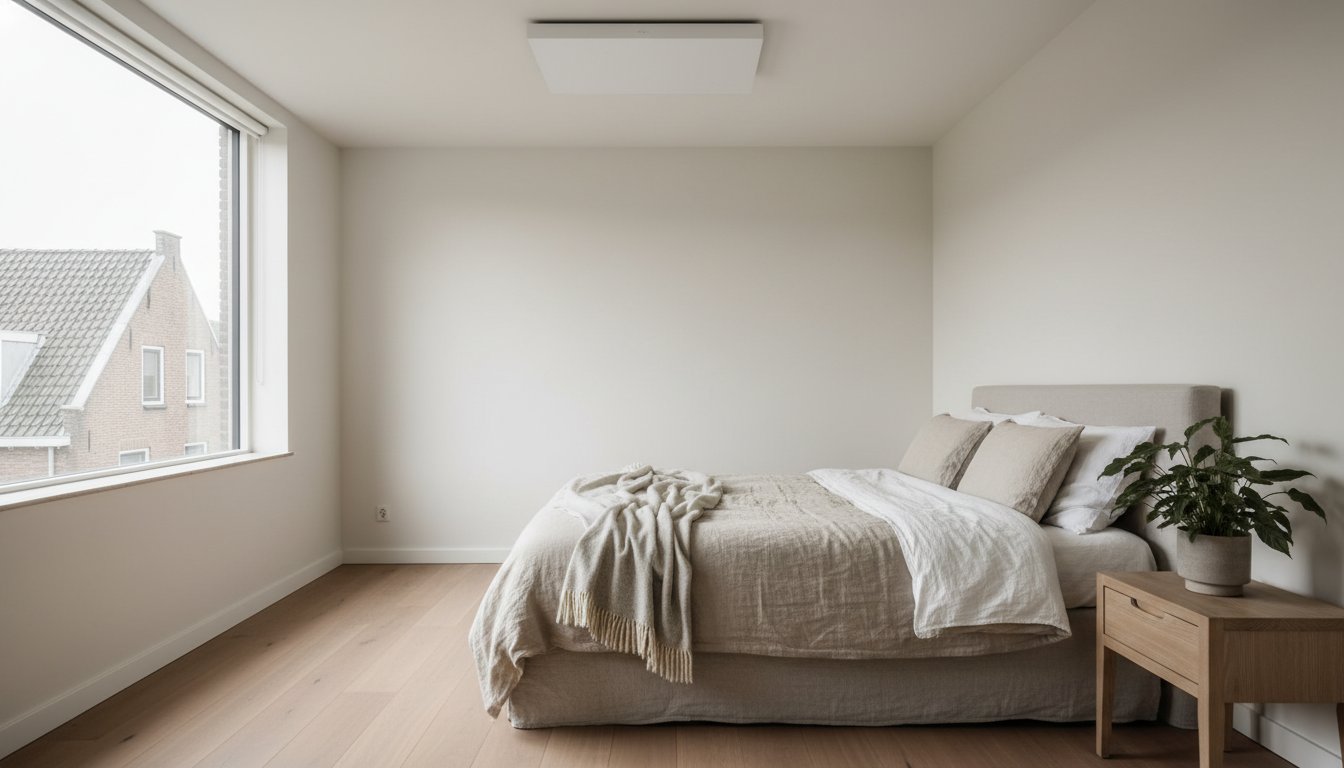
Considering infrared heating for your bedroom? Start with how you use the room: brief supplementary heating while dressing requires a different assessment from keeping the entire room warm. Insulation, ventilation, heat loss and panel position determine suitability. We help you assess these choices.
Key considerations
Choose sufficient power based on heat loss, control heating by room and follow installation instructions. Infrared heating does not replace ventilation. A panel does not guarantee better sleep, fewer allergies or a fixed percentage saving.
Use, temperature and ventilation
Decide when you need heat and what temperature suits your use. There is no universal setting for every bedroom. Avoid leaving a room cold and damp for long periods. Keep ventilating; investigate moisture sources, cold surfaces and possible building defects if condensation or mould appears. Heating alone does not automatically resolve these causes.
What does infrared heating do?
An electric panel transfers heat through radiation and also convection. Coverage and placement affect comfort: a wardrobe, curtain or bed can obstruct heat transfer. A fanless panel avoids a fan-driven airflow, but does not make the room dust-free or purify its air. It does not independently control humidity either.
Compare heating options
Infrared may suit targeted supplementary heating or a room used separately. For main heating, compare the whole home, heat demand and energy costs. Electric resistance heaters, such as panels and convectors, do not produce extra heat simply because their design differs; a heat pump uses a different principle. An infrared panel is therefore not automatically the cheapest or most sustainable choice. When used alongside an existing system, coordinate the controls carefully.
Power, placement and controls
Use a heat-loss calculation for the desired indoor temperature. A fixed value per m² or m³ is at most an initial indication: windows, external walls, insulation and ventilation change the result. Wall or ceiling installation is permitted only if the selected model is suitable. Maintain specified clearances from bedding, furniture and ceiling materials. Have the electrical connection and circuit assessed where necessary.
A room thermostat with a suitable schedule helps control operating times and temperature. Position its sensor as instructed and avoid interference from direct radiation, draughts or sunlight. Check the range and compatibility of wireless components. Smart functions help only when settings and use suit your situation.
Advice and product selection at HeatXL
We advise private and business end users and also supply installers and wholesalers. Share dimensions, insulation, existing heating and intended operating times with us. We compare suitable panels and controls for your home or customer project. Glass, metal, a mirror or an image determines the appearance; always also check model-specific performance, installation and warranty terms.
Make an informed choice
Assess comfort, investment and running costs together. An electric panel does not automatically make a home entirely gas-free: other rooms and hot-water provision also matter. Explore the available options and ask us for a proposal suited to your use.
Bedroom heating FAQ
How many watts do I need?
This depends on heat loss and intended use. Floor area or room volume alone is insufficient for a final choice.
Is infrared heating healthier?
We make no medical promises. Ventilation, moisture control and cleaning remain necessary regardless of the heating system. Discuss health concerns with a healthcare professional.
Can a panel stay on at night?
Only if the model, installation and controls are suitable according to the manual. Never cover the panel and maintain required clearances. Assess the need and schedule for each room.
How do I calculate running costs?
Multiply actual input power in kW by operating hours and the electricity tariff per kWh. A 600 W panel heating continuously for three hours uses 1.8 kWh. Thermostat control can reduce active time; the entire evening is not necessarily active heating time.
Where should I place the panel?
In a wall or ceiling position permitted by the manufacturer, suited to the occupied area and clearances. A combustible ceiling requires explicit suitability and compliance with installation instructions; wattage alone does not establish this.
Does a panel produce sound or light?
Many flat panels have no fan or visibly glowing element. A relay may click and materials may expand audibly. Models with lighting or other controls differ; check product data if darkness and quiet are important.
Can I heat only this room?
Separate controls allow targeted use. Also consider heat loss to adjacent rooms, moisture and the existing system’s controls. Zoning does not guarantee lower total costs.