
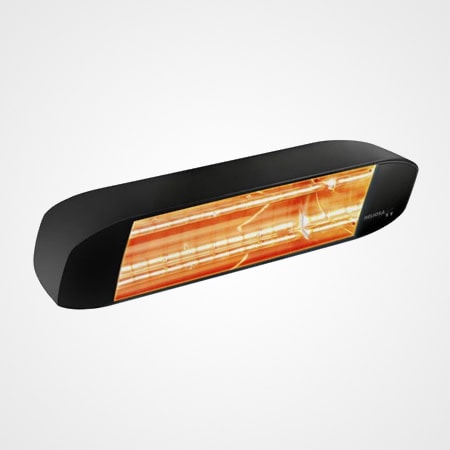
Heating a shed starts with choosing between three goals: a pleasant workplace while doing jobs, a continuously heated space or protecting particular stored items. These goals need different settings and sometimes different equipment. This guide builds the choice from use and the condition of the shed.
Key points
Establish the goal, limit unnecessary heat loss and check the surroundings for dust, moisture and combustible materials. Then compare heating options for the same performance. Infrared is not unaffected by draughts and does not make insulation or maintenance unnecessary.
Assessing use and building first
Note how often and for how long you are inside, which position you use and which doors remain open. A daily-used space needs a different assessment from a workbench used for one hour a week. Building quality partly determines how quickly heat is lost, regardless of the heat source.
Improve roof, walls, glazing and gaps where possible. Maintain ventilation for the activity and moisture balance. Installing a larger appliance alone does not resolve leaks, construction moisture or unwanted airflows. Moisture and rust problems need their own assessment alongside comfort heating.
Comparing heating options fairly
A convector heats mainly through air circulation; a radiant appliance can direct more warmth towards a workplace. Both ultimately transfer heat to the surroundings. An infrared panel also causes convection. The best choice depends on task, mounting, distance and conditions, not just the technology’s name.
For a locally used workplace, a suitable radiant heater may be interesting if it removes the need to heat a larger area. Comparing 1,000 watts of infrared with 2,000 watts of convection does not by itself prove equal comfort or half the costs. Assess this in the specific arrangement and include actual operating hours.
Panels, dark radiant heaters and other heaters have different applications and surface temperatures. An appliance without a visible glow can still be very hot. Use only approved wall, ceiling or freestanding mounting, and choose the version according to actual environmental risks.
Determining output and distribution
For the whole space, output must suit heat loss and desired temperature. Local warmth also requires assessment of coverage and distance. A fixed formula using thirty or sixty watts per cubic metre is not a reliable calculation for every shed. Extra output can increase peak load and is not automatically more economical.
An arrangement above or beside the workbench must account for your posture, workpieces and storage. Obstacles can block direct warmth. Check output and exact dimensions of the chosen version and follow model information for mounting height and distances, rather than assuming universal coverage or a ceiling advantage.
Planning safety and storage protection
With wood dust, sawdust, paint mist or flammable vapours, have the environment expertly assessed before choosing an appliance. An IP code does not prove fire or explosion safety. Hot surfaces and electrical components remain important. Ventilate, extract, clean and inspect according to the requirements of the work and appliance.
Have simultaneous load with machines and tools assessed. Follow permitted substrate, brackets and clearances. A standard plug does not mean every socket has sufficient capacity. Do not change protective devices to use a larger heater without installation advice.
Frost protection is a separate task
A frost setting at a room sensor does not automatically protect every pipe or machine; the sensor measures only at its own position. Cold spots may have lower temperatures, and power failure remains possible. Assess water pipes and storage separately. Domestic appliances have their own permitted ambient temperatures. Check the climate class and manual of the exact model rather than applying one general lower limit.
Our advice based on your use
We help private and business end users, installation companies and wholesalers. Share photos, dimensions, insulation, working duration and materials present. State what you want to protect and which appliances are used simultaneously. We can then discuss a targeted proposal and information still needing investigation.
Clarifying costs and management beforehand
Request a quote including appliance, controls, mounting and connection. Discuss checks, cleaning, warranty and any fault notifications. An app does not always have alarm functions, and a notification is not a guarantee against damage. Low maintenance does not mean service or inspection is unnecessary.
Frequently asked questions
How do I compare consumption?
Calculate kilowatts multiplied by actual operating hours. A 1.5 kW heater running continuously for two hours uses 3 kWh. Multiply by your tariff and compare the same comfort goal. Assuming a fixed twenty to thirty minutes switched on per hour is not generally valid.